




403
Sorry!!
Error! We're sorry, but the page you were looking for doesn't exist.

Flydubai Doubles Bangkok Flights From September
(MENAFN- The Arabian Post)
Arabian Post Staff -Dubai
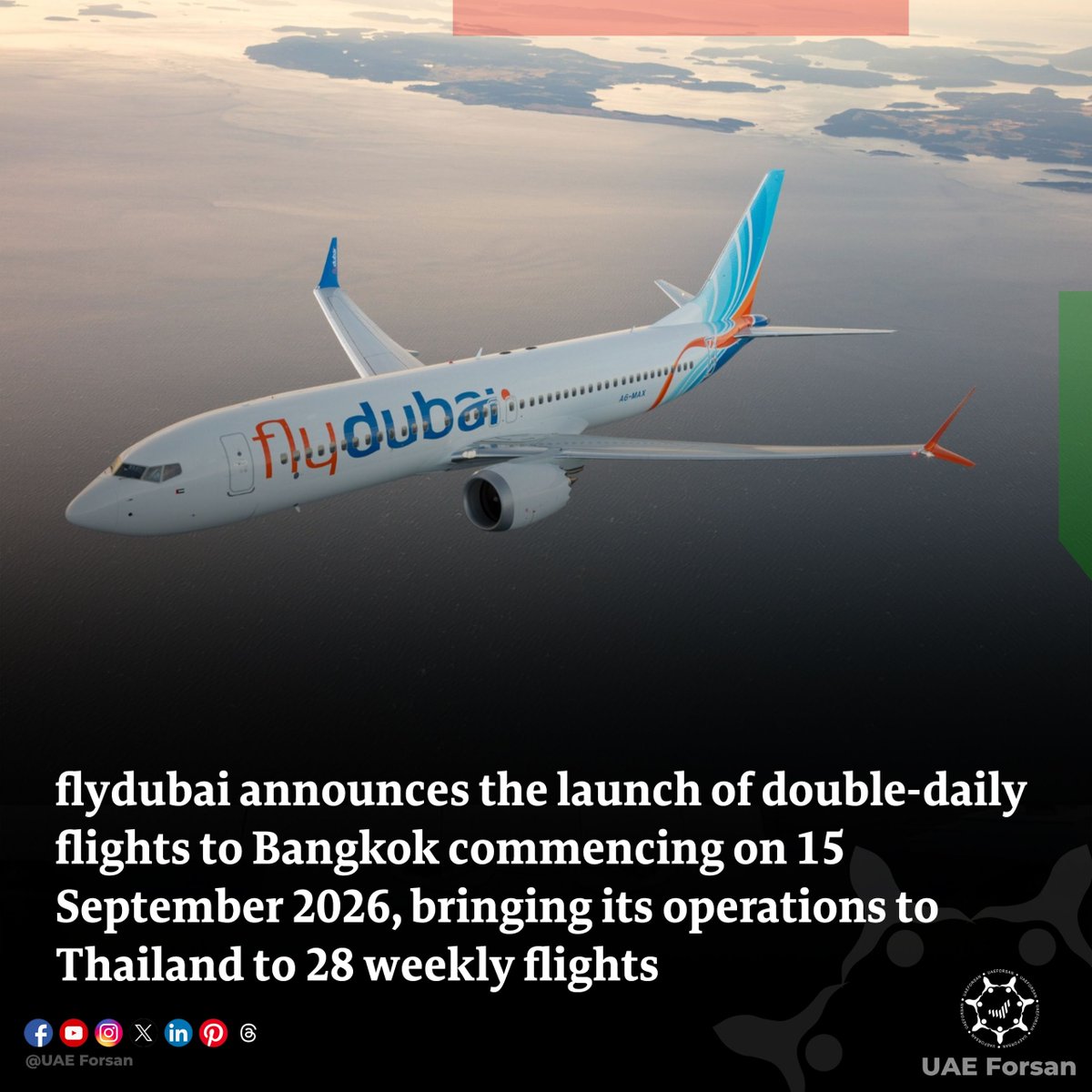
flydubai will operate double-daily services between Dubai and Bangkok from 15 September 2026, raising its total weekly flights on the route to 28 and strengthening Thailand's position within the carrier's expanding Asian network.
The Dubai-based airline said the additional frequency will link Terminal 3 at Dubai International Airport with Don Mueang International Airport in Bangkok, enhancing connectivity for leisure and business travellers. The move reflects sustained demand on the Gulf–Southeast Asia corridor and underscores flydubai's strategy of deepening its footprint in high-growth markets beyond the Middle East.
Bangkok has long been one of the most sought-after destinations for travellers from the Gulf, driven by tourism, retail, medical services and growing commercial ties. Thailand's tourism authority has reported a steady recovery in international arrivals following the pandemic-era downturn, with Middle Eastern visitors forming a resilient segment. Airlines have responded by rebuilding capacity and introducing additional frequencies, betting on strong forward bookings into the final quarter of the year.
flydubai's expansion comes as Dubai International Airport maintains its position among the world's busiest hubs for international passengers. Operating from Terminal 3, commonly associated with its codeshare partner Emirates, allows the airline to offer smoother transfers for connecting traffic. The partnership enables passengers to access onward destinations across Europe, North America and Africa on a single itinerary, reinforcing Dubai's role as a global transit point.
The decision to use Don Mueang rather than Bangkok's Suvarnabhumi Airport reflects a tactical choice. Don Mueang has become a significant base for low-cost and hybrid carriers, offering operational efficiencies and slot availability that can support higher-frequency services. Industry analysts note that secondary airports in major cities have gained prominence as airlines seek to manage costs while maintaining access to large metropolitan markets.
See also Georgetown Qatar students earn elite global affairs awards in Chinaflydubai's network strategy over the past decade has centred on opening underserved routes and increasing frequencies on proven performers. The carrier, established in 2008, now serves more than 120 destinations across Europe, Asia, Africa and the Middle East. Southeast Asia has featured prominently in its growth plans, with Bangkok often cited as a key leisure gateway.
Aviation data indicates that traffic between the UAE and Thailand has regained momentum, supported by visa facilitation, strong diaspora links and growing bilateral trade. Thailand's economy relies heavily on tourism receipts, and Gulf travellers are regarded as high-spending visitors. At the same time, outbound travel from Thailand to Dubai has expanded, aided by the emirate's status as a retail, events and financial centre.
The airline industry globally has entered a phase of capacity recalibration. Aircraft delivery delays and engine maintenance challenges have constrained growth for some carriers, yet routes demonstrating consistent demand have attracted additional frequencies. flydubai operates a fleet composed primarily of Boeing 737 aircraft, configured to offer both business and economy cabins, a feature it markets as combining low-cost efficiency with full-service comfort.
Executives at flydubai have repeatedly emphasised the importance of network optimisation. By increasing Bangkok services to two flights a day, the airline can offer more flexible departure times, improving connectivity for transit passengers and appealing to point-to-point travellers seeking convenience. Morning and evening options also enable better coordination with connecting flights in Dubai.
Competition on the Dubai–Bangkok corridor remains robust. Emirates operates widebody aircraft to Bangkok's Suvarnabhumi Airport, while other regional and Asian carriers provide direct links between the Gulf and Thailand. Analysts observe that frequency and schedule reliability often weigh more heavily than aircraft size in influencing passenger choice, particularly among business travellers.
See also UAE floating hospital expands care for Gaza patientsThailand's broader aviation sector has been undergoing restructuring. Authorities have worked to enhance airport capacity and regulatory standards following earlier international scrutiny, while carriers such as Thai Airways International have pursued financial and operational reforms. Increased Gulf capacity adds competitive pressure but also signals confidence in Thailand's long-term tourism prospects.
For Dubai, strengthening ties with Southeast Asia aligns with its economic diversification agenda. Trade between the UAE and Thailand spans energy, food products, jewellery and electronics. Enhanced air links facilitate cargo flows alongside passenger traffic, even when the primary focus is leisure travel. Airlines frequently adjust bellyhold capacity in response to seasonal cargo demand, especially for perishable goods and high-value items.
Travel industry representatives suggest that forward bookings into the final quarter show healthy demand for Thailand, supported by school holidays and cooler weather in the Gulf. While geopolitical tensions and fuel price volatility remain external risks, airlines have generally maintained optimistic capacity plans for Asia-Pacific routes.
Passengers on flydubai's Bangkok service will continue to have access to a business class cabin offering lie-flat or recliner-style seating, depending on aircraft type, alongside in-flight entertainment and meal options. The carrier has positioned itself as a hybrid model, targeting value-conscious travellers who still expect a level of service associated with legacy airlines.
Aviation consultants note that increasing frequency rather than launching entirely new destinations can be a prudent growth tactic. Higher frequencies strengthen brand visibility, improve aircraft utilisation and create scheduling advantages without the marketing costs associated with opening untested routes. Bangkok's consistent traffic profile makes it a logical candidate for such expansion.
Notice an issue? Arabian Post strives to deliver the most accurate and reliable information to its readers. If you believe you have identified an error or inconsistency in this article, please don't hesitate to contact our editorial team at editor[at]thearabianpost[dot]com. We are committed to promptly addressing any concerns and ensuring the highest level of journalistic integrity.

Legal Disclaimer:
MENAFN provides the
information “as is” without warranty of any kind. We do not accept
any responsibility or liability for the accuracy, content, images,
videos, licenses, completeness, legality, or reliability of the information
contained in this article. If you have any complaints or copyright
issues related to this article, kindly contact the provider above.
Most popular stories
Market Research

More Story







Comments
No comment