


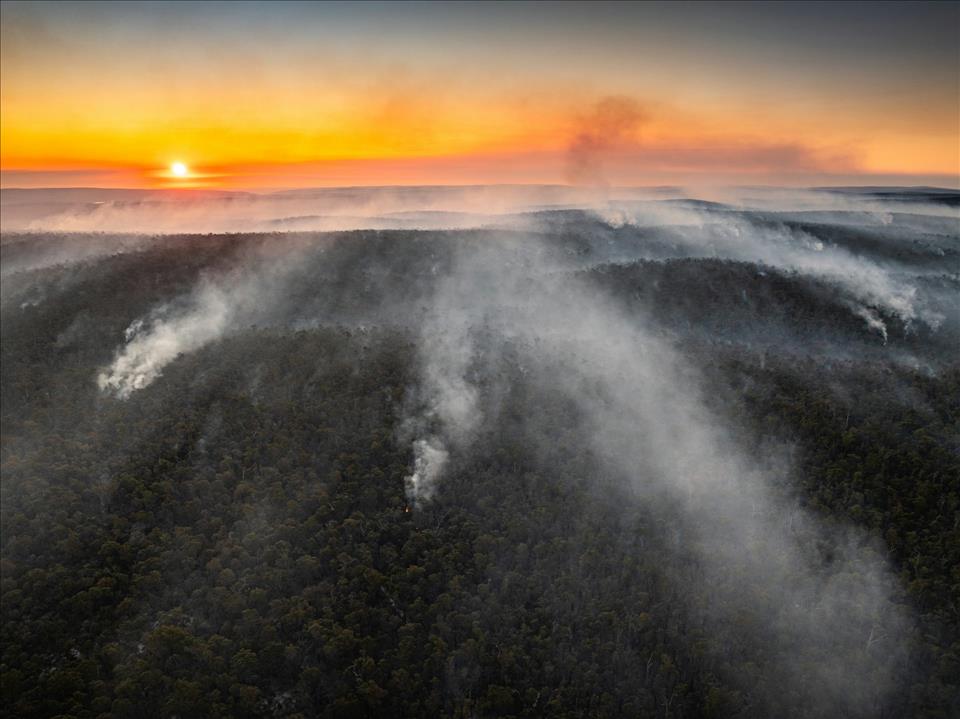
In 1939, A Royal Commission Found Burning Forests Leads To More Bushfires. But This Cycle Of Destruction Can Be Stopped


This line of thinking dates back to the 1939 Stretton Royal Commission, which followed the catastrophic Black Friday fires. To avoid future devastation, Judge Leonard Stretton called for large-scale prescribed burning to reduce fire fuel.
Victoria's devastating 1939 Black Friday fires killed dozens – and shaped decades of official responses to bushfire. Bruce Howard/NLA
But Stretton's crucial main judgement is often omitted from the story. In his judgement, Stretton singled out burning forests to promote pasture as a root cause of Black Friday:
If shrubby regrowth is the real problem, why did Stretton call for more prescribed burning? His reasoning: it was too late to change course. Any forest“in a dangerous condition” of dense regrowth had to be cleared or burned.
As our new research on southwestern Australia's karri and jarrah forests shows, Stretton's lesser-known comments might hold a solution: burn far less to stop fire-prone regrowth making the next fires worse.
In this extract from Judge Stretton's 1939 judgement on the Black Friday fires, he describes what he saw as the problem with the condition of the forests. National Library of Australia Of bushfire and scrub
For millennia, Australia's First Nations burned small areas with extraordinary control and precision, sometimes leaving vast landscapes deliberately unburnt. This regime produced a low fire risk landscape of old, open forest, interspersed with a mosaic of areas burnt very frequently.
In comparison, British colonisers used large-scale fires to clear leaf litter and promote pasture for cattle and sheep.
For instance, after years of setting fires along the lower Snowy River, the seasoned bushman K.C Rogers described how the original forests had been converted into“almost impenetrable peppermint scrubs”.
As an unnamed Gundungurra elder once told journalist Dame Mary Gilmore:
In his testimony to the 1939 Royal Commission, the Commonwealth Inspector-General of Forests, Charles Lane Poole, said:
What Rogers describes as“scrubs” and Lane Poole as“thickening” are the same thing: dense regrowth of fire-prone shrubs after fire.
Plants can calm a fire or feed it. Vegetation near the ground can easily ignite and even carry fire into the canopy, but vegetation high above the ground works to slow the winds fanning the flames. Burning or logging mature forests can lead to decades of higher fire risk.
Long unburnt jarrah forest with a midstorey of Bull Banksia (Banksia grandis) that suppresses lower growth and reduces windspeed on the ground. Philip Zylstra, CC BY Short term gain, long-term pain?
Prescribed burning resets the clock, giving a few short years with an open understorey. But the void is soon filled by flammable fast-growing shrubs.
A dry, dense understorey makes bushfires more severe. The single strongest predictor of forest flammability is the height and density of the shrubby understorey.
The alternative is to stop burning and wait for long-term openness to return naturally, as Lane-Poole suggested. As forests age, taller plants able to calm a fire take light, water and nutrients, outcompeting shorter plants which feed fire. But Stretton judged this too risky, as forests left to recover naturally would“always remain dangerously inflammable”.
Official fire records show recovery time can vary from 21 years in ash forests in the Australian Alps, to 56 years in southwest karri and jarrah forests, to nearly a century in the fire-sensitive Great Western Woodlands running from the Nullarbor to the WA Wheatbelt.
Burning the southwestSince the 1960s, the WA Department of Biodiversity, Conservation and Attractions (DBCA) has used prescribed burns to reduce fuel load in southwestern forests.
“Fuel load” is a concept invented in the United States to describe layers of pine needles on pine forest floors. Our work shows it's a poor fit for the Australian bush.
Burning off leaf litter in jarrah and karri forests clears the understorey for perhaps a year. Regrowing shrubs then create a dense understorey for about 50 years before opening up again.
In the southwest, large bushfires almost exclusively occur in forests thick with flammable regrowth. Around Sydney and the Blue Mountains, extreme fires are most common in recently burnt areas.
Shrubby regrowth is abundant after a prescribed burn in jarrah forest (left), while jarrah forest left unburnt for 60 years is open and less fire-prone. Philip Zylstra, CC BY-NC-ND Challenging the norm
In 2022, the key research underpinning the WA conservation department's burning regime was debunked.
The same year we published findings showing bushfires were occurring in dense shrubby regrowth. Scientists from the state conservation department responded, saying the department's records contained flawed data and suggested ignoring all the records for old forests, which showed a decline in flammability over time.
But 98.4% of those old forest records were sound, according to their criteria. When we removed only the flawed ones, our findings became stronger.
We also used advanced modelling to understand how fire risk falls in mature forests: over time, low, dry shrubs are replaced by with taller, less-fire prone plants and trees.
Less fire – in a hotter world?Would it be worth removing the short-term defence of prescribed burning to bring forests back to a less flammable state?
In our new study, we examined whether phasing out prescribed burning could help Australian forests endure climate change. The answer was clear: it's entirely possible to stop the cycle of fire feeding more fire, and help forests endure new climatic conditions.
Official records show 77% of all areas burned in over 500,000 hectares of forested southwest national parks this century were due to prescribed burns. Of the remaining burned area, 20% burned from escaped prescribed burns and 23% from backburning done under a key efficiency indicator creating incentives for low cost backburns over direct firefighting. American studies show shifting from direct firefighting to backburning can triple the area burnt annually.
If large-scale prescribed burning and incentives to backburn ended, the area burned annually would immediately fall 87%, leaving only fires started by lightning, accident or arson.
But would fuel accumulate and drive uncontrollable fires? In our new research, we tested this common assumption using previously measured historic trends for the area as a whole and found southwest forests easily passed through the most flammable stages and matured into low-fire environments.
Our modelling suggests less area would be burned in the hotter, drier climate of 2100 than it is today if both widespread burning policies were ended.
What should authorities do?When Stretton called for more prescribed burns, it was to reduce the risk of new conflagrations. But the megafires have continued. The Black Summer fires of 2019–20 were Australia's worst to date. They happened despite record prescribed burning in national parks in New South Wales.
Humans have a deep-seated desire to intervene in nature. But our research shows long-unburnt forests act to limit fire without human intervention – even as the climate changes.
Moving away from routine burns doesn't mean being idle. Authorities need to heavily invest in rapid fire detection and attack, better resourcing firefighters, training and employing many more specialist remote area firefighters and exploring fire-fighting drones.
It's important to note our research focuses on southwestern forests. Many other Australian forests types also become more flammable through burning. But we haven't yet crunched the numbers to see if it's possible to age these forests through the shrubby, fire-prone intermediate phase.
Even so, what we've found so far is good news. Terrifying bushfires could become smaller and more manageable – if we overcome the drive to burn the bush.
In a response, a WA DBCA spokesperson said:
Prescribed burning is the State's main risk mitigation strategy for protecting the community and environment from the devastating impacts of large bushfires. Lower fuel loads result in lower intensity and slower spreading bushfires in summer conditions.
[DBCA] research confirms that prescribed burning is effective in reducing the frequency, severity and size of bushfires in south west forests when at least 45 per cent of the landscape has a fuel age of less than six years since last burnt.
Removing fire from fire-prone ecosystems often leads to high severity fires, as seen in a range of significant bushfires that have occurred in Australia and overseas. Claims that forest flammability declines with age rest on data that remain inadequate. Following these recommendations would be unwise as it would likely lead to substantially increased bushfire risk and impact for many decades.


Legal Disclaimer:
MENAFN provides the
information “as is” without warranty of any kind. We do not accept
any responsibility or liability for the accuracy, content, images,
videos, licenses, completeness, legality, or reliability of the information
contained in this article. If you have any complaints or copyright
issues related to this article, kindly contact the provider above.


Comments
No comment