




403
Sorry!!
Error! We're sorry, but the page you were looking for doesn't exist.
Poland Faces Ambitious EU Target To Cut Greenhouse Gas Emissions By 90% By 2040
(MENAFN- ING) The European Commission has proposed an official EU-wide target to reduce greenhouse gas emissions by 90% by 2040 relative to 1990 emission levels. The reaction from Poland's Ministry of Climate and Environment on raising the emission reduction levels was cautious. The country faces huge challenges already to meet
its existing commitments In this article EC proposes aggressive greenhouse gas target Cautious comments from the Polish Ministry of Climate and Environment
Poland – with its still coal-dominated power system - is the hardest hit in the CEE region by the high cost of European Union Allowances (EUAs) EC proposes aggressive greenhouse gas target
European Commission
its existing commitments In this article EC proposes aggressive greenhouse gas target Cautious comments from the Polish Ministry of Climate and Environment
Poland – with its still coal-dominated power system - is the hardest hit in the CEE region by the high cost of European Union Allowances (EUAs) EC proposes aggressive greenhouse gas target
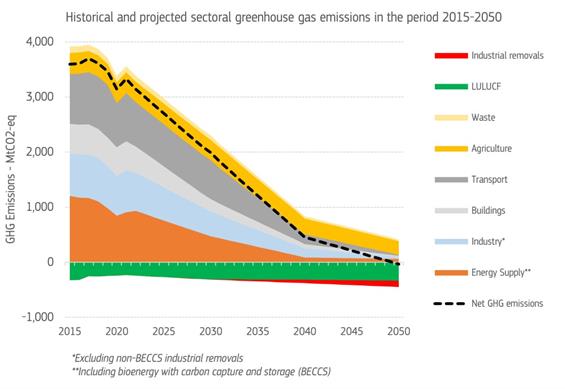
In line with expectations, the European Commission (EC) yesterday formally proposed a 90% emissions reduction target by 2040 relative to 1990 levels. The proposed target is in line with the already legally binding target of a 55% reduction by 2030 (and the comprehensive Fit-for-55 regulatory package) and the long-term goal of climate neutrality by 2050 (zero net emissions, i.e. gross emissions minus removals).
According to the EC's impact assessment (this is a fascinating over 600-page read), EU policies that have already been adopted for 2030 mean significant reductions in emissions from the energy and transport sectors (including raising the ambition level in the EU ETS and bringing transport and buildings under the new ETS from 2026). Additional effort is needed, however, in reducing process emissions in industry and implementing carbon capture and storage / utilisation technologies (CCS/CCU).
Historical and projected greenhouse gas emissions in the EU by sectorIn million tons of CO2 equivalent
European Commission
According to the EC, the proposed measures will have a fairly neutral effect on the EU economy as a whole. These are the results from three powerful general equilibrium models. Roughly speaking, the economic adjustment costs are to be compensated for with gains from lower bills on imported fossil fuels. Nevertheless, the expected changes in output or employment by sector, or distributional effects on households, could be significant and will require public intervention to ensure a just transition. The EC has not yet provided an assessment of the impact of the proposed target on individual EU economies. Poland will request that.
The new proposed 90% emissions reduction target confirms the EC's determination to combat climate change. This approach is also likely to be maintained by the new commission, after the June elections to the European Parliament. Once adopted, emissions reductions in the 2030s are likely to proceed at a faster pace than the projected reduction path for the current decade. The target will require approval by member states and the European Parliament, probably sometime in 2025.
Cautious comments from the Polish Ministry of Climate and EnvironmentPoland will request the EC for an assessment of the impact assessment of the proposed targets and policies on individual member states. This was mentioned yesterday by Urszula Zielinska, Deputy Minister of Climate and Environment. Zielinska said Poland sees little room for further climate commitments. The government is expected to work out an official position on the proposed EU-wide target within the next few weeks. By mid-year, it is expected to submit to Brussels an update to the National Energy and Climate Plan, which is an important element of the EU-wide energy and climate governance process. Zielinska assured the EC that Poland intends to meet its current reduction commitments until 2030 and its 2050 climate neutrality goal.
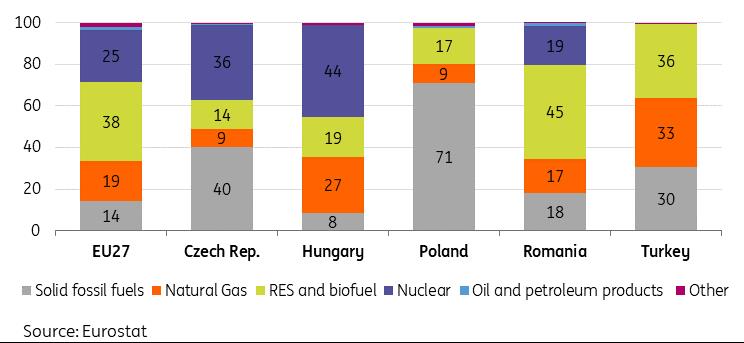
Electricity generation mix in EU27 and CEE countries, as of 2021 (%)In our view, Poland's priority is to radically accelerate investment in zero energy capacity (RES and nuclear), electricity grids, and energy efficiency (in buildings, industry, and other sectors) over the next 10 years. As we pointed out in our recent report , Poland – with its still coal-dominated power system - is the hardest hit in the CEE region by the high cost of European Union Allowances (EUAs).
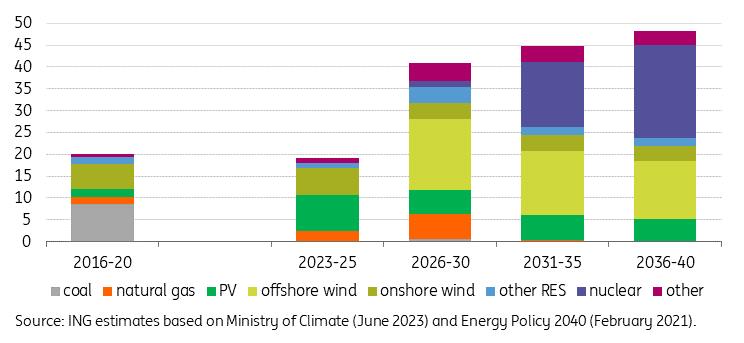
Poland's projected annual power investments (in constant 2020 PLN billion)At the same time, the country can use significant EU financing by 2030 (from the National Recovery and Resilience Plan and cohesion policy funds) and access to private financing, including from banks, to double its power investments in the current decade.
Author:Leszek Kasek

Legal Disclaimer:
MENAFN provides the
information “as is” without warranty of any kind. We do not accept
any responsibility or liability for the accuracy, content, images,
videos, licenses, completeness, legality, or reliability of the information
contained in this article. If you have any complaints or copyright
issues related to this article, kindly contact the provider above.
Most popular stories
Market Research

More Story






Comments
No comment