







403
Sorry!!
Error! We're sorry, but the page you were looking for doesn't exist.
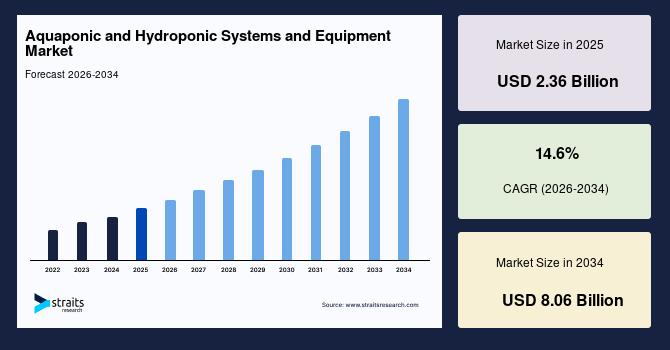
Aquaponic And Hydroponic Systems And Equipment Market Size, 2034
| Market Metric | Details & Data (2025-2034) |
|---|---|
| 2025 Market Valuation | USD 2.36 Billion |
| Estimated 2026 Value | USD 2.71 Billion |
| Projected 2034 Value | USD 8.06 Billion |
| CAGR (2026-2034) | 14.6% |
| Study Period | 2022-2034 |
| Dominant Region | Europe |
| Fastest Growing Region | North America |
| Key Market Players | AmHydro, Aquaponic Lynx LLC, Argus Control Systems Limited, Colorado Aquaponics, ECF Farmsystems |
Download Free Sample Report to Get Detailed Insights.
Aquaponic And Hydroponic Systems & Equipment Market Dynamics Market DriversRising Demand for Year-Round Crop Production And Growing Investments in Greenhouse and Indoor Farming Infrastructure Drives Market
Growing consumer demand for uninterrupted availability of fresh fruits, vegetables, and herbs throughout the year is accelerating adoption of hydroponic and aquaponic farming systems. Unlike traditional agriculture, these systems enable controlled cultivation independent of seasonal and climatic limitations, ensuring consistent crop supply. Commercial growers and food retailers are increasingly investing in controlled farming methods to stabilize production and reduce supply chain disruptions. This rising need for predictable, high-quality agricultural output is driving strong demand for advanced cultivation systems and related equipment.
Increasing investments in greenhouse facilities and indoor farming projects are significantly boosting demand for hydroponic and aquaponic systems and equipment. Governments, agritech firms, and private investors are funding controlled-environment agriculture projects to improve food security, optimize land usage, and enhance agricultural productivity. Modern indoor farms require advanced irrigation systems, nutrient delivery units, climate control technologies, and monitoring equipment to maintain efficient operations. As large-scale commercial indoor farming expands globally, demand for integrated cultivation infrastructure and automation technologies continues to rise.
Market RestraintsHigh Initial Setup & Infrastructure Costs and Limited Crop Variety Suitability Restrain Market
Aquaponic and hydroponic farming systems require substantial upfront investment in greenhouses, climate control systems, lighting, irrigation units, sensors, and automation technologies. The cost of establishing controlled-environment infrastructure can be significantly higher than conventional farming methods, particularly for large-scale commercial operations. Small and medium-sized growers often face financial barriers due to limited access to capital and long payback periods. These high setup costs can slow adoption, especially in price-sensitive agricultural markets.
All kinds of crops are not commercially viable for hydroponic and aquaponic cultivation, limiting the range of produce that growers can efficiently cultivate. Leafy greens, herbs, and certain vegetables dominate production, while many staple crops and deep-rooted plants remain difficult or uneconomical to grow in controlled systems. This restricts market diversification opportunities for commercial operators and narrows revenue potential. Limited crop adaptability can also reduce adoption among farmers seeking broader agricultural flexibility.
Market OpportunitiesRising Demand for Locally Produced Fresh Vegetables & Herbs and Expansion of Direct-to-Consumer Urban Farming Business Models Offers Growth Opportunities
Consumers are increasingly preferring locally grown fresh produce due to rising concerns regarding food freshness, supply chain transparency, and pesticide usage. Hydroponic and aquaponic systems enable cultivation closer to urban consumption centers, reducing transportation time and post-harvest losses. Restaurants, supermarkets, and premium retailers are also seeking consistent supplies of high-quality herbs and leafy greens throughout the year. This growing preference for locally sourced produce is creating strong opportunities for controlled-environment farming systems and equipment providers.
Urban farming companies are increasingly adopting direct-to-consumer models through subscription services, online delivery platforms, and local retail partnerships. Hydroponic and aquaponic systems support compact, high-yield cultivation within cities, enabling faster delivery of fresh produce to consumers. Rising consumer interest in traceable and sustainably grown food is strengthening demand for localized indoor farming operations. This trend is opening new opportunities for scalable farming infrastructure, automation technologies, and modular cultivation systems.
Market Challenges Limited Financing Access for Indoor Farming Startups and Regulatory Uncertainty Regarding Soil-less Farming Practices Challenges Market Growth
Many indoor farming startups face challenges in securing funding due to high capital requirements, long return-on-investment periods, and uncertain profitability models. Financial institutions and investors often view hydroponic and aquaponic projects as high-risk compared to conventional agriculture ventures. Limited access to affordable financing can restrict expansion plans, technology adoption, and large-scale infrastructure development. This funding gap creates barriers for new entrants and slows commercialization of advanced farming systems.
The regulatory framework for hydroponic and aquaponic farming remains inconsistent across countries and regions, creating operational uncertainty for growers and equipment providers. Variations in certification standards, water usage regulations, food labeling rules, and organic farming eligibility can complicate market entry and product commercialization. Lack of clear policy support also affects investment confidence in controlled-environment agriculture projects. These regulatory inconsistencies create compliance challenges and may delay broader adoption of indoor farming technologies.
Regional Analysis Aquaponic and Hydroponic Systems and Equipment Market in EuropeEurope is the most significant global aquaponic and hydroponic systems and equipment market shareholder and is estimated to exhibit a CAGR of 13.40% during the forecast period. The European countries generate considerable revenue in the aquaponic and hydroponic systems and equipment market. Aquaponic and hydroponic techniques help support the agriculture industry as they are both integral to indoor and vertical farming, which is gaining immense popularity in the region. One of the main drivers for the growth of the aquaponics market in the region is the increasing concern for food safety and security among the people. This increases the need in the area for innovative farming strategies. This drives the growth of the region's aquaponic and hydroponic systems and equipment market. Moreover, European initiatives such as "green crop protection" have helped manufacturers invest in product innovation and provide eco-friendly solutions for applications in the agricultural industry.
North America is anticipated to exhibit a CAGR of 16.10% over the forecast period. The high growth in the North American region for the aquaponic and hydroponic industry is attributed to the increased emphasis on alternative farming techniques and good technological development. Aquaponics and hydroponics serve as ideal solutions to the region's demand for food due to their ability to provide high-quality, nutritious, fresh crops close to urban centers wherein highly perishable items are sent to the market quickly. In addition, the North American region is estimated to grow significantly due to many leading companies operating in the region, such as Nelson & Pade Aquaponics, Backyard Aquaponics, and Aquaponics USA. The presence of research institutes in the North American region working on developing alternative farming techniques is also a significant factor in helping the development of the region's aquaponic and hydroponic systems and equipment market.
In Asia-Pacific region, countries such as India have the highest populations globally, which creates a higher food demand in these regions. This is expected to drive the Asia-Pacific region's aquaponic and hydroponic systems and equipment market. The aquaponic and hydroponic market in the Asia-Pacific region is enormous, considering countries' dependence on agriculture. In addition, agriculture is a primary occupation for a large population in the countries located in this region. These countries have adopted modern farming techniques in the face of rapid urbanization and an increased number of abandoned farms. The agricultural sector in the area is an essential contributor to the overall GDP of the region, recording extraordinary growth in the years 2008-2019.
In the Middle East and Africa, most of the population lives in rural areas. Most people in this region rely on agriculture-related activities for their livelihood. Long, dry summers and mild, rainy winters are the hallmarks of a Mediterranean climate in more tropical areas. The countries in this region depend on agriculture and focus more on developing this industry, further assisting in improving the yield and generating more revenue. With recent technological advancements in the region, the market is estimated to grow in the future, especially in Israel, Saudi Arabia, and South Africa.
Segmental Analysis By ApplicationThe vegetable segment dominates the global market and is projected to exhibit a CAGR of 15.09% over the forecast period. Aquaponic and hydroponic techniques are primarily used for the cultivation of vegetables. Through aquaponic and hydroponic growing systems, fish and vegetables are grown together. The vegetables and the fish both reap the benefits from each other through the aquaponic system. This circulating water contains fish excrement, which is rich in beneficial bacteria and nutrients and can provide nutrients to plants without fertilizers. In addition, the waste excreted by fish serves as a natural source of organic nutrients, and helpful microorganisms turn the waste into a source of nutrients that plants can use. Plants also naturally filter the water, giving fish and microbes a clean environment. Therefore, the need for pesticides and fertilizers is not present in aquaponics.
Herb cultivation through aquaponic and hydroponic techniques has been increasing. Herbs are grown aquaponic and offer better aroma and flavor than those produced through conventional farming systems. As per the study done by the University of Minnesota, it is a fact that herbs grown with the help of aquaponic and hydroponic systems have more than 30% more aromatic oils than those produced with the help of conventional farming.
By EquipmentThe heating, ventilation, and air conditioning (HVAC) segment owns the highest market share and is predicted to grow at a CAGR of 12.97% over the forecast period. The process of aquaponic and hydroponic food production requires constant monitoring and control over food production. This includes maintaining an adequate temperature and heat in the system. Heating, ventilation, and air conditioning are the primary technologies used to maintain temperature and heat in an aquaponic system. These systems are designed to consider internal and external environment fluctuations across the region where aquaponic and hydroponic systems must be set up.
In any agricultural production, water plays a significant role in crop production. Water provides nourishment to the crop and helps in crop production. The irrigation system is integrated within the substrates to provide a nutrient solution directly to the plant's roots in hydroponics and aquaponics. With the usage of the irrigation system, the rigorous farming method is capable of functioning using only 5% of water and 25% of fertilizers and pesticides.
By TechniqueThe nutrient-film technique segment is the most significant contributor to the market and is anticipated to exhibit a CAGR of 15.95% over the forecast period. The nutrient-film technique is a hydroponic growing technique that all aquaponic and hydroponic growers mostly use because of its adaptability to some harsh environments, such as regions with low arable land and poor climatic conditions. The technique is preferred because it is simple and works well with many common garden plants, including lettuce and herbs. In this technique, shallow streams of nutrient-rich water flow through horizontal pipes. The plants are planted in the holes at the top of the pipes and can take advantage of this nutrient-rich film of water.
A deep-water culture system is another aquaponic and hydroponic farming technique often used for large-scale production. The deep-water culture technique is a low-maintenance setup and is ideal for fast-growth plants like lettuce and leafy greens and can be scaled to almost any size easily. Like other aquaponic and hydroponic growing techniques, the deep-water culture technique also required constant monitoring to ensure the health of the fish, bacteria, and plants.
Competitive LandscapeThe aquaponic and hydroponic systems and equipment market is highly fragmented, with participation from global greenhouse technology providers, irrigation system manufacturers, controlled-environment agriculture (CEA) solution companies, and a large number of agri-tech startups offering modular and AI-enabled farming systems. Established players such as Netafim, Priva, and Signify compete primarily on end-to-end greenhouse integration, precision irrigation technology, system reliability, energy efficiency, scalability, and long-term service contracts with commercial farms and agribusinesses. In contrast, emerging players compete on low-cost modular systems, rapid deployment hydroponic kits, AI-based farm management software, and localized customization for urban farming and vertical agriculture applications, especially in space-constrained and high-density cities.
List of Key and Emerging Players in Aquaponic and Hydroponic Systems and Equipment Market-
AmHydro
Aquaponic Lynx LLC
Argus Control Systems Limited
Colorado Aquaponics
ECF Farmsystems
BetterGrow Hydro
Endless Food Systems
general Hydroponics
Hydrodynamics International
GreenTech Agro LLC
Hydrofarm LLC
LivinGreen
Nelson & Pade Aquaponics
Pentair AES
Perth Aquaponics
Pegasus Agriculture
UrbanFarmers AG.
-
June 2022 - GrowGeneration Corp., the nation's largest chain of specialty hydroponic and organic garden centers, announced the opening of a new hydroponic garden center to serve the growing Mississippi market.
-
February 2023 - Springworks Farm, an aquaponic greenhouse company based in Lisbon, Maine, received USD 22 million in new funding to fuel its regional expansion. According to a press release, the funds will be used to construct Springworks' fourth and largest greenhouse, adding 120,000 square feet of production space.
| Report Metric | Details |
|---|---|
| Market Size in 2025 | USD 2.36 Billion |
| Market Size in 2026 | USD 2.71 Billion |
| Market Size in 2034 | USD 8.06 Billion |
| CAGR | 14.6% (2026-2034) |
| Base Year for Estimation | 2025 |
| Historical Data | 2022-2024 |
| Forecast Period | 2026-2034 |
| Report Coverage | Revenue Forecast, Competitive Landscape, Growth Factors, Environment & Regulatory Landscape and Trends |
| Segments Covered | By Applications, By Equipment, By Technique |
| Geographies Covered | North America, Europe, APAC, Middle East and Africa, LATAM |
| Countries Covered | US, Canada, UK, Germany, France, Spain, Italy, Russia, Nordic, Benelux, China, Korea, Japan, India, Australia, Taiwan, South East Asia, UAE, Turkey, Saudi Arabia, South Africa, Egypt, Nigeria, Brazil, Mexico, Argentina, Chile, Colombia |
Download Free Sample Report to Get Detailed Insights.
Aquaponic and Hydroponic Systems and Equipment Market Segments By Applications-
Vegetables
Fruits
Herbs
Fish
Others
-
Heating, Ventilation, and Air Conditioning (HVAC)
Irrigation System
LED Grow Light
Aeration System
Others
-
Nutrient-Film Technique
Media-Filled Grow Bed
Deep-Water Culture Technique
Ebb and Flow System
Others
-
North America
Europe
APAC
Middle East and Africa
LATAM

Legal Disclaimer:
MENAFN provides the
information “as is” without warranty of any kind. We do not accept
any responsibility or liability for the accuracy, content, images,
videos, licenses, completeness, legality, or reliability of the information
contained in this article. If you have any complaints or copyright
issues related to this article, kindly contact the provider above.
Most popular stories
Market Research

More Story








Comments
No comment