







403
Sorry!!
Error! We're sorry, but the page you were looking for doesn't exist.
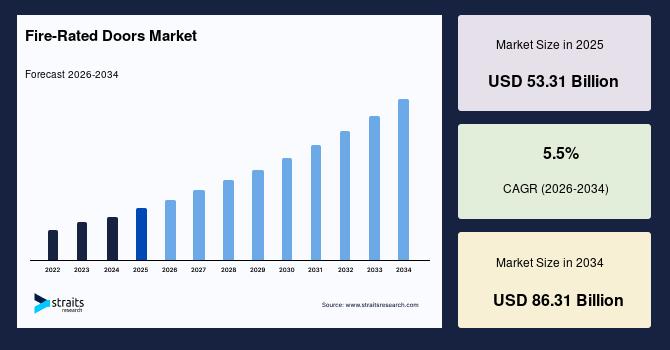
Fire-Rated Doors Market Size, Share, Growth, Forecast, 2034
| Market Metric | Details & Data (2025-2034) |
|---|---|
| 2025 Market Valuation | USD 53.31 Billion |
| Estimated 2026 Value | USD 56.24 Billion |
| Projected 2034 Value | USD 86.31 Billion |
| CAGR (2026-2034) | 5.5% |
| Study Period | 2022-2034 |
| Dominant Region | Europe |
| Fastest Growing Region | North America |
| Key Market Players | Agta record ltd., American Automatic Doors, Inc., ASSA ABLOY Group, Dormakaba Holding AG, FAAC S.p.A. Soc Unipersonale |
Download Free Sample Report to Get Detailed Insights.
Fire-rated Doors Market Dynamics Market DriversStringent Fire Safety Regulations & Mandatory Building Codes and Rising Enforcement of Occupancy Certification Drives Market
Stringent fire safety regulations and mandatory building codes are increasingly requiring the installation of certified fire-rated doors across residential, commercial, and industrial buildings. Authorities are updating safety norms to ensure better containment of fire hazards and improved evacuation safety. This is pushing developers to integrate compliant fire protection systems at the design stage itself rather than as an afterthought. As a result, demand for certified fire-rated doors is rising steadily across new construction projects.
Rising enforcement of occupancy certifications and frequent compliance audits are making fire safety adherence a critical requirement for building approvals and operational use. Regulatory bodies are conducting stricter inspections, ensuring that buildings meet prescribed fire resistance standards before granting occupancy clearance. Non-compliance can lead to penalties, project delays, or revocation of permits, increasing pressure on stakeholders. This is driving strong demand for tested and approved fire-rated door systems in both new and retrofit projects.
Market RestraintsStringent Testing & Certification Requirements and Availability of Low-cost Non-certified Alternatives Restrain Fire-rated Doors Adoption
Fire-rated doors must comply with rigorous fire resistance, smoke control, and safety performance standards before being approved for commercial use. The testing and certification process is often time-consuming and expensive, increasing product development and compliance costs for manufacturers. Frequent updates in regional safety regulations further add complexity, especially for companies operating across multiple markets. These factors can delay product launches and create barriers for small and mid-sized manufacturers.
The presence of low-cost non-certified doors in price-sensitive markets poses a significant challenge for certified fire-rated door manufacturers. Many small contractors and buyers prioritize lower upfront costs over long-term safety compliance, particularly in developing regions with weak regulatory enforcement. This creates pricing pressure on organized manufacturers investing heavily in certified products and quality assurance. As a result, adoption of compliant fire-rated doors can be slower in cost-driven construction segments.
Market OpportunitiesGrowing Adoption of Smart Buildings and Increasing Retrofitting & Renovation Activities in Aging Infrastructure Opens New Avenues for Market Players
The increasing development of smart buildings is creating strong demand for technologically advanced fire-rated doors integrated with automated fire detection and access control systems. Modern commercial infrastructure increasingly requires doors capable of supporting centralized building safety management and emergency response functions. This trend is driving opportunities for manufacturers offering sensor-enabled, remotely monitored, and electronically integrated fire-rated door solutions. Demand is particularly rising across hospitals, airports, commercial complexes, and high-rise buildings.
Large numbers of older commercial and residential buildings are undergoing renovations to comply with updated fire safety regulations and occupancy standards. Aging infrastructure often lacks modern fire compartmentalization systems, creating significant replacement opportunities for certified fire-rated doors. Governments and property owners are increasingly investing in safety upgrades to improve regulatory compliance and occupant protection. This is generating sustained demand for retrofit-compatible fire-rated door solutions across developed and emerging markets.
Market ChallengesHigh Dependency on Construction and Real Estate Sector Performance and Long Replacement Cycles Challenges Fire-rated Doors Market Growth
The fire-rated doors market is heavily dependent on new construction activity and infrastructure development across commercial, residential, and industrial sectors. Economic slowdowns, rising interest rates, or reduced real estate investments can directly impact demand for fire-rated door installations. Delays or cancellations of large construction projects also affect procurement cycles for fire safety products. This strong reliance on construction sector performance creates demand volatility for manufacturers and suppliers.
Fire-rated doors are designed for long operational lifespans and typically do not require frequent replacement unless damaged or affected by regulatory upgrades. This limits recurring demand and reduces replacement-driven revenue opportunities for manufacturers. In many buildings, maintenance and repairs are preferred over complete door replacement to minimize costs. As a result, market growth remains closely tied to new construction and retrofit activities rather than repeat purchases.
Regional AnalysisThe global market for Fire-Rated Doors has been segmented based on geography into North America, Europe, Asia Pacific, and LAMEA.
The North American fire-rated doors market is analyzed across the U.S., Canada, and Mexico. The fire-rated doors market in North America is anticipated to grow at a CAGR of 5.9% from 2026 to 2034. An increase in the demand for automatic fire-rated doors in commercial improvement and repair is expected to fuel the growth of the market in the U.S. Furthermore, enhanced building safety and security is also anticipated to drive the market growth in the U.S. Homeowners are not only indulging in renovation projects but are also captivating on discretionary home improvement projects. Consumer expenditure on home improvement per household increased by 17% in 2018, a noteworthy part of that growth results from an upsurge in discretionary "want-to-have" projects. Moreover, the significant increase in the demand for automatic fire-rated doors in commercial improvement and repair services is also expected to fuel the growth of the market in the U.S. Easy nailing, planking, and recent trends of using innovative technologies in fire doors boost the growth of the market.
Europe is the largest market for fire-rated doors and is expected to grow throughout the forecast period. The fire-rated doors market in Europe is anticipated to grow at a CAGR of 5.7% from 2023 to 2031. Germany accounted for the major share of this market in 2021. According to European Construction Sector Observatory (Country profile Germany), the overview for the construction sector in Germany is strong, compelled by a flourishing housing market and positive progress for all market segments such as construction, manufacturing, and others, and the overall turnover growth of the industry is expected to be 4.8 % in 2021. High adoption of advanced technology, along with an increase in construction spending on commercial buildings is expected to boost the market growth.
Asia-Pacific holds the highest position in the global fire-rated doors market. China accounted for a major share of this market in 2021, and India is expected to experience rapid growth during the forecast period. In addition, developing economies, such as China, India, and Indonesia, are expected to support market expansion due to an increase in demand for residential construction. The rapid urbanization and presence of a large population contribute toward the growth of the fire-rated doors market in Asia-Pacific. Furthermore, an increase in consumer awareness regarding safety measures and product properties propels the growth of the fire-rated doors market.
Segmental AnalysisBased on material, the market is segmented into wood, glass, metal, and others.
Wood is a fibrous and porous structural tissue found in the stems and roots of trees and other woody plants. It is a natural resource and can be fabricated in all sizes and shapes. Wood as a material is environmentally sustainable, biodegradable, and renewable in nature. In addition, it is a preferred material for making fire-rated doors, owing to its features such as thermal insulation, high strength, low cost, and easily available.
Glass fire doors possess features such as high-temperature tolerance, glazing properties, toughness, and others. Fire-rated glass doors have a fire and heat resistance capacity of 30 minutes to 120 minutes. Glass fire doors are suitable for residences, restaurants, workplaces, big retail outlets, airports, and other projects.
Metal doors possess features such as durability, heat resistance, lightweight, and fire-resistant, and enhance the architecture of the building. In addition, they require minimum maintenance and have notably longer product lives in comparison to other materials. Moreover, a rise in commercial and residential building investments, such as developments in homes, hotels, malls, shopping centers, and apartment buildings, is anticipated to provide lucrative opportunities for market growth.
By mechanism, the market is segmented into swinging, sliding, hinged, and others.
Swinging doors can open in either direction or then close by themselves. Single-panel and double-panel doors are commonly available mechanisms of swing doors, which are best suited for applications in the commercial sector, such as in restaurants, hotels, shopping malls, and others. Similarly, swinging doors have applications in the residential sector, such as at homes, residential dwellings, and others.
Sliding doors are parallel to the wall and are opened horizontally by a sliding mechanism. They are opened and closed by slipping sideways instead of swinging on hinges. Single and double-leaf doors are commonly available mechanisms of sliding doors. The sliding doors have features such as safety, security, energy efficiency, and others. These doors consist of features such as thermal insulation, high corrosion control, and high durability.
Folding doors, popularly known as bifold doors, open by folding back in sections or panels and are used as internal or external room dividers. They encompass the folding mechanism of doors employing multiple hinges applied through several panels that result in doors that co-exist as a door-wall system. In addition, these doors provide enough insulation without compromising the inner temperature of the infrastructure or building.
Based on end users, the market is segmented into residential and non-residential.
Fire-rated doors are used in residential buildings such as domestic dwellings, garages, and multi-family homes. They consist of 30 minutes fire-resistant capacity and are commonly used in residential areas. The fire-rated doors made from solid core construction are widely used in residential areas, owing to their features such as heaviness and thickness.
Fire-rated doors are used in commercial sectors such as restaurants, big retail outlets, airports, offices, electrical substations, swimming pools, and other projects. Fire-rated doors in commercial areas act as a passive fire protection system. Non-residential fire-rated doors are made from materials such as steel, wood, and other composite materials. An increase in commercial construction activities and repair drives the growth of the fire-rated doors market.
Competitive LandscapeThe fire-rated doors market is moderately fragmented, with a mix of global building safety solution providers, specialized fire protection manufacturers, and regional construction product companies competing across commercial, industrial, and residential infrastructure segments. Established players compete primarily on fire resistance certification compliance, product durability, acoustic and thermal insulation performance, integration with smart building systems, and strong relationships with construction contractors and facility managers. Emerging and regional players compete on cost efficiency, localized manufacturing, faster project execution, and customization for building codes and architectural requirements, especially in developing construction markets. The market is also increasingly influenced by smart building integration, where fire-rated doors are becoming part of connected safety ecosystems.
List of Key and Emerging Players in Fire-Rated Doors Market-
Agta record ltd.
American Automatic Doors, Inc.
ASSA ABLOY Group
Dormakaba Holding AG
FAAC S.p.A. Soc Unipersonale
GEZE GmbH
Gilgen Door Systems AG
Godrej Security Solutions
GRAUTHOFF Türgruppe GmbH
Griffon Corporation Inc.
Gretsch--Unitas GmbH
Horton Automatics
Jansen Holding GmbH
JELD-WEN Holding, Inc.
KONE Corporation
LABEL S.p.a.
Lindner Group KG
MANUSA GEST
Nabtesco Corporation
Neuform-Türwerk Hans Glock GmbH and Co
Royal Boon Edam International B.V.
ReinaerdtTür GmbH
Sanwa Holdings Corporation
SchörghuberSpezialtüren KG
STANLEY Access Technologies LLC
November 2025: Henan Yuankai Door Industry formed a strategic partnership with a Brazilian distributor to supply steel fire-rated doors and expand regional distribution in Latin America, strengthening low-cost, high-volume localized fire door supply chains.
July 2025: Harmony Fire secured an approximately USD 14.8 million fire safety contract with Sheffield Council for large-scale fire-rated door replacement works.
Report Scope| Report Metric | Details |
|---|---|
| Market Size in 2025 | USD 53.31 Billion |
| Market Size in 2026 | USD 56.24 Billion |
| Market Size in 2034 | USD 86.31 Billion |
| CAGR | 5.5% (2026-2034) |
| Base Year for Estimation | 2025 |
| Historical Data | 2022-2024 |
| Forecast Period | 2026-2034 |
| Report Coverage | Revenue Forecast, Competitive Landscape, Growth Factors, Environment & Regulatory Landscape and Trends |
| Segments Covered | By Material, By Mechanism, By End User |
| Geographies Covered | North America, Europe, APAC, Middle East and Africa, LATAM |
| Countries Covered | US, Canada, UK, Germany, France, Spain, Italy, Russia, Nordic, Benelux, China, Korea, Japan, India, Australia, Taiwan, South East Asia, UAE, Turkey, Saudi Arabia, South Africa, Egypt, Nigeria, Brazil, Mexico, Argentina, Chile, Colombia |
Download Free Sample Report to Get Detailed Insights.
Fire-Rated Doors Market Segments By Material-
Wood
Glass
Metal
Others
-
Swinging Fire Doors
Sliding Fire Doors
Folding Doors
Others
-
Residential
Commercial
Industrial
-
North America
Europe
APAC
Middle East and Africa
LATAM

Legal Disclaimer:
MENAFN provides the
information “as is” without warranty of any kind. We do not accept
any responsibility or liability for the accuracy, content, images,
videos, licenses, completeness, legality, or reliability of the information
contained in this article. If you have any complaints or copyright
issues related to this article, kindly contact the provider above.
Most popular stories
Market Research

More Story








Comments
No comment