







403
Sorry!!
Error! We're sorry, but the page you were looking for doesn't exist.
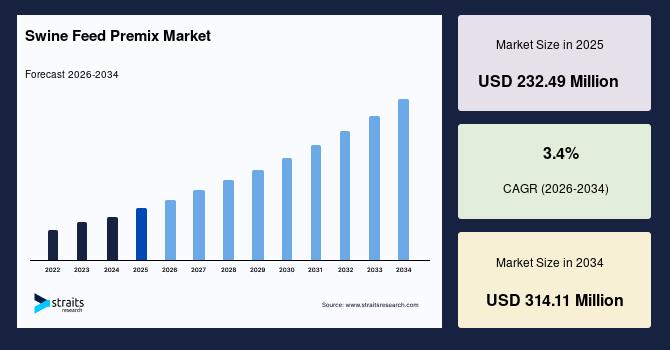
Swine Feed Premix Market Size, Share, Growth, Forecast, 2034
| Market Metric | Details & Data (2025-2034) |
|---|---|
| 2025 Market Valuation | USD 232.49 Million |
| Estimated 2026 Value | USD 240.39 Million |
| Projected 2034 Value | USD 314.11 Million |
| CAGR (2026-2034) | 3.4% |
| Study Period | 2022-2034 |
| Dominant Region | Asia Pacific |
| Fastest Growing Region | Europe |
| Key Market Players | Cargill Inc., Land O Lakes Inc., Lallemand Inc., Archer Daniels Midland Company (ADM), ForFarmers |
Download Free Sample Report to Get Detailed Insights.
Swine Feed Premix Market Dynamics Market DriversRising Focus on Improving Feed Conversion Ratio (FCR) and Growing Consumption of High-quality Meat in Urban and Export Markets Drives Demand
Rising demand for efficient pork production is driving strong adoption of swine feed premixes that enhance feed conversion ratios and improve weight gain per unit of feed. Producers are increasingly seeking nutrient-dense formulations to maximize output while reducing overall feed costs. This is boosting demand for vitamins, amino acids, and enzyme-enriched premixes across commercial pig farming. The focus on productivity optimization is making FCR improvement a key purchase driver for swine feed solutions.
Feed Conversion Ratio (FCR)
| Parameter | Description | Example |
|---|---|---|
| Feed Conversion Ratio (FCR) | Measures efficiency of converting feed into body weight gain | FCR = 3.0 means 3 kg feed → 1 kg weight gain |
| Formula | Total feed consumed ÷ Weight gain | 6 kg feed ÷ 2 kg gain = 3.0 |
| Low FCR | Indicates high efficiency (better performance, lower cost) | 2.5–3.0 is considered efficient in swine farming |
| High FCR | Indicates low efficiency (higher feed cost) | 4.0+ means more feed needed for same growth |
| Importance | Helps farmers optimize feed cost and productivity | Lower FCR = higher profitability in livestock production |
Growing consumer preference for safe, nutritious, and high-quality pork in urban and international markets is driving demand for advanced swine feed premixes. Producers are increasingly investing in nutrition solutions that improve meat quality, taste, and safety standards to meet export requirements. Rising disposable incomes and changing dietary habits are further strengthening premium meat consumption trends. This is significantly increasing demand for specialized feed premixes in export-oriented livestock production systems.
Market Restraints Quality Inconsistency in Raw Inputs and High Formulation Costs Restrain Swine Feed Premix Adoption
Variability in the quality of raw materials such as vitamins, amino acids, and mineral sources can significantly affect the performance of swine feed premixes. Inconsistent input quality leads to uneven nutrient composition and reduced feed effectiveness. This creates challenges for manufacturers in maintaining uniform product standards and reliable animal performance.
Developing balanced and effective swine feed premixes requires extensive research, testing, and precision in nutrient formulation. The need for advanced additives and specialized ingredients further increases production costs. This makes premix formulation expensive, especially for manufacturers aiming to deliver high-performance and customized nutrition solutions.
Market Opportunities Growing Aquaculture–Livestock Integrated Systems and Rise of Specialty Pork Farming Offers Growth Opportunities for Market Players
Integrated farming systems that combine aquaculture with livestock production are creating new demand for customized swine feed premixes that improve nutrient efficiency and reduce waste across interconnected farming operations. These systems rely on balanced nutrition strategies that support both fish and pig productivity while optimizing resource utilization such as water, feed, and by-products. This is increasing demand for multifunctional premixes from large integrated agribusinesses and feed manufacturers. Thus, companies like Nutreco are developing advanced nutrition solutions supporting integrated and sustainable animal farming systems.
The rising demand for premium, organic, and specialty pork products is creating strong opportunities for high-value swine feed premixes tailored to specific growth, flavor, and health requirements. Specialty pork producers focus on antibiotic-free, high-nutrition feed strategies to meet consumer expectations in premium and export markets. This is driving demand for customized premix solutions from feed manufacturers and additive suppliers targeting niche livestock segments
Market Challenges Disease Outbreaks in Livestock and Regulatory Compliance Burden Challenges Swine Feed Premix Market Growth
Disease outbreaks such as swine fever and other viral infections can sharply disrupt production cycles and reduce overall feed demand. Farmers often cut herd sizes or delay stocking, directly impacting premix consumption. Such outbreaks also create market uncertainty and disrupt supply chain planning for manufacturers.
Strict regulations on feed safety, antibiotic usage, and ingredient approvals increase compliance requirements for swine feed premix producers. Manufacturers must invest heavily in testing, documentation, and certification processes across different regions. This slows product launches and increases operational complexity and costs.
Regional Analysis Asia-Pacific Dominates the Global MarketAsia-Pacific is the most significant revenue contributor and is expected to grow at a CAGR of 3.85% during the forecast period. In terms of consumption of compound feed, China is in first place. Pork consumption is rising across the nation due to urbanization, rising middle-class incomes, and higher pork consumption. As a result, the demand for swine feed premix is driven by the rising price of raw materials for animal use and the increasing demand for meat. The processed meat sector also contributes to the market by expanding healthily and demanding premium pork meat. The industry for compound feed, swine feed additives, and swine feed premix is anticipated to continue growing steadily with the introduction of intensive animal farming systems.
Europe is expected to grow at a CAGR of 3.10% during the forecast period. The high demand for German pork in Italy, the Netherlands, China, and Poland boosts the swine feed premix market. The need for feed premix is rising because the nation is home to many top compound feed manufacturers. Additionally, the industry is placing more and more emphasis on innovations and the expansion of product lines. According to global trends, amino acids are the most significant portion, while minerals and vitamins are growing the fastest. German consumers are drawn to probiotic feed products because of their health advantages, such as improved digestibility and immunity. Pork consumption fell in 2017 compared to 2016 due to people becoming more aware of the harm that animal agriculture causes to the environment.
The United States is in the lead in terms of regional production and consumption of compound feed. The country's swine population is significantly expanding, fueling market expansion. An investigation by the International Production and Processing Expo (IPPE) in Atlanta found that a lack of vitamins can cause abnormalities in animals, reducing their production and lifespan and giving the impression that they are physically weaker. Animal feed companies need help providing vitamin-rich animal feed in the nation due to the comparatively high cost of vitamins. Breeders are under much pressure to maintain pricing due to the rising cost of swine feed's primary materials.
LAMEA holds a significant market share. The rise in meat imports and exports and growing consumer awareness of the quality of meat products are the main drivers of the Brazilian feed premix business. The prevalence of African swine year (ASF) in China and the global spread of diseases are having a good impact on the country's swine feed population growth, which in turn is boosting the premix market's expansion. The industrialization of meat production is also fueling the nation's need for swine feed premix. The two main reasons driving demand in the market are the increased demand for swine meat products and the expansion of the processed meat sector. The remaining nations of Africa, together with Kenya, Tanzania, Malawi, Namibia, and Ethiopia, are included in this segment.
Segmental AnalysisBy Type
The amino acid segment is the highest contributor to the market and is estimated to grow at a CAGR of 3.95% during the forecast period. One of the main components of the premix for swine feed is amino acids. Premixes give pigs essential amino acids such as lysine, threonine, and methionine. The amino acids market has increased demand among farmers due to its effectiveness as the building blocks of animal proteins. Due to rising feed prices and economic pressure, maintaining an appropriate crude protein level in the feed mix is essential. Therefore, amino acids are practical additions to the premixed swine feed. Amino acids are a crucial part of the swine feed premix. Premixes provide swine with critical amino acids such as lysine, threonine, and methionine. Farmers' interest in the amino acids market has risen as the need for these protein-building blocks has become apparent. Additionally, the meat sector in these nations is under intense pressure to supply the market more quickly.
Tetracycline and penicillin are two common antibiotics included as feed additives to the feed premix. These antibiotics are necessary for enhanced swine health. However, due to bacteria's growing resistance to antibiotics, tetracycline and penicillin usage in swine feed has been replaced and reduced. According to international medical organizations, antibiotics used to treat humans cannot be used to treat animals. Antibiotics from the tetracycline class are widely used throughout Asia-Pacific. Antibiotics are prohibited in the European Union and the United States, which has slowed global expansion. The situation in South America is comparable to that in Asia-Pacific, where swine farmers use antibiotics for therapeutic and growth-promoting goals.
Farmers choose to add vitamins A, D, E, K, riboflavin, niacin, pantothenic acid, choline, and B12 as premixes to the regular swine diets. These are the vital vitamins needed for the health of swine, particularly for breeders and producers. The amount of vitamins in swine diets from the feed is typically less than what is necessary for pigs. For instance, pig diets made of corn and soybean meal include fewer components high in vitamins. As vitamins promote more remarkable growth and performance in pigs, producers prefer using them in swine feed. The University recommends several vitamins per tonne of swine feed from Missouri, Colombia: 200.0 grams of choline, 2.0 grams of vitamin K, 4.0 grams of riboflavin, and 30.0 grams of niacin present. The vitamins in finished feeds are lost during processing and storage. Thus, vitamins are being given to the feed to make up for these losses.
Antioxidants are common feed additives in the feed premix, including BHA (butylated hydroxyanisole) and BHT (butylated hydroxytoluene). The demand for antioxidants is rising due to a focus on raw material quality. One of the biggest markets for antioxidants is in Asia-Pacific. The main driver of this market is the need for natural synthetics in the region, particularly in China, India, South Korea, and Vietnam. Numerous governments are promoting the development of antioxidants because of their multiple advantages. Antioxidants maintain food's flavor, color, and stability by stabilizing fats. One of the elements propelling the market for antioxidants is the prevention of the rancidity of lipids and oils in animal feed. Another aspect accelerating the market's growth is increased farmer awareness of antioxidants. The FDA has designated butylated hydroxytoluene (BHT) as a GRAS chemical, which is considered safe to consume in small amounts.
Competitive LandscapeThe swine feed premix market landscape is moderately fragmented, with a mix of global animal nutrition companies, integrated agribusiness firms, and regional feed manufacturers competing across commercial pig farming value chains. Established players such as Cargill, ADM, dsm-firmenich, Nutreco, and Alltech compete primarily on advanced formulation capabilities, scientific R&D, product efficacy, regulatory compliance, and strong global supply networks. In contrast, emerging and regional players focus on cost-effective premix solutions, localized feed formulations, faster distribution, and customization for small and mid-scale pig farms, especially in price-sensitive markets across Asia-Pacific and Latin America. The swine feed premix market competition is also influenced by integration with livestock health solutions and advisory services, as companies move beyond products into full nutrition management ecosystems.
List of Key and Emerging Players in Swine Feed Premix Market-
Cargill Inc.
Land O Lakes Inc.
Lallemand Inc.
Archer Daniels Midland Company (ADM)
ForFarmers
DLG Group
Koninklijke (DSM NV)
De Heus Voeders BV
Biomin GmbH
Kent Nutrition Group Inc.
Novus International
DutchFarm International BV
Vitalic
Danish Agro (Vilomix AS)
Baltussen Wanroij Group (Champix)
Burkmann Industries Inc
September 2025: ADM and Alltech signed a definitive agreement to form a North American animal feed joint venture, combining feed mills and premix capabilities to strengthen integrated swine and livestock nutrition supply chains.
August 2025: dsm-firmenich inaugurated a new animal nutrition and feed additive manufacturing facility in Jadcherla, India.
August 2025: Shunya Agritech signed an MoU with ICAR-IIMR for hydroponic maize-based livestock feed research, aimed at improving nutrient-rich feed inputs that directly feed into premix formulation quality for swine and dairy systems.
Report Scope| Report Metric | Details |
|---|---|
| Market Size in 2025 | USD 232.49 Million |
| Market Size in 2026 | USD 240.39 Million |
| Market Size in 2034 | USD 314.11 Million |
| CAGR | 3.4% (2026-2034) |
| Base Year for Estimation | 2025 |
| Historical Data | 2022-2024 |
| Forecast Period | 2026-2034 |
| Report Coverage | Revenue Forecast, Competitive Landscape, Growth Factors, Environment & Regulatory Landscape and Trends |
| Segments Covered | By Type |
| Geographies Covered | North America, Europe, APAC, Middle East and Africa, LATAM |
| Countries Covered | US, Canada, UK, Germany, France, Spain, Italy, Russia, Nordic, Benelux, China, Korea, Japan, India, Australia, Taiwan, South East Asia, UAE, Turkey, Saudi Arabia, South Africa, Egypt, Nigeria, Brazil, Mexico, Argentina, Chile, Colombia |
Download Free Sample Report to Get Detailed Insights.
Swine Feed Premix Market Segments By Type-
Antibiotics
Vitamins
Antioxidants
Amino Acids
Minerals
Acidifiers
Others
-
North America
Europe
APAC
Middle East and Africa
LATAM

Legal Disclaimer:
MENAFN provides the
information “as is” without warranty of any kind. We do not accept
any responsibility or liability for the accuracy, content, images,
videos, licenses, completeness, legality, or reliability of the information
contained in this article. If you have any complaints or copyright
issues related to this article, kindly contact the provider above.
Most popular stories
Market Research

More Story








Comments
No comment