







403
Sorry!!
Error! We're sorry, but the page you were looking for doesn't exist.
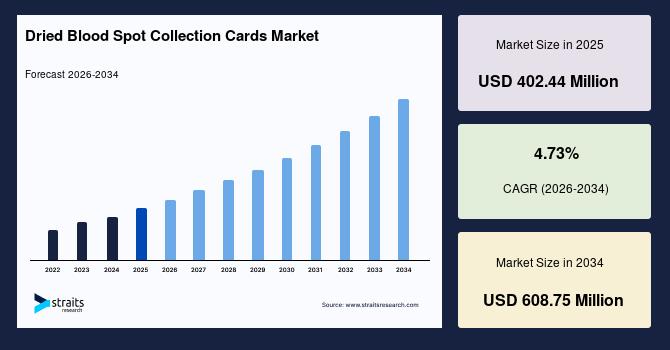
Dried Blood Spot Collection Cards Market Size, Share, Forecast, 2034
| Market Metric | Details & Data (2025-2034) |
|---|---|
| 2025 Market Valuation | USD 402.44 Million |
| Estimated 2026 Value | USD 420.75 Million |
| Projected 2034 Value | USD 608.75 Million |
| CAGR (2026-2034) | 4.73% |
| Study Period | 2022-2034 |
| Dominant Region | North America |
| Fastest Growing Region | Asia Pacific |
| Key Market Players | QIAGEN, PerkinElmer, Hoffmann-La Roche Ltd, Thermo Fisher Scientific Inc., Danaher Corporation |
Download Free Sample Report to Get Detailed Insights.
Dried Blood Spot Collection Cards Market Dynamics Market DriversRising Demand for Newborn Screening Programs and Expansion of Decentralized Clinical Trials Drives Market
The expansion of national newborn screening programs is significantly increasing blood spot collection cards market demand worldwide. DBS cards are extensively used for detecting inherited metabolic disorders, congenital hypothyroidism, and cystic fibrosis using minimal neonatal blood samples. Their ability to maintain sample stability during long-distance transportation supports centralized laboratory testing efficiency. For example, the US Recommended Uniform Screening Panel (RUSP) widely relies on DBS-based neonatal screening protocols. Governments are increasingly investing in tandem mass spectrometry-integrated DBS workflows to strengthen early disease detection and preventive pediatric healthcare programs.
The growing adoption of decentralized clinical trials is driving dried blood spot collection cards market demand in pharmaceutical bioanalysis and remote patient monitoring. Drug developers increasingly utilize DBS sampling to support home-based participation in oncology, immunology, and rare disease studies without frequent hospital visits. Compared to conventional venous sampling, DBS methods significantly reduce sample transportation and storage costs while improving patient retention in multi-site trials. Pharmaceutical companies are integrating DBS workflows with LC-MS/MS platforms for pharmacokinetic studies, therapeutic drug monitoring, and biomarker analysis.
Market RestraintsVariability in Hematocrit Levels and Shortage of Skilled Personnel for DBS Sample Interpretation Restrain Market
Variability in hematocrit level is a significant dried blood spot collection cards market restraint, as differences in blood viscosity and red blood cell concentration can affect sample absorption and analyte distribution on filter paper. These variations often create inconsistencies in quantitative test results, particularly in pharmacokinetic studies, therapeutic drug monitoring, and neonatal diagnostics. Uneven blood spreading may reduce extraction accuracy and analytical reproducibility during laboratory processing. As a result, clinical laboratories and pharmaceutical companies face challenges in assay standardization, regulatory compliance, and validation of DBS-based bioanalytical testing methods.
The dried blood spot collection cards market faces limitations due to the shortage of professionals skilled in DBS sample handling, extraction, and analytical interpretation. Accurate DBS testing requires expertise in microsampling techniques, contamination control, and matrix variability correction during quantitative analysis. Many clinical laboratories in developing regions lack trained personnel capable of validating DBS workflows for pharmacokinetic studies and molecular diagnostics. This skill gap increases the likelihood of analytical inconsistencies and delays assay standardization, limiting wider adoption of DBS technologies in pharmaceutical and clinical laboratory applications globally.
Market OpportunitiesExpansion of At-home Therapeutic Drug Monitoring Programs and Increasing Utilization of DBS Cards in Forensics Offer Lucrative Growth Opportunities
The growing adoption of at-home therapeutic drug monitoring programs is creating significant opportunities for the dried blood spot collection cards market growth. Healthcare providers are increasingly utilizing DBS sampling for remote monitoring of immunosuppressants, anti-epileptic drugs, and biologics without requiring hospital-based venous collection. This approach improves patient convenience while reducing laboratory logistics costs. Pharmaceutical companies and specialty diagnostic laboratories are developing DBS-compatible home collection kits integrated with telehealth platforms, enabling medication monitoring and personalized treatment optimization across chronic disease management programs.
The growing adoption of dried blood spot collection cards in forensic toxicology and anti-doping analysis is creating significant opportunities for dried blood spot collection cards market players. Forensic laboratories are increasingly using DBS sampling for narcotics detection, alcohol biomarker testing, and postmortem toxicology due to its minimal sample requirement and easier transportation. DBS cards also improve sample stability for controlled substance analysis during long-term storage. Law enforcement agencies and sports regulatory organizations are expanding DBS-based screening programs because they simplify remote sample collection while supporting accurate LC-MS/MS-based forensic and toxicological investigations.
Regional Analysis North America: Market Leadership through Expanding Newborn Screening Programs and Strong Integration of DBS WorkflowsThe North America dried blood spot collection cards market accounted for a share of 35.06% among all regions in 2025 due to expanding federally supported newborn screening programs, rising adoption of decentralized clinical trial models across the US, and increasing utilization of DBS-based toxicology testing in forensic laboratories. Strong presence of advanced LC-MS/MS infrastructure, reimbursement-backed diagnostic screening frameworks, and growing pharmaceutical outsourcing for remote bioanalytical sampling further strengthen regional demand for high-precision DBS collection technologies.
The dried blood sport collection cards market in the US is growing due to increasing adoption of DBS-based pharmacokinetic sampling in FDA-regulated decentralized clinical trials, expanding CDC-supported HIV and hepatitis surveillance programs, and rising utilization of at-home microsampling kits by specialty diagnostic laboratories. Strong integration of DBS workflows with high-throughput LC-MS/MS platforms and growing forensic toxicology testing across state laboratories are further accelerating demand for advanced DBS collection technologies throughout the country.
Canada's dried blood spot collection cards market is supported by increasing deployment of DBS sampling in tuberculosis monitoring programs among northern migrant communities, growing use of microsampling in opioid exposure and harm-reduction studies, and rising adoption of DBS-based vitamin D deficiency screening in remote provinces with limited diagnostic accessibility. Canadian public health laboratories are also utilizing DBS cards for environmental exposure biomonitoring, particularly in mining and industrial regions, supporting long-term toxicology and occupational health surveillance initiatives.
Asia Pacific: Fastest Growth Driven by Expanding DBS Utilization and Growing Government Investment in Toxicology LaboratoriesThe Asia Pacific dried blood spot collection cards market is expected to register the fastest growth with a CAGR of 7.89% during the forecast period, driven by expanding DBS utilization in large-scale thalassemia and G6PD deficiency screening programs across Southeast Asia. Rising deployment of microsampling in rural tuberculosis surveillance initiatives and increasing government investment in decentralized infectious disease diagnostics also drive dried blood spot collection cards market growth. Rapid expansion of contract research organizations conducting multi-country clinical trials and growing adoption of cost-efficient sample transport systems are further accelerating regional market demand.
Increasing DBS utilization in national forensic toxicology laboratories for narcotics and synthetic drug detection, rising adoption of DBS-based therapeutic drug monitoring for immunosuppressants in organ transplant centers, and expanding anti-doping testing programs across professional sports institutions drive the dried blood spot collection cards market in China. Growing government investment in high-throughput toxicology laboratories is further accelerating demand for advanced DBS sampling technologies.
Singapore's dried blood spot collection cards market expansion is supported by growing DBS adoption within Biopolis-linked translational research institutes, increasing use of microsampling in cross-border infectious disease surveillance at Changi-linked public health laboratories, and rising therapeutic drug monitoring applications in Singapore's advanced transplant care centers. Expansion of government-supported precision medicine initiatives and centralized biomedical testing infrastructure is further accelerating demand for high-quality DBS collection technologies across the country.
Dried Blood Spot Collection Cards Market Segmentation Analysis By TypeIn 2025, the Whatman 903 segment accounted for a share of 41.20% in the dried blood collection card market, by card type. Its FDA-recognized compatibility with newborn screening workflows, superior analyte stability for tandem mass spectrometry applications, and widespread adoption in global HIV viral load monitoring programs has maintained segment dominance.
The FTA segment is expected to grow at a CAGR of 5.34% during the forecast period, driven by rising utilization in HPV genotyping, tuberculosis molecular testing, and hereditary disease screening applications requiring stable DNA preservation. Increasing adoption of PCR-based infectious disease diagnostics and expanding use of room-temperature nucleic acid transport systems are further supporting segment growth across clinical and research laboratories.
By ApplicationNewborn screening (NBS) led the application segment with a share of 30.76% in 2025 due to its critical role in early genetic disorder identification, including sickle cell disease and cystic fibrosis, using DBS-based multiplex assays. Strong integration with hospital-based perinatal screening programs and automated high-throughput neonatal testing platforms enhances rapid result turnaround and population-level disease prevention strategies.
The forensic application segment is expected to have the fastest growth, registering a CAGR of 5.13% during the forecast period. DBS cards are used in cold-chain-free toxicology evidence preservation, increasing their deployment in synthetic opioid metabolite screening in law enforcement labs and expanding adoption for rapid DNA-based suspect identification in decentralized crime scene investigations.
By End UseBy end use, hospitals dominated the dried blood spot collection cards market with a share of 73.52% in 2025. This dominance is attributed to high utilization in inpatient neonatal screening protocols, routine therapeutic drug monitoring in chronic disease management, and integration with hospital-based clinical pathology laboratories for centralized sample processing. Increasing hospital adoption of DBS for infectious disease testing and rapid diagnostic workflows further strengthens dominance across end-use healthcare settings.
The diagnostics centers segment is expected to grow at a CAGR of 6.48% during the forecast period, fueled by rising demand for multiplex infectious disease screening panels, increased outsourcing of pharmacogenomic and therapeutic drug testing, and adoption of cost-efficient, high-volume sample processing workflows that reduce turnaround time and improve laboratory efficiency.
Competitive LandscapeThe dried blood spot collection cards market is consolidated, with a limited number of specialized diagnostics and filtration technology providers accounting for a major share of global revenues. Companies including QIAGEN, PerkinElmer, and Cytiva Whatman maintain competitive positioning through certified filter paper technologies, newborn screening expertise, and strong distribution partnerships with clinical laboratories. Market participants are increasingly investing in volumetric microsampling systems, automation-compatible DBS workflows, and molecular diagnostics integration. Emerging innovators are also focusing on hematocrit-independent sampling technologies to strengthen precision bioanalysis and decentralized diagnostic testing capabilities globally.
List of Key and Emerging Players in Dried Blood Spot Collection Cards Market-
QIAGEN
PerkinElmer
Hoffmann-La Roche Ltd
Thermo Fisher Scientific Inc.
Danaher Corporation
Agilent Technologies
BD
Centogene N.V.
Bio-Rad Laboratories, Inc.
GE HealthCare
Shimadzu Corporation
Ahlstrom-Munksjö
Cytiva
In March 2026: Tasso renewed SOC 2 Type II certification for its remote blood collection and DBS testing infrastructure.
In February 2026: Tasso expanded commercialization of its Tile-T20 dried whole blood cartridge and Tasso Mini device platform for decentralized clinical trials and remote testing.
In September 2025: Tasso announced that the TS Blood Collection Kit developed through the Tasso-SNBL joint venture received certification as a controlled medical device under Japan's Pharmaceuticals and Medical Devices Act
Report Scope| Report Metric | Details |
|---|---|
| Market Size in 2025 | USD 402.44 Million |
| Market Size in 2026 | USD 420.75 Million |
| Market Size in 2034 | USD 608.75 Million |
| CAGR | 4.73% (2026-2034) |
| Base Year for Estimation | 2025 |
| Historical Data | 2022-2024 |
| Forecast Period | 2026-2034 |
| Report Coverage | Revenue Forecast, Competitive Landscape, Growth Factors, Environment & Regulatory Landscape and Trends |
| Segments Covered | By Card Type, By Application, By End Use |
| Geographies Covered | North America, Europe, APAC, Middle East and Africa, LATAM |
| Countries Covered | US, Canada, UK, Germany, France, Spain, Italy, Russia, Nordic, Benelux, China, Korea, Japan, India, Australia, Taiwan, South East Asia, UAE, Turkey, Saudi Arabia, South Africa, Egypt, Nigeria, Brazil, Mexico, Argentina, Chile, Colombia |
Download Free Sample Report to Get Detailed Insights.
Dried Blood Spot Collection Cards Market Segments By Card Type-
Whatman 903
Ahlstrom 226
FTA
Other Card Types
-
Newborn Screening (NBS)
Infectious Diseases Testing
Therapeutic Drug Monitoring
Forensic Application
Other Applications
-
Hospitals & Clinics
Diagnostics Centers
Other End Uses
-
North America
Europe
APAC
Middle East and Africa
LATAM

Legal Disclaimer:
MENAFN provides the
information “as is” without warranty of any kind. We do not accept
any responsibility or liability for the accuracy, content, images,
videos, licenses, completeness, legality, or reliability of the information
contained in this article. If you have any complaints or copyright
issues related to this article, kindly contact the provider above.
Most popular stories
Market Research

More Story








Comments
No comment