







403
Sorry!!
Error! We're sorry, but the page you were looking for doesn't exist.
Green Tea Market Size, Share, Trends, Demand, Forecast, 2034
| Market Metric | Details & Data (2025-2034) |
|---|---|
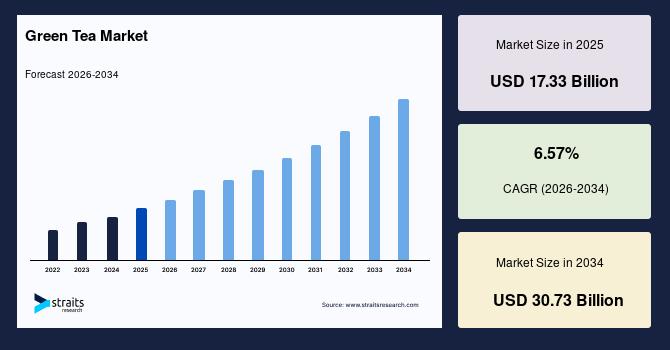
| 2025 Market Valuation | USD 17.33 Billion |
| Estimated 2026 Value | USD 18.47 Billion |
| Projected 2034 Value | USD 30.73 Billion |
| CAGR (2026-2034) | 6.57% |
| Study Period | 2022–2034 |
| Dominant Region | Asia Pacific |
| Fastest Growing Region | North America |
| Key Market Players | Tata Consumer Products, Unilever PLC, Associated British Foods PLC, The Coca-Cola Company, Nestlé S.A. |
Download Free Sample Report to Get Detailed Insights.
Green Tea Market Dynamics Market Drivers Rise of Functional Green Tea Blends and Increasing Demand for Botanical & Floral Green Tea Infusions Drives Market DemandRising consumer demand for beverages that support immunity, digestion, stress management, and overall wellness is a key green tea market driver. Consumers are increasingly preferring products infused with probiotics, adaptogens, collagen, and vitamins as healthier daily beverage options. Growing interest in preventive healthcare and clean-label functional drinks is further accelerating demand across urban and younger consumer groups.
Consumers are increasingly seeking botanical and floral green tea infusions that offer unique flavor experiences along with relaxation and wellness benefits, which drives green tea market demand. Ingredients such as jasmine, rose, chamomile, lavender, and mint are gaining popularity among health-conscious and premium tea buyers. Social media trends, café culture, and rising preference for aromatic natural beverages are further supporting market demand. Manufacturers are expanding premium and specialty tea portfolios with exotic floral blends to attract younger urban consumers. Growing interest in clean-label and naturally flavored beverages is also encouraging higher adoption of botanical green tea products across retail and foodservice channels.
Market RestraintsFlavor Bitterness, Limited Consumer Acceptance, and Climate Variability Restrict Wider Consumption of Green Tea
The natural bitter and earthy taste profile of green tea can limit acceptance among consumers accustomed to sweeter beverages. Many first-time consumers perceive unsweetened green tea as less palatable compared to flavored soft drinks or coffee-based beverages. Manufacturers often need to invest in flavor masking and product innovation to improve taste appeal. This creates formulation challenges while maintaining clean-label and low-sugar positioning.
A key green tea market restraint comes from production, which is highly dependent on climatic conditions, including rainfall, temperature, and soil quality. Extreme weather events, changing rainfall patterns, and rising temperatures can negatively impact tea leaf quality and crop yields. Supply instability can increase raw material costs and disrupt production consistency. These challenges are becoming more significant with growing climate-related agricultural risks.
Market OpportunitiesExpansion of Green Tea-based Alcohol Alternatives and Growth of Cold Brew and RTD Green Tea Formats Opens New Market Avenues
The rising demand for alcohol-free social beverages is creating strong opportunities for the green tea market growth, encompassing mocktails, botanical tonics, and wellness drinks. Consumers, particularly Gen Z and millennials, are increasingly seeking sophisticated non-alcoholic alternatives with natural ingredients and functional benefits. Companies such as ITO EN and Suntory Holdings have expanded premium tea-based beverage portfolios targeting wellness-focused consumers. The trend is also encouraging cafés, restaurants, and premium retail outlets to introduce sparkling and infused green tea beverages. Growing sober-curious lifestyles are expected to further strengthen demand for premium green tea alcohol alternatives.
The growing preference for convenient and on-the-go beverages opens avenues for cold brew and RTD green tea products across retail and foodservice channels. Consumers are increasingly favoring low-calorie, refreshing, and clean-label drinks that combine convenience with perceived health benefits. Companies such as The Coca-Cola Company and PepsiCo have expanded RTD tea portfolios with flavored and functional green tea variants. Cold brew green tea is also gaining popularity due to its smoother taste profile and lower bitterness compared to traditional brewed tea. Expansion of convenience stores, quick-commerce platforms, and café chains is further supporting product accessibility and consumption.
Regional Insights Asia Pacific: Market Dominance Led by Strong Regional Specialization and Rising Export MomentumThe Asia Pacific green tea market accounted for the largest regional share of 46.83% in 2025 due to its deep-rooted cultural consumption and large-scale production base. Countries such as China, Japan, and India account for most of the global tea cultivation, ensuring consistent supply and cost efficiency. Daily consumption of green tea as a traditional beverage in households strongly supports stable demand across all income groups. The region also benefits from advanced tea processing expertise, especially in Japan's steamed tea and China's pan-fired varieties. Rapid urbanization and rising health awareness are further increasing demand for organic and ready-to-drink green tea, while expanding retail networks and e-commerce platforms strengthen accessibility.
The green tea market growth in China is supported by centuries-old cultivation systems and strong regional specialization across Zhejiang, Fujian, and Yunnan. The market is strongly shaped by traditional tea culture, where green tea is consumed daily as part of household routines, hospitality practices, and wellness-oriented lifestyles. Chinese green tea varieties such as Longjing (Dragon Well) and Biluochun are widely recognized in global specialty tea markets for their craftsmanship and origin-based identity. Export activity is closely linked to demand for premium loose-leaf teas and specialty blends, particularly in Europe and Southeast Asia. The industry also benefits from structured support through national trade and agricultural modernization initiatives.
The India green tea market is expanding steadily, driven by wellness trends, urban consumption shifts, and rising export momentum. Tea Board of India data shows that total tea exports reached 280.40 million kg in 2025, the highest level recorded, supported by strong demand from West Asia and China, improving India's global trade position. Assam, Darjeeling, and the Nilgiris continue to anchor production, while domestic demand is shifting toward packaged green tea, tea bags, and functional beverages. Export growth is also supported by improved unit realization and rising interest in premium orthodox and specialty teas in international markets.
North America: Fastest Growth Driven by Increasing Shift from Carbonated Soft Drinks toward Functional and Strong Retail-led AccessibilityThe North America green tea market is expected to register the fastest regional growth with a CAGR of 7.83% during the forecast period, driven by rapid lifestyle shifts toward healthier beverage alternatives and strong adoption of functional drinks. Consumers are increasingly replacing carbonated soft drinks with antioxidant-rich beverages, supporting steady demand for green tea in both hot and ready-to-drink formats. Expansion of specialty tea cafés, wellness-focused retail chains, and premium organic product availability is further accelerating consumption. The region also benefits from strong e-commerce penetration, enabling wide accessibility of imported Asian tea varieties.
The green tea market in the US is strongly shaped by lifestyle-driven beverage substitution, where consumers are increasingly shifting from carbonated soft drinks toward functional and wellness-oriented drinks. Green tea is widely integrated into café culture, particularly through matcha-based lattes, iced green tea blends, and bottled ready-to-drink formats sold in convenience stores and premium grocery chains. The market is also influenced by fitness and wellness communities, where green tea is positioned as a low-calorie hydration option. Product innovation in flavored green tea, sparkling variants, and energy-infused blends continues to expand shelf presence across major retail and foodservice channels.
Canada's green tea market is primarily shaped by multicultural consumption patterns and strong retail-led accessibility rather than café-driven innovation. Green tea adoption is closely linked to urban immigrant populations, especially East Asian communities, where traditional tea drinking habits influence household consumption. Retail supermarkets and specialty ethnic grocery stores play a central role in distribution, with green tea commonly purchased in packaged tea bags and imported loose-leaf forms. Seasonal consumption patterns are also more stable compared to the US, with steady household usage rather than heavy café-based consumption. The market is additionally supported by growing interest in clean-label and organic
Green Tea Market Segmentation Analysis By Product TypeTea bags held a 38.47% share in the product type segment in 2025, driven by convenience, standardized taste, and strong household and workplace adoption. They benefit from wide retail availability across supermarkets and e-commerce platforms. Their ease of preparation aligns well with busy urban lifestyles.
RTD tea is expected to grow at a CAGR of 8.27% due to rising demand for on-the-go and functional beverage options. It is gaining traction among younger consumers as a healthier alternative to carbonated drinks. Growth is further supported by expanding retail access and continuous flavor innovation.
By CategoryBy category, the conventional segment dominated in 2025 and is projected to grow at a CAGR of 5.84% due to its strong production base, cost efficiency, and widespread availability. It remains the preferred choice for daily consumption across global markets. Established supply chains and consumer familiarity continue to support its leading position.
The organic segment is expected to grow at a CAGR of 8.43% driven by rising demand for clean-label, pesticide-free, and sustainably produced tea. Health-conscious consumers are increasingly shifting toward premium and environmentally responsible options. Expanding retail availability and organic product ranges are further accelerating growth.
By FlavorBy flavor, the unflavored segment is expected to grow at a CAGR of 5.62% due to its traditional consumption pattern and perception as a pure, natural beverage. It is widely preferred for its authentic taste and minimal processing. Strong cultural acceptance and consistent household demand continue to support its stability.
The flavored segment is expected to grow at a CAGR of 7.97% as consumers increasingly seek variety and enhanced taste experiences. It is gaining popularity among younger consumers through fruit, herbal, and botanical infusions. Continuous product innovation and premium flavor offerings are driving strong growth momentum.
By Distribution ChannelIn 2025, supermarkets & hypermarkets accounted for a share of 44.88% in 2025 due to wide product availability, strong brand assortment, and high consumer trust in physical retail channels. These stores enable easy price and brand comparison, driving frequent purchases. Strong shelf visibility and promotional activities further reinforce their dominance.
The online retail segment is expected to grow at a CAGR of 9.08% due to rising digital adoption and evolving consumer shopping preferences. E-commerce platforms offer wider product variety, including premium and niche tea brands with convenient home delivery. Subscription models and targeted digital marketing are further accelerating channel growth.
Recent Industry DevelopmentsIn August 2025, Reliance Consumer Products acquired a majority stake in a joint venture with Naturedge Beverages to expand its healthy functional beverage portfolio, including herbal and tea-based drinks under the Shunya brand.
In August 2025, Tea Avenue entered into a strategic collaboration with FranGlobal to expand into the Indian premium tea café market through franchise-led business expansion.
In August 2025, Gardens of India announced an exclusive tea partnership with Grand Hyatt Gurgaon to strengthen premium hospitality tea offerings and expand engagement with the Hyatt hotel network.
In August 2025, Clean Jeju Green Tea Agricultural Cooperative Sumang announced the launch of a new Hojicha green tea product as part of its portfolio diversification and direct-to-consumer expansion strategy.
List of Key and Emerging Players in Green Tea Market-
Tata Consumer Products
Unilever PLC
Associated British Foods PLC
The Coca-Cola Company
Nestlé S.A.
Ito En Ltd.
Kirin Holdings Company Limited
Arizona Beverage Company
Twinings (Diageo PLC)
Bigelow Tea Company
Lipton
Barry's Tea
Yogi Tea
Tea Avenue
Clean Jeju Green Tea Agricultural Cooperative Sumang
In August 2025, Reliance Consumer Products acquired a majority stake in a joint venture with Naturedge Beverages to expand its healthy functional beverage portfolio, including herbal and tea-based drinks under the Shunya brand.
In August 2025, Tea Avenue entered into a strategic collaboration with FranGlobal to expand into the Indian premium tea café market through franchise-led business expansion.
In August 2025, Gardens of India announced an exclusive tea partnership with Grand Hyatt Gurgaon to strengthen premium hospitality tea offerings and expand engagement with the Hyatt hotel network.
In August 2025, Clean Jeju Green Tea Agricultural Cooperative Sumang announced the launch of a new Hojicha green tea product as part of its portfolio diversification and direct-to-consumer expansion strategy.
Report Scope| Report Metric | Details |
|---|---|
| Market Size in 2025 | USD 17.33 Billion |
| Market Size in 2026 | USD 18.47 Billion |
| Market Size in 2034 | USD 30.73 Billion |
| CAGR | 6.57% (2026-2034) |
| Base Year for Estimation | 2025 |
| Historical Data | 2022-2024 |
| Forecast Period | 2026-2034 |
| Report Coverage | Revenue Forecast, Competitive Landscape, Growth Factors, Environment & Regulatory Landscape and Trends |
| Segments Covered | By Product Type, By Category, By Flavor, By Distribution Channel |
| Geographies Covered | North America, Europe, APAC, Middle East and Africa, LATAM |
| Countries Covered | US, Canada, UK, Germany, France, Spain, Italy, Russia, Nordic, Benelux, China, Korea, Japan, India, Australia, Taiwan, South East Asia, UAE, Turkey, Saudi Arabia, South Africa, Egypt, Nigeria, Brazil, Mexico, Argentina, Chile, Colombia |
Download Free Sample Report to Get Detailed Insights.
Green Tea Market Segments By Product Type-
Loose Leaf Tea
Tea Bags
Powdered Tea
Ready-to-Drink (RTD) Tea
Concentrates & Extracts
-
Organic
Conventional
-
Flavored
Unflavored
-
Supermarkets & Hypermarkets
Specialty Stores
Online Retail
HoReCa
-
North America
Europe
APAC
Middle East and Africa
LATAM

Legal Disclaimer:
MENAFN provides the
information “as is” without warranty of any kind. We do not accept
any responsibility or liability for the accuracy, content, images,
videos, licenses, completeness, legality, or reliability of the information
contained in this article. If you have any complaints or copyright
issues related to this article, kindly contact the provider above.
Most popular stories
Market Research

More Story








Comments
No comment