







403
Sorry!!
Error! We're sorry, but the page you were looking for doesn't exist.
Reinforced Plastics Market Size, Share, Growth, Analysis 2034
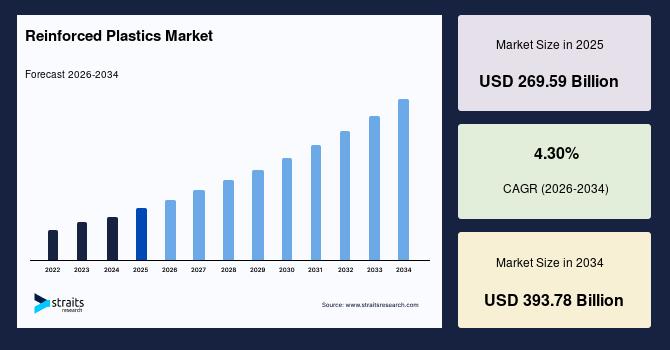
| Market Metric | Details & Data (2025-2034) |
|---|---|
| 2025 Market Valuation | USD 269.59 Billion |
| Estimated 2026 Value | USD 281.18 Billion |
| Projected 2034 Value | USD 393.78 Billion |
| CAGR (2026-2034) | 4.30% |
| Study Period | 2022-2034 |
| Dominant Region | Europe |
| Fastest Growing Region | North America |
| Key Market Players | BASF SE, Solvay SA, Celanese Corporation, Toray Industries, Inc., Hexcel Corporation |
Download Free Sample Report to Get Detailed Insights.
Reinforced Plastics Market Dynamics Emerging Trends in Reinforced Plastics MarketCircular Economy and Composite Recycling Ecosystems
Reinforced plastics are increasingly influenced by end-of-life material recovery approaches that aim to reduce composite waste accumulation. Mechanical grinding is used to convert waste composites into filler-grade material, while pyrolysis processes help recover usable glass fibers from thermoset-rich structures. Chemical recycling methods are also gaining attention for breaking down resin matrices without fully degrading fiber integrity. Alongside recovery technologies, product design is shifting toward recyclable composite structures that allow easier separation of resin and reinforcement. Manufacturers are testing secondary applications for recovered fibers in non-critical components such as panels and casings.
Hybrid and Multi-Material Reinforcement Architectures
A key reinforced plastics market trend is the shift toward hybrid reinforcement systems that combine multiple fiber types within a single composite structure. Glass fibers are increasingly blended with carbon fibers to balance cost efficiency and mechanical strength, while aramid fibers are used to enhance impact resistance in demanding applications. Nanoscale reinforcements such as graphene and carbon nanotubes are also introduced in small proportions to improve stiffness, thermal stability, and crack resistance. Material design focuses on achieving property gradients across a single component, where different zones deliver different performance characteristics.
Market DriversIncreasing Use of Glass Fiber Reinforced Plastics in Automotive Industry and Rapid Expansion of Wind Energy Sector Drives Market
The increasing use of glass fiber reinforced plastics (GFRP) in the automotive industry is a key reinforced plastics market driver, as OEMs accelerate material substitution from metals to composites to achieve weight reduction, improved fuel efficiency, and lower CO2 emissions. GFRP materials are widely used in components such as front-end modules, dashboards, underbody shields, and structural reinforcements due to their high strength-to-weight ratio and cost efficiency. For example, BMW uses GFRP-based composite materials in various body and structural components across its lightweight vehicle platforms to reduce overall vehicle mass and enhance performance.
The rapid expansion of the wind energy sector drives reinforced plastics market demand, particularly through rising demand for epoxy-based composite systems used in wind turbine blade manufacturing. These composites are essential due to their excellent fatigue resistance, structural integrity, and ability to withstand extreme environmental conditions over long operational lifespans. Wind turbine blades rely heavily on epoxy resin systems reinforced with glass or carbon fibers to achieve the required aerodynamic efficiency and mechanical strength. The Siemens Gamesa SG 14-222 DD offshore wind turbine, which uses advanced epoxy-based composite blade structures exceeding 108 meters in length to maximize energy capture efficiency.
Market RestraintsPerformance Uncertainty and Embedded Manufacturing Path Restrain Market
Reinforced plastics face long-term performance uncertainty due to gradual degradation at the fiber–resin interface under vibration, thermal fluctuations, and moisture exposure. Interfacial debonding is difficult to detect through conventional inspection methods, reducing confidence in safety-critical and long-duration applications. As a result, manufacturers often apply conservative design margins, limiting full material performance utilization.
Reinforced plastics manufacturing depends on specialized tooling systems such as molds, autoclaves, and fiber placement equipment designed for specific composite geometries. Switching to alternative material systems requires major tooling redesign and requalification, creating strong manufacturing path dependency. High sunk costs and validation requirements discourage OEMs from frequent material substitution decisions.
Market OpportunitiesExpansion into Electrification Infrastructure Components and Rail Interior & Structural Subsystems Offers Growth Opportunities to Market Players
Expansion of electrification infrastructure creates strong opportunity for reinforced plastics in high-voltage and energy distribution systems. EV charging stations, grid modernization projects, and battery storage installations require materials with high electrical insulation, flame resistance, and thermal stability. Reinforced plastics can replace metal in transformer housings, switchgear enclosures, busbar supports, and protective covers for high-voltage systems. Lightweight construction reduces installation effort and simplifies modular deployment in urban and remote locations. Corrosion resistance improves performance in outdoor and high-humidity conditions, where metal degradation becomes a concern.
Rail & metro infrastructure expansion creates strong opportunity for reinforced plastics market growth. Demand is increasing for lightweight materials in seat frames, luggage racks, interior wall panels, flooring systems, and ceiling modules. Reinforced plastics also find use in door assemblies, cable management systems, and partition structures due to vibration resistance and durability under continuous operation. Fire-retardant grades with low smoke emission support strict passenger safety standards in enclosed transit environments. Material substitution reduces vehicle weight, improving energy efficiency in metro operations.
Regional Analysis Asia Pacific: Market Dominance by Electric Vehicle Expansion, New Energy Vehicle Growth, and Agricultural Mechanization AdoptionThe Asia Pacific reinforced plastics market accounted for a share of 37.48% in 2025 due to the presence of automotive manufacturers in Japan and South Korea, who increasingly use platform-based vehicle architectures to improve production efficiency across multiple models. This approach supports reuse of common structural modules such as front-end carriers, dashboards, underbody shields, and interior support frames. Reinforced plastics fit effectively into this system due to consistent performance, mold flexibility, and compatibility with complex geometries. Standardized platforms allow composite components to be integrated once and deployed across several vehicle variants without major redesign effort. Continuous platform production cycles strengthen long-term material uptake across automotive manufacturing hubs in Asia Pacific.
China's reinforced plastics market is driven by the rapid expansion of electric vehicle and new energy vehicle manufacturing, increasing demand for reinforced plastics across battery systems, body structures, and thermal management components. China produced 3.18 million NEVs during the first quarter of 2025, marking a 50.4% year-on-year increase, while NEV sales reached 3.08 million units. Automakers use glass fiber and carbon fiber reinforced polymers to lower vehicle weight and improve energy efficiency without compromising structural strength. Reinforced plastics also support compact component integration and flexible vehicle design, which are important for modern EV platforms.
The India reinforced plastics market is expanding due to increasing replacement of conventional metal and standard plastic materials in agricultural equipment applications. Manufacturers are adopting reinforced plastics in irrigation systems, sprayer tanks, tractor components, greenhouse structures, and crop storage units because of strong resistance to fertilizers, pesticides, moisture, and harsh outdoor conditions. India's growing agricultural mechanization is increasing demand for reinforced plastics in irrigation systems, tractor components, sprayer tanks, and crop storage structures.
North America: Fastest Growth Driven by Aerospace Innovation, Urban Air Mobility Growth, and Infrastructure Modernization NeedsThe North America reinforced plastics market is expected to have the fastest regional growth with a CAGR of 3.45% during the forecast period due to rising investment in hydrogen production, storage, and transportation infrastructure. Expanding hydrogen mobility applications are increasing demand for reinforced plastics in high-pressure storage tanks and fuel distribution systems. Carbon fiber-reinforced composites provide lightweight performance and high structural strength required for compressed hydrogen storage under extreme pressure conditions. In 2025, the Government of Canada announced a USD 49 million investment in HTEC for a hydrogen liquefaction facility designed to process 15 tons of hydrogen per day and support hydrogen refueling networks in British Columbia and Alberta.
The reinforced plastic market in the US is steadily growing due to the presence of aerospace companies and advanced mobility startups. This is increasing the use of reinforced plastics in electric aircraft and eVTOL platforms to improve flight efficiency and reduce structural weight. Carbon fiber-reinforced composites support lightweight airframe construction, longer battery range, and aerodynamic vehicle designs required for urban air mobility applications. The Federal Aviation Administration has also launched an eVTOL integration pilot program with eight partners to support the deployment of electric air mobility systems across the country.
Canada's reinforced plastics market is driven by severe freeze–thaw cycles across Ontario, Quebec, and Alberta that accelerate cracking, spalling, and corrosion in steel and concrete infrastructure. FRP rebar, bridge rehabilitation systems, pipelining solutions, and structural strengthening applications gain adoption due to higher durability requirements. Reinforced plastics offer strong resistance to moisture ingress and chemical degradation, making them suitable for harsh seasonal conditions and extending the service life of critical infrastructure assets.
Segmentation Analysis By Fiber TypeBy fiber type, Glass fiber reinforced plastics (GFRP) accounted for a share of 62.34% in 2025 due to lower material cost compared to carbon and aramid alternatives, making them suitable for large-scale deployment. High resistance to corrosion supports use in bridges, pipelines, and marine structures exposed to moisture and chemicals. Wide structural applicability strengthens usage across construction, automotive components, and infrastructure reinforcement. Good mechanical strength combined with lightweight properties enables efficiency improvements in transportation systems and civil engineering applications under demanding operating conditions.
The carbon fiber reinforced plastics segment is expected to grow at a CAGR of 5.61% during the forecast period due to increasing adoption in wind energy systems for longer turbine blades that improve stiffness, fatigue resistance, and energy capture efficiency. Growing turbine sizes require materials capable of withstanding high aerodynamic loads and continuous cyclic stress. CFRP enables lighter yet stronger blade structures, enhancing rotational stability and reducing mechanical deformation. Improved rigidity supports better energy conversion under variable wind conditions. High fatigue resistance and long service life make CFRP suitable for both offshore and onshore wind energy installations.
By Manufacturing ProcessBy manufacturing process, injection molding accounted for the largest share of 43.05% in 2025 due to rapid electrification of vehicles and rising use of lightweight housings for sensors, connectors, and battery support structures. Automakers emphasize weight reduction while maintaining structural strength and thermal stability in EV designs. The process enables high-precision manufacturing of complex geometries used in electric drivetrains and electronic systems. Strong electrical insulation enhances safety in high-voltage applications. High-volume production capability supports consistent quality and cost efficiency across standardized automotive components.
The resin transfer molding segment is expected to grow at a CAGR of 4.56% during the forecast period, driven by increasing use in aerospace manufacturing for aircraft structural panels, wing components, and cabin interiors where high strength-to-weight ratio and dimensional precision are essential. RTM ensures uniform resin distribution, reducing void formation and enhancing structural integrity. Lightweight composite components improve fuel efficiency and extend aircraft range. Single-step molding of complex geometries reduces assembly requirements. High fatigue resistance and excellent surface finish support long service life and reliable performance in critical aerospace applications.
By End-use IndustryTransportation led the end-use industry with a share of 31.23% in 2025 due to increasing electrification of mobility systems, which drives use of reinforced plastics in high-voltage insulation parts and thermally stable composite housings across transport equipment. Automotive and rail platforms depend on materials that ensure electrical safety under high energy loads while enabling lightweight construction. Reinforced plastics offer strong dielectric strength, heat resistance, and structural reliability in battery systems, power electronics, and wiring assemblies. Rising integration of electric drivetrains further strengthens adoption in safety-critical and performance-focused transportation applications.
The wind energy segment is expected to register a CAGR of 6.41% during the forecast period due to expanding onshore and offshore wind farms, which increases the use of reinforced plastics in turbine blades, nacelles, and hub structures requiring high strength-to-weight performance. Larger turbine designs depend on composite materials to maintain structural stability under continuous wind load stress. Reinforced plastics enable longer blades that enhance energy capture while reducing overall weight. Offshore installations require strong corrosion resistance and durability in harsh marine environments.
Competitive LandscapeThe reinforced plastics market landscape remains highly fragmented, comprising global chemical and composite manufacturers, mid-sized specialty material producers, and regional fabricators supplying application-specific solutions. Established players compete through large-scale production capacity, advanced material innovation, long-term supply agreements with automotive, aerospace, and infrastructure clients, and strong R&D capabilities focused on performance enhancement and cost optimization. Emerging players focus on niche applications, flexible manufacturing, localized supply chains, and customized composite solutions tailored to specific end-use requirements such as lightweighting, corrosion resistance, and design flexibility. The reinforced plastics market competition also depends on pricing efficiency, material performance consistency, regulatory compliance, and the ability to integrate sustainable and recyclable composite technologies.
List of Key and Emerging Players in Reinforced Plastics Market-
BASF SE
Solvay SA
Celanese Corporation
Toray Industries, Inc.
Hexcel Corporation
Owens Corning
Dow Inc.
DuPont de Nemours, Inc.
SABIC
Mitsubishi Chemical Group Corporation
Teijin Limited
SGL Carbon
Lanxess AG
Avient Corporation
PPG Industries, Inc.
In September 2025, Loop Industries + Taro Plast (Italy) signed a commercial agreement (Sept 2025) for the supply of recycled PET-based polymer feedstock (Loop DMT) and its use in automotive and specialty polymer applications, including reinforced plastics formulations.
In August 2025, Allen Reinforced Plastics (Jaykay Enterprises group) secured multiple defense-grade reinforced composite contracts from Bharat Dynamics Limited (BDL) and BrahMos Aerospace to strengthen India's domestic reinforced polymer composites supply chain for defense systems.
In August 2025, PTC Industries + Kineco Aerospace & Defence signed a strategic MoU (Aug 2025 onwards) to develop hybrid metal–composite reinforced aerospace structures and lightweight reinforced composite assemblies for aircraft and defense platforms.
Report Scope| Report Metric | Details |
|---|---|
| Market Size in 2025 | USD 269.59 Billion |
| Market Size in 2026 | USD 281.18 Billion |
| Market Size in 2034 | USD 393.78 Billion |
| CAGR | 4.30% (2026-2034) |
| Base Year for Estimation | 2025 |
| Historical Data | 2022-2024 |
| Forecast Period | 2026-2034 |
| Report Coverage | Revenue Forecast, Competitive Landscape, Growth Factors, Environment & Regulatory Landscape and Trends |
| Segments Covered | By Fiber Type, By Manufacturing Process, By End-Use Industry |
| Geographies Covered | North America, Europe, APAC, Middle East and Africa, LATAM |
| Countries Covered | US, Canada, UK, Germany, France, Spain, Italy, Russia, Nordic, Benelux, China, Korea, Japan, India, Australia, Taiwan, South East Asia, UAE, Turkey, Saudi Arabia, South Africa, Egypt, Nigeria, Brazil, Mexico, Argentina, Chile, Colombia |
Download Free Sample Report to Get Detailed Insights.
Reinforced Plastics Market Segments By Fiber Type-
Glass Fiber Reinforced Plastics (GFRP)
Carbon Fiber Reinforced Plastics (CFRP)
Aramid Fiber Reinforced Plastics (AFRP)
Natural Fiber Reinforced Plastics (NFRP)
-
Injection Molding
Compression Molding
Pultrusion
Filament Winding
Resin Transfer Molding (RTM)
-
Transportation
Building & Construction
Electrical & Electronics
Wind Energy
Others
-
North America
Europe
APAC
Middle East and Africa
LATAM

Legal Disclaimer:
MENAFN provides the
information “as is” without warranty of any kind. We do not accept
any responsibility or liability for the accuracy, content, images,
videos, licenses, completeness, legality, or reliability of the information
contained in this article. If you have any complaints or copyright
issues related to this article, kindly contact the provider above.
Most popular stories
Market Research

More Story








Comments
No comment