







403
Sorry!!
Error! We're sorry, but the page you were looking for doesn't exist.
The $600 Billion Wake-Up Call: New Splunk Research Reveals Downtime Is A Systemic Business Crisis
(MENAFN- Mid-East Info)
In partnership with Oxford Economics, the Splunk study shows that the financial toll of an outage is immediate, severe, and potentially long-lasting. Downtime has become a systemic business crisis that threatens revenue, brand equity and shareholder value, costing an organization $95 million in lost revenue annually. This is nearly twice the level seen in 2024. “Downtime is inevitable; prolonged disruption is not,” said Kamal Hathi, SVP and GM, Splunk, a Cisco company.“The most resilient organizations are not the ones with the most tools or the biggest vision for AI. They are the ones that align technology with business outcomes, empower people with context, and design systems that bend, but do not break, under pressure.” The Business Impact of Downtime: Technology executives increasingly view the consequences of an outage as more severe. Publicly disclosing a data breach is now considered the most severe hidden cost, with 71% of technology executives rating it as very or prohibitively disruptive, up from 23% in 2024. The report also found that organizations across EMEA reported the highest average downtime-related costs globally, reaching $354 million annually per organization. Many of the industries central to Gulf economies were among the hardest hit globally, including information services and technology organizations, which reported average downtime costs of $402 million annually, followed by energy and utilities ($364 million), retail and consumer goods ($357 million), and financial services ($309 million). The findings come as organizations across the Middle East accelerate large-scale digital transformation initiatives, increasing reliance on cloud environments, AI-driven operations, and third-party digital services. As digital ecosystems become more complex, resilience and end-to-end visibility are becoming increasingly critical to maintaining business continuity and customer trust. Furthermore, downtime triggers a chain reaction of hidden costs, including:
Splunk, a Cisco company, helps build a safer and more resilient digital world. Organizations trust Splunk to prevent security, infrastructure and application issues from becoming major incidents, absorb shocks from digital disruptions, and accelerate digital transformation. Splunk and the Splunk> logo are trademarks or registered trademarks of Cisco and/or its affiliates in the U.S. and other countries. A listing of Cisco's trademarks can be found at . Third-party trademarks mentioned are the property of their respective owners. The use of the word“'partner”' does not imply a partnership relationship between Cisco or its affiliates and any other company.
-
$600 Billion Annual Impact: Aggregate downtime costs for the Global 2000 have soared 50% in two years.
-
$15,000 Per Minute: The average cost of downtime for organizations, highlighting the immediate financial impact of service disruptions.
3.4% Stock Price Drop: The average decline in shareholder value following a single downtime incident.
In partnership with Oxford Economics, the Splunk study shows that the financial toll of an outage is immediate, severe, and potentially long-lasting. Downtime has become a systemic business crisis that threatens revenue, brand equity and shareholder value, costing an organization $95 million in lost revenue annually. This is nearly twice the level seen in 2024. “Downtime is inevitable; prolonged disruption is not,” said Kamal Hathi, SVP and GM, Splunk, a Cisco company.“The most resilient organizations are not the ones with the most tools or the biggest vision for AI. They are the ones that align technology with business outcomes, empower people with context, and design systems that bend, but do not break, under pressure.” The Business Impact of Downtime: Technology executives increasingly view the consequences of an outage as more severe. Publicly disclosing a data breach is now considered the most severe hidden cost, with 71% of technology executives rating it as very or prohibitively disruptive, up from 23% in 2024. The report also found that organizations across EMEA reported the highest average downtime-related costs globally, reaching $354 million annually per organization. Many of the industries central to Gulf economies were among the hardest hit globally, including information services and technology organizations, which reported average downtime costs of $402 million annually, followed by energy and utilities ($364 million), retail and consumer goods ($357 million), and financial services ($309 million). The findings come as organizations across the Middle East accelerate large-scale digital transformation initiatives, increasing reliance on cloud environments, AI-driven operations, and third-party digital services. As digital ecosystems become more complex, resilience and end-to-end visibility are becoming increasingly critical to maintaining business continuity and customer trust. Furthermore, downtime triggers a chain reaction of hidden costs, including:
-
Financial and Market Erosion: The study found that the average cost of downtime has reached $15,000 per minute. In addition, organizations see an average 3.4% drop in stock price following a downtime event.
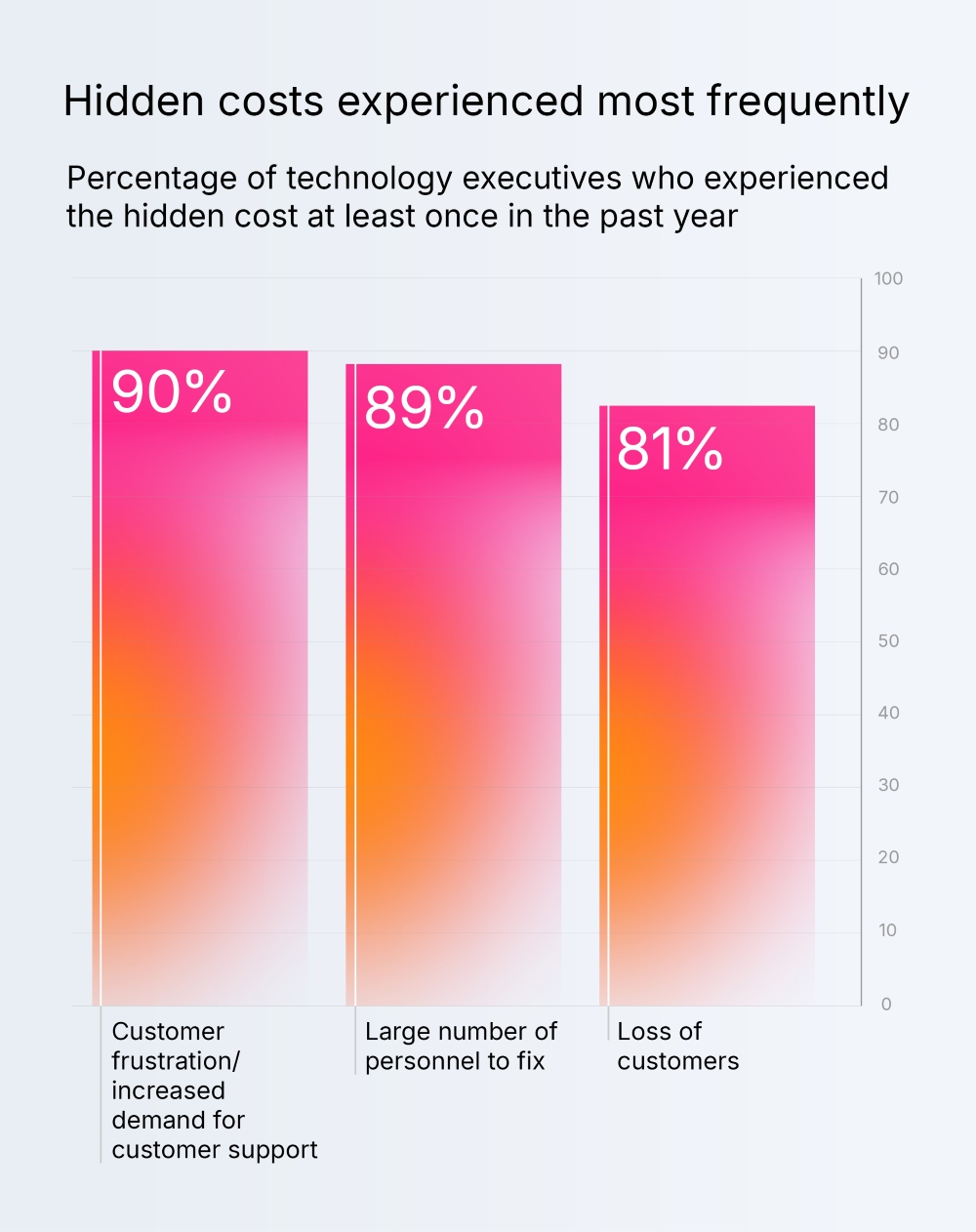
Customer Churn: Eighty-one percent of technology leaders cite the loss of customers as a consequence of downtime, with 47% admitting customers are often or very often the first to detect service degradation or outages.
Escalating Ransomware Costs: Ransomware payouts have nearly tripled since 2024, now reaching $40 million on average, making them one of the most significant direct financial burdens.
Regulatory Exposure: Regulatory fines have reached an average of $51 million per organization, with 57% of technology executives now viewing these penalties as very or prohibitively disruptive.
Operational Drag: A staggering 89% of tech leaders cite the need for large numbers of personnel to fix issues. Nearly all (90%) tech leaders report increased demand for customer support with 76% of finance and 74% of marketing executives feeling the pressure as well.
Brand Recovery: Nearly 20% of marketing professionals report that it takes an entire quarter to recover brand health following remediation.
-
Higher Resilience for AI Experts: 74% of these experts avoided the need to publicly disclose a data breach last year, compared to just 54% of non-experts.
Customer Retention: These expert organizations are nearly three times more likely to report that they have never lost customers due to downtime (42% versus 15% for non-experts).
-
Prioritizing Observability: About three-fourths of ITOps and engineering leaders identify end-to-end observability as their top investment priority to improve infrastructure resilience, taking precedence over traditional hardware or data center upgrades.
Automating to Reduce Human Error: Sixty-six percent of ITOps and engineering leaders are prioritizing investments in automation to mitigate the risks of human error, which remains the leading cause of downtime across the technology stack.
Targeting AI Investments: Organizations are focusing their AI budgets on high-impact areas, with 85% of technology leaders prioritizing AI-driven security automation and 65% investing in AI-powered observability to gain deeper, real-time insights into their digital ecosystems.
Splunk, a Cisco company, helps build a safer and more resilient digital world. Organizations trust Splunk to prevent security, infrastructure and application issues from becoming major incidents, absorb shocks from digital disruptions, and accelerate digital transformation. Splunk and the Splunk> logo are trademarks or registered trademarks of Cisco and/or its affiliates in the U.S. and other countries. A listing of Cisco's trademarks can be found at . Third-party trademarks mentioned are the property of their respective owners. The use of the word“'partner”' does not imply a partnership relationship between Cisco or its affiliates and any other company.

Legal Disclaimer:
MENAFN provides the
information “as is” without warranty of any kind. We do not accept
any responsibility or liability for the accuracy, content, images,
videos, licenses, completeness, legality, or reliability of the information
contained in this article. If you have any complaints or copyright
issues related to this article, kindly contact the provider above.
Most popular stories
Market Research

More Story








Comments
No comment