







403
Sorry!!
Error! We're sorry, but the page you were looking for doesn't exist.
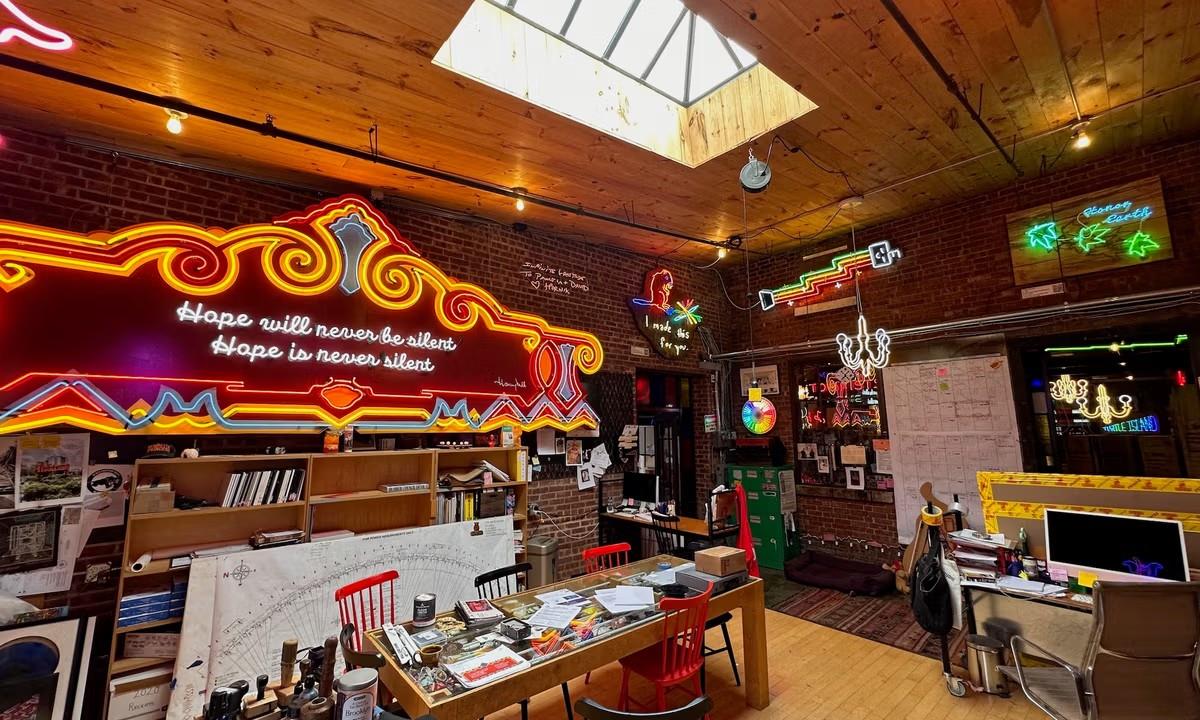
New Residency In Upstate New York Will Give Indigenous Artists Access To Neon Fabrication Studio The Art Newspaper International Art News And Events
(MENAFN- USA Art News)
Native Neon Residency Puts Indigenous Artists in Conversation With Neon
A new residency in upstate New York is reframing neon as both a material and a point of access. Lite Brite Neon Studio, the Kingston-based fabrication shop known for projects with Glenn Ligon, Theaster Gates, and Jeffrey Gibson, is partnering with the Walker Youngbird Foundation to launch Native Neon, a residency for Indigenous artists working with neon for the first time.
The program begins in September, with Sarah Rowe as its inaugural recipient. Rowe, an enrolled member of the Ponca Tribe of Nebraska and of Lakota descent, will receive $50,000, a $10,000 stipend, and an approximately week-long residency at the studio. The finished work is expected to be exhibited in a nearby indoor or outdoor space.
For Rowe, whose practice spans drawings, paintings, and installations, the opportunity opens a new material register. Her recent projects include Water Ledger, a 2025-26 solo exhibition at the John Michael Kohler Arts Center in Sheboyagan, Wisconsin, and Starseeds (2023), a 23,000-square-foot mural in Omaha, Nebraska. Both works reflect her interest in scale, place, and the layered histories embedded in landscape.
Rowe has said she is drawn to neon as a form of drawing with light, and to the possibility of translating line work into illumination itself. The residency is likely to engage the theme of the heyoka, the trickster figure in Lakota tradition that recurs throughout her work, and to use color in ways that unsettle perception. She has described the project as a“liminal” space, one that evokes the“realm of the trickster.”
Lite Brite Neon, founded in Brooklyn in 1999 and moved to a 15,000-square-foot facility upstate in 2017, has long sought to make neon more accessible. That goal aligns closely with the foundation's own concerns. Reid Walker, who founded the Walker Youngbird Foundation, said the medium presents“a substantial barrier to entry,” and that the program is intended to demystify the process while helping Native artists expand their practices.
The collaboration developed over several years, beginning when the foundation acquired Marie Watt's Shared Horizon (Keepers of the Eastern Door) (2024), a neon work fabricated at Lite Brite. Watt also advised on the inaugural residency. The result is a program that treats technical access as a form of cultural support, and places Indigenous artists at the center of a medium that has often been expensive, specialized, and difficult to enter.

Legal Disclaimer:
MENAFN provides the
information “as is” without warranty of any kind. We do not accept
any responsibility or liability for the accuracy, content, images,
videos, licenses, completeness, legality, or reliability of the information
contained in this article. If you have any complaints or copyright
issues related to this article, kindly contact the provider above.
Most popular stories
Market Research

More Story




Comments
No comment