







403
Sorry!!
Error! We're sorry, but the page you were looking for doesn't exist.
Consumer Healthcare Market Size, Share, Growth, Analysis, 2034
| Market Metric | Details & Data (2025-2034) |
|---|---|
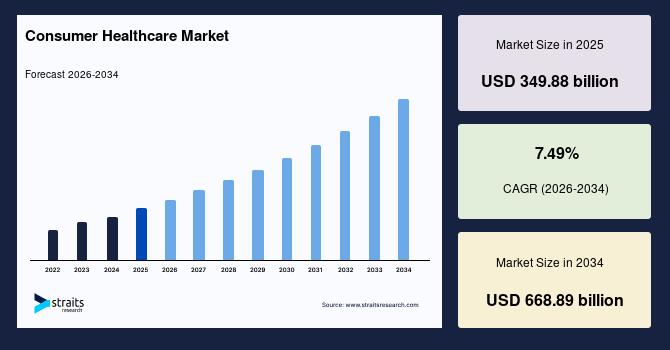
| 2025 Market Valuation | USD 349.88 billion |
| Estimated 2026 Value | USD 375.45 billion |
| Projected 2034 Value | USD 668.89 billion |
| CAGR (2026-2034) | 7.49% |
| Study Period | 2022-2034 |
| Dominant Region | North America |
| Fastest Growing Region | Asia Pacific |
| Key Market Players | Haleon plc, Bayer, Kenvue Inc., Johnson & Johnson Services Inc., Procter & Gamble |
Download Free Sample Report to Get Detailed Insights.
What are the Top Trends in Consumer Healthcare Market?Consumer health organizations are increasingly using connected health devices with OTC and wellness products to develop smart self-care systems. Wearables, such as smart thermometers and app-based diagnostic devices, are now combined with personalized supplements.
Consumer healthcare is shifting toward microbiome-based products targeting the human gut, skin, and immune system. Companies are expanding their research on the human microbiome, focusing on launching the next generation of high-quality solutions to meet consumer needs.
The shift of medications from prescription to OTC products is expanding the growth of consumer healthcare. This permits non-prescription access, supporting consumer self-management.
What are the Driving Factors of Consumer Healthcare Market?Increasing collaborations between large organizations and consumer healthcare brands integrate vitamins, immunity boosters, mental wellness supplements, and at-home diagnostic kits into employee wellness programs. This integration expands institutional demand, drives bulk purchasing, and creates sustained, high-volume consumption of consumer healthcare products.
A growing elderly population across developed countries is driving the demand for vitamins, joint support, and other chronic disease management supplements. The World Health Organization (WHO) stated that, by 2030, 1 in 6 people in the world will be aged 60 years, and the number of people aged 80 years or older is expected to triple between 2020 and 2050 to reach 426 million.
Expansion of manufacturers in developed countries integrates OTC products into wider retail and digital distribution networks, which improves product accessibility, increases purchase frequency, and supports sustained growth in consumer healthcare demand.
Growing health awareness campaigns and public health initiatives integrate preventive nutrition into daily healthcare routines, which increases supplement adoption, drives consistent retail demand, and sustains long-term consumption of consumer healthcare products.
What are the Restraining Factors in the consumer healthcare market?
Quality and labeling risks in OTC products restrain market confidence. Any contamination or labeling error directly affects brand credibility and reduces consumer trust, which slows adoption and limits repeat purchases.
Limited reimbursement coverage restrains premium product uptake. When vitamins and OTC lifestyle products remain out-of-pocket expenses in several European countries, consumers reduce spending, which slows market growth for higher-value offerings.
Rising private-label competition restrains branded product pricing power. Retailer-led store brands apply downward price pressure, reduce brand differentiation, and limit revenue growth for established consumer healthcare companies.
What are the Emerging Opportunities in Consumer Healthcare Market?Direct-to-consumer subscription models deliver personalized vitamin and supplement solutions. This approach strengthens brand loyalty, improves repeat purchases, and supports steady revenue growth.
Expansion of OTC women's health and menopause products acts as a growth factor because unmet needs among women consumers remain high. Broader, intimate and hormonal wellness portfolios attract new user segments and expand overall market demand.
Integration of teleconsultations with OTC subscription services improves continuity of care. Ongoing guidance increases consumer trust, retention, and long-term product adoption.
Use of clinically validated ingredients in functional beverages bridges nutrition and healthcare. This convergence attracts health-conscious consumers and expands the addressable consumer healthcare market.
Regional Analysis North America Consumer Healthcare MarketThe consumer healthcare market in North America had a share of 43.26% in 2025. The growth is supported by strong demand for nutraceuticals and the growing interest in natural wellness products like oils and capsules. Growing health awareness campaigns for preventive health management and strong distribution networks further position North America as a leader in the consumer healthcare market. Consumers in this region actively manage common conditions such as pain, allergies, digestive issues, and vitamin deficiencies through OTC medicines and supplements, which sustains strong retail demand. Large corporations include OTC products and supplements in workplace wellness benefits, which drives bulk purchasing and recurring demand.
Source: Straits Analysis
Asia Pacific Consumer Healthcare MarketAsia Pacific is emerging as the fastest-growing region, growing at a CAGR of 9.50% from 2026 to 2034. This growth is augmented by rapid urbanization and increased disposable income, thereby leading to increased consumer expenditure on wellness and self-care products. The growth of modern retail outlets and e-commerce channels in countries such as India, China, and Australia increases accessibility to OTC medicines, supplements, and self-care products. Improving disposable income allows consumers to spend more on preventive care, supplements, and branded consumer healthcare products.
Europe Consumer Healthcare MarketThe European market is experiencing strong growth, driven by increasing demand for natural and plant-based supplements, which increases the demand for clean label and sustainable products. Expansion of advanced pharmacy-led clinical services and community care services allows pharmacists to assess and treat minor conditions without the need to visit the doctor and increases sales of OTC medication. Older adults in the region increasingly rely on pain relief, joint health, digestive aids, and eye-care products, which supports long-term consumption growth.
Latin America Consumer Healthcare MarketThe Latin American market is growing steadily due to increasing public education on immunity, nutrition deficiencies, and lifestyle diseases, which encourages consumers to adopt self-care products. Gaps in public healthcare access push consumers toward OTC solutions for common ailments, increasing retail demand. Regional production of generics and store-brand OTC products lowers prices and improves availability across middle- and low-income populations.
Middle East & Africa Consumer Healthcare MarketThe Middle East & Africa market is propelled by rapid digital adoption in health services, where pharmacies are leveraging online sales, mobile apps, and remote consultations to enhance accessibility for OTC and wellness products, particularly in the GCC. The trend toward digestive and gut health supplements, owing to increasing awareness of immunity, is also driving demand for probiotics in the region. National programs targeting nutrition, maternal health, and non-communicable diseases indirectly increase consumption of consumer healthcare products.
Product InsightsOver-the-counter (OTC) pharmaceuticals dominated the consumer healthcare market, by product, accounting for 44.10% of the total market share. The segment's leadership is driven by increasing self-medication trends, growing awareness of minor ailment management, and easy accessibility without prescription requirements.
The dietary supplements segment is anticipated to register a CAGR of 8.05% during the forecast period. Growth in this segment is supported by rising preventive healthcare awareness, an increasing aging population, and growing demand for immunity-boosting and wellness products. Consumers are increasingly adopting vitamins, minerals, herbal supplements, and protein-based products as part of daily health routines.
Distribution Channel InsightsThe online channel is expected to register a CAGR of 8.32% of the consumer healthcare market during the forecast period. Growth in this segment is fueled by digitalization, convenience, doorstep delivery, subscription-based purchases, and competitive pricing strategies.
The offline channel segment is expected to register a CAGR of 8.12% of the consumer healthcare market during the forecast period. Its relevance is particularly strong in developing economies and rural regions where digital penetration, logistics infrastructure, and online payment adoption remain comparatively limited.
Competitive LandscapeThe consumer healthcare market is fragmented in nature, with major multinational players like Haleon, Bayer AG, and Reckitt Benckiser Group plc holding significant market share due to strong brand portfolios and worldwide distribution networks. Regional players and private label manufacturers compete through natural formulations, digital channels of sales, and strategic acquisitions that help shape competitive dynamics in this market.
List of Key and Emerging Players in Consumer Healthcare Market-
Haleon plc
Bayer
Kenvue Inc.
Johnson & Johnson Services Inc.
Procter & Gamble
Bayer AG
GlaxoSmithKline plc
Pfizer Inc.
Sanofi S.A.
Reckitt Benckiser Group plc
Abbott Laboratories
Nestlé
Amway
Herbalife Nutrition Ltd.
Nature's Bounty Co.
Sun Pharmaceutical Industries Ltd.
Zydus Lifesciences
Perrigo Company plc
21st Century HealthCare, Inc
Boehringer Ingelheim GmbH
| TIMELINE | COMPANY | DEVELOPMENT |
|---|---|---|
| February 2026 | Zuellig Pharma | Zueling acquired the Zam-Buk and Vapex consumer healthcare brands from Bayer to expand its consumer healthcare portfolio. |
| February 2026 | Johnson & Johnson Services Inc. | Johnson & Johnson Services Inc. launched its new contact lenses in Singapore- ACUVUE OASYS MAX 1-Day MULTIFOCAL for Astigmatism. |
| February 2026 | Kenvue Inc. | The company's brand Neutrogena launched Clear, its first collection formulated to address adult acne. |
| January 2026 | 21st Century HealthCare, Inc. | 21st Century HealthCare, Inc. launched its first direct-to-consumer (DTC) e-commerce store. This platform offers direct access to the company's complete range of trusted wellness products. |
| January 2026 | Amway | Amway India launched 'Beyond Biotin' Nutrilite Biotin C Plus to support healthy hair, skin, and nails from within. |
| November 2025 | Zydus Lifesciences | Zydus received US FDA approval for Verapamil Hydrochloride extended-release tablets for hypertension management. |
| July 2025 | Bayer AG | DKSH Business Unit Healthcare and Bayer expanded access to cardiovascular and women's health products across Southeast Asia. |
Source: Secondary Research
Report Scope| Report Metric | Details |
|---|---|
| Market Size in 2025 | USD 349.88 billion |
| Market Size in 2026 | USD 375.45 billion |
| Market Size in 2034 | USD 668.89 billion |
| CAGR | 7.49% (2026-2034) |
| Base Year for Estimation | 2025 |
| Historical Data | 2022-2024 |
| Forecast Period | 2026-2034 |
| Report Coverage | Revenue Forecast, Competitive Landscape, Growth Factors, Environment & Regulatory Landscape and Trends |
| Segments Covered | By Product, By Distribution Channel |
| Geographies Covered | North America, Europe, APAC, Middle East and Africa, LATAM |
| Countries Covered | US, Canada, UK, Germany, France, Spain, Italy, Russia, Nordic, Benelux, China, Korea, Japan, India, Australia, Singapore, Taiwan, South East Asia, UAE, Turkey, Saudi Arabia, South Africa, Egypt, Nigeria, Brazil, Mexico, Argentina, Chile, Colombia |
Download Free Sample Report to Get Detailed Insights.
Consumer Healthcare Market Segments By Product-
Over-the-counter (OTC) Pharmaceuticals
-
Analgesics
Antipyretics
Allergy Relief
Weight Loss Products
Gastrointestinal Products
-
Online
-
Online Pharmacies
Telemedicine Platforms
Other E-commerce Platforms
-
Supermarkets and Hypermarkets
Pharmacies and Drugstores
Convenience Stores
Other Offline Channels
-
North America
Europe
APAC
Middle East and Africa
LATAM

Legal Disclaimer:
MENAFN provides the
information “as is” without warranty of any kind. We do not accept
any responsibility or liability for the accuracy, content, images,
videos, licenses, completeness, legality, or reliability of the information
contained in this article. If you have any complaints or copyright
issues related to this article, kindly contact the provider above.
Most popular stories
Market Research

More Story








Comments
No comment