






403
Sorry!!
Error! We're sorry, but the page you were looking for doesn't exist.
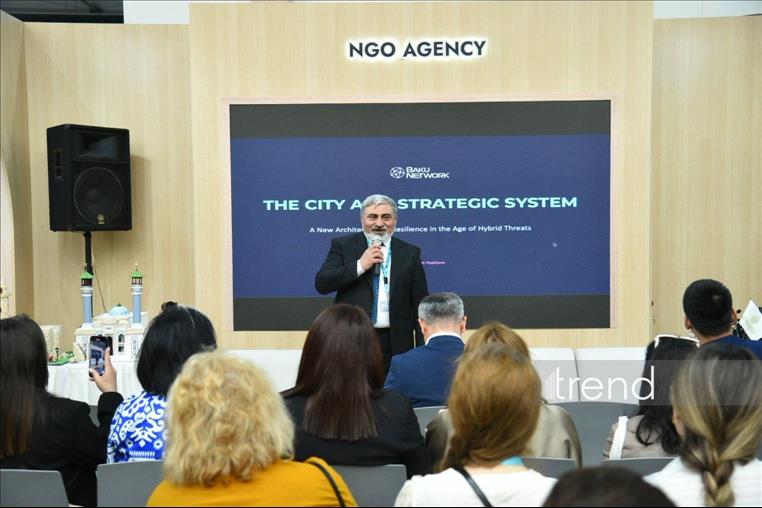
Baku Network At WUF13: Experts Deliberate On Future Urban Environments Under Hybrid Threats (PHOTO)
(MENAFN- Trend News Agency)
BAKU, Azerbaijan, May 21. A high-level panel
discussion titled "The City as a Strategic System" successfully
convened within the framework of the 13th session of the World
Urban Forum (WUF13) in Baku, organized under the strategic
initiative of the Baku Network Public Union for Research and
Analysis, Trend
reports.
During the panel session, international experts and policy analysts cross-examined the development of a completely new structural architecture engineered to safeguard municipal resilience in an era characterized by compounding hybrid threats.
The specialized panel took place within the dedicated pavilion of the Agency for State Support to Non-Governmental Organizations of the Republic of Azerbaijan.
The event featured keynote briefings delivered by Elchin Alioghlu, Deputy Director of Trend News Agency and Head of the Baku Network Public Union for Research and Analysis, alongside Sahil Karimli, Deputy Director of Trend News Agency and Project Director of the Baku Network Public Union for Research and Analysis.
Opening the session, Sahil Karimli pointed out that hosting the World Urban Forum (WUF13) in Baku stands as a major testament to the nation's capacity to manage massive, high-tier multilateral summits with deep professionalism, dignity, and global hospitality.
"It is with immense civic pride that we highlight the execution of this monumental international forum in our country, particularly noting the participation of a record-breaking volume of global delegates. Civil society and non-governmental organizations continue to deliver substantial structural contributions to the long-term outcomes of this summit," Karimli emphasized.
Delivering his address, Elchin Alioghlu stated that modern urban planning workflows must meticulously synthesize historical development patterns with progressive, cutting-edge methodologies targeting municipal environments, utility infrastructure lines, and public spaces.
According to him, the evolution of urban landscapes throughout global history has remained unyieldingly linked to the management of population density parameters, infrastructure expansion constraints, and aggregate quality-of-life metrics.
Alioghlu concurrently directed sharp focus toward the non-negotiable urgency of aggressively expanding green infrastructure grids across modern metropolitan landscapes.
"The cultivation of green municipal zones transcends simple ecological aesthetics or basic landscaping. These green networks exert a direct, quantifiable impact on baseline quality of life, the local social atmosphere, and the general comfort of the urban environment," Alioghlu observed.
According to the director, within the long-term master-planning framework guiding Baku's architectural evolution toward the year 2050, municipal authorities intend to execute a massive, phased scaling of the capital's total green spaces.
The expert further detailed global urbanization trajectories and ongoing structural changes across planetary demographic data.
--
Legal Disclaimer:
MENAFN provides the
information “as is” without warranty of any kind. We do not accept
any responsibility or liability for the accuracy, content, images,
videos, licenses, completeness, legality, or reliability of the information
contained in this article. If you have any complaints or copyright
issues related to this article, kindly contact the provider above.
Most popular stories
Market Research

More Story



Comments
No comment