







403
Sorry!!
Error! We're sorry, but the page you were looking for doesn't exist.
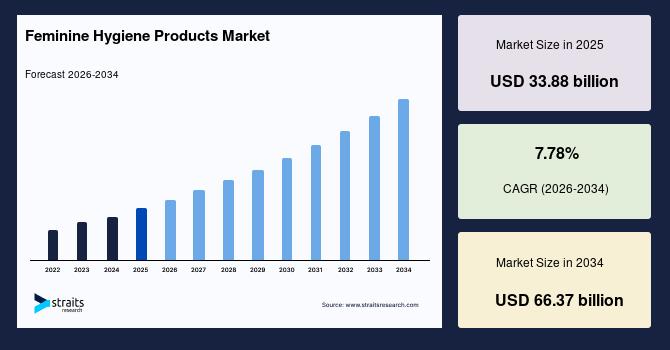
Feminine Hygiene Products Market Size, Share, Growth & Forecast By 2034
| Market Metric | Details & Data (2025-2034) |
|---|---|
| 2025 Market Valuation | USD 33.88 billion |
| Estimated 2026 Value | USD 36.46 billion |
| Projected 2034 Value | USD 66.37 billion |
| CAGR (2026-2034) | 7.78% |
| Study Period | 2022-2034 |
| Dominant Region | Asia Pacific |
| Fastest Growing Region | North America |
| Key Market Players | Procter & Gamble, Kimberly-Clark Corporation, Johnson & Johnson, Essity AB, Unicharm Corporation |
Download Free Sample Report to Get Detailed Insights.
Feminine Hygiene Products Market Dynamics Emerging Trends in Feminine Hygiene Products MarketShift toward Microbiome-friendly Feminine Care Products
The feminine hygiene products market is shifting toward microbiome-friendly and therapeutic products that help maintain vaginal pH balance and prevent infections. Companies such as Procter & Gamble and The Honey Pot Company are introducing plant-based washes and probiotic-infused solutions designed for intimate health. With many women experiencing conditions like bacterial vaginosis and urinary tract infections, demand is increasing for preventive and functional hygiene products. This shift highlights rising awareness, safer ingredient preferences, and a move toward wellness-focused feminine care solutions.
Expansion of Subscription-based D2C Menstrual Care Models
The feminine hygiene products market is witnessing strong growth in subscription-based direct-to-consumer and personalized menstrual care models, which are reshaping how products are accessed and used. Companies such as Cora and Unicharm Corporation provide customized kits based on individual flow patterns and cycle needs. Integration with digital platforms like Flo enables personalized recommendations. Increasing digital adoption is encouraging consumers to choose convenient, home-delivered solutions, improving engagement and brand loyalty, and reducing dependence on traditional retail channels.
Feminine Hygiene Products Market DriversGovernment-Led Menstrual Hygiene Programs and Growing Female Workforce Drives Market
Government-led initiatives improve affordability, accessibility, and awareness. Programs like Pradhan Mantri Bhartiya Janaushadhi Pariyojana supply sanitary pads at highly subsidized prices, significantly reducing cost barriers for low-income populations. Large-scale distribution exceeding 300 million pads annually has expanded product reach in rural and semi-urban areas. According to UNICEF, such initiatives have increased rural usage by 15-20%, creating new consumer segments. Companies like Hindustan Unilever leverage this momentum by introducing affordable product lines, strengthening distribution networks, and driving long-term market penetration.
The increasing number of working women is a key driver of the feminine hygiene products market across major economies. In India, the Government of India's Periodic Labour Force Survey (PLFS) shows that the female Labour Force Participation Rate (LFPR) rose to 35.3% in December 2025, reflecting a steady increase in women entering the workforce. Similarly, in the US, Bureau of Labor Statistics data indicates that the labor force participation rate for women aged 25–54 stood at around 77.8% in Q3 2025, highlighting strong and sustained female workforce engagement in a mature economy. This rising participation of women in both emerging and developed markets is directly boosting demand for convenient, reliable menstrual hygiene solutions suited to active professional lifestyles.
Feminine Hygiene Products Market RestraintsPrice Sensitivity and Product Safety Concerns Restrain Feminine Hygiene Products Market Growth
Price sensitivity is a critical restraint in developing economies where disposable income is limited. Many women prioritize essential household expenses over hygiene products, leading to irregular usage or continued reliance on low-cost traditional alternatives. In countries like India, even small price differences significantly influence purchasing decisions, restricting adoption of branded or premium products. This limits overall consumption volume and slows category expansion. As a result, market growth depends heavily on affordable product offerings, subsidies, and low-cost innovations to ensure wider accessibility.
Concerns regarding product safety and potential health risks restrain the adoption of certain products, such as tampons, which have been linked to conditions like Toxic Shock Syndrome. Increasing scrutiny of chemicals, fragrances, and synthetic materials used in sanitary products raises skepticism about long-term usage. This leads some women to limit usage frequency or shift to traditional or alternative solutions. As a result, safety concerns slow down product adoption, particularly for newer or less familiar product categories in the market.
Feminine Hygiene Products Market OpportunitiesGrowing Inclination toward Preventive Healthcare and Rising Demand for Organic, Biodegradable Products Offer Growth Opportunities for Market Players
The convergence of feminine hygiene with preventive healthcare creates a strong growth opportunity as consumers increasingly focus on holistic intimate wellness. Products are evolving beyond basic hygiene to include solutions supporting pH balance, infection prevention, and overall reproductive health. Integration with health platforms and services enables better education, monitoring, and personalized care. In markets like India, rising health consciousness is encouraging women to adopt such value-added products. This shift allows companies to position offerings within the broader healthcare ecosystem, increasing product relevance, differentiation, and long-term consumer engagement.
The growing demand for organic and biodegradable feminine hygiene products presents a strong market opportunity, driven by increasing consumer awareness of health, sustainability, and environmental impact. Conventional sanitary products often contain synthetic materials and plastics that contribute significantly to landfill waste and environmental pollution, prompting a shift toward eco-friendly alternatives such as organic cotton pads, biodegradable sanitary napkins, and reusable menstrual cups. Rising preference for chemical-free and skin-friendly products, especially among urban and health-conscious consumers, is further accelerating adoption. Government and NGO-led sustainability initiatives, along with stricter environmental regulations on single-use plastics in several countries, are encouraging manufacturers to innovate in sustainable product lines. This transition is creating a high-growth niche segment within the broader feminine hygiene products market, offering significant opportunities for premiumization, brand differentiation, and long-term consumer loyalty.
Regional Analysis Asia Pacific: Market Leadership through Vast Urban Female Population and Retail Penetration Through Local PharmaciesThe Asia Pacific feminine hygiene products market accounted for 34.20% of global revenue in 2025 with the increasing penetration of low-cost rural retail networks such as village micro-stores and cooperative outlets that improve product reach in remote areas. Growth is further supported by rising mobile payment adoption, enabling easier purchase of hygiene products in small-value transactions. Strong cultural shift toward menstrual openness through social media influencers and digital health campaigns is accelerating acceptance and reducing usage stigma across diverse communities.
The Chinese market is driven by its vast urban female population and strong penetration of branded sanitary products. Consumers in Tier-1 and Tier-2 cities increasingly prefer premium ultra-thin pads, organic cotton variants, and panty liners offered by both domestic players (such as Sofy China and Freedom-based local brands) and global companies. Rapid expansion of e-commerce platforms like Tmall and JD has significantly improved product accessibility and discreet purchasing, especially among younger consumers. Growing health awareness and reduced stigma around menstruation, supported by school-based education programs and public health campaigns, are expanding usage in semi-urban regions.
The India feminine hygiene products market is supported by rising female workforce participation in urban and semi-urban cities, which increases demand for convenient on-the-go sanitary solutions during travel and office hours. Expansion of tier-2 and tier-3 city retail penetration through local pharmacies and small kirana (grocery) stores improves product accessibility beyond metros. Increasing adoption of low-cost private label sanitary products from domestic manufacturers supports affordability-driven mass consumption, especially among first-time users in price-sensitive rural and emerging urban populations.
North America: Fastest Growth Driven by Expansion of Subscription-based Delivery Services and Increasing Adoption of Menstrual CupsThe North America feminine hygiene products market is expected to register the fastest growth with a CAGR of 9.76% during the forecast period due to high adoption of premium organic and chemical-free products, especially among health-conscious consumers in the US and Canada, with brands like Cora and Rael gaining traction. Expansion of subscription-based delivery services like Hello Bello-style D2C models supports convenience-driven purchases. Strong penetration of femtech apps such as Flo and Clue drives personalized product usage, while widespread retail availability in pharmacies and supermarkets ensures consistent category accessibility.
The US feminine hygiene products market is expanding due to increasing demand for organic cotton and toxin-free product certifications, as consumers shift toward ingredient transparency standards verified by labels like“OEKO-TEX” and“GOTS.” Growth is also driven by rising adoption of subscription-based replenishment models integrated with digital health tracking apps, improving purchase consistency. Expansion of hospital and university campus vending machines is improving instant accessibility and reducing usage gaps in public spaces.
The Canada feminine hygiene products market is expanding due to rising demand for medically positioned“menstrual wellness” products sold through pharmacy-led channels like Shoppers Drug Mart, where pharmacist recommendations influence purchase decisions. Strong uptake of sustainable reusable products, such as menstrual cups and period underwear, in environmentally regulated provinces like British Columbia, supported by zero-waste policies. Increasing indigenous and remote community outreach programs and improving menstrual equity access in northern territories are accelerating adoption in underserved populations.
Feminine Hygiene Products Market Segmentation Analysis By ProductThe menstrual care products segment is projected to grow at a CAGR of 8.26% revenue share. The growth is driven by increasing adoption of ultra-thin, high-absorbency sanitary technologies improving comfort and mobility. Rising demand for period-specific products like overnight pads and sport variants supports segmentation. Innovation in discreet packaging and odor-control features enhances user convenience, driving repeat purchases and premium product adoption within menstrual care categories.
The cleaning & deodorizing products segment is expected to grow at a CAGR of 8.69% during the forecast period, fueled by increasing adoption of pH-balanced intimate washes designed for daily microbiome protection. Rising demand for fragrance-free and hypoallergenic formulations supports sensitive-skin usage. Innovation in multifunctional products combining cleansing, odor control, and infection prevention enhances convenience, driving frequent usage and category expansion.
By Distribution ChannelSupermarkets & hypermarkets dominated the distribution channel segment with a share of 34.81% in 2025 due to strong in-store product visibility through dedicated feminine care aisles and shelf placements influencing impulse purchases. High-frequency grocery visits ensure routine stocking behavior. Private label offerings at competitive prices and bulk purchase discounts attract price-sensitive consumers, driving consistent volume sales.
The e-commerce segment is expected to have the fastest growth, registering a CAGR of 9.12% during the forecast period, boosted by discreet purchase behavior enabled by anonymous packaging and privacy-focused checkout options, which encourage sensitive-category buying without social hesitation. Expansion of hyper-personalized recommendations using browsing history and cycle-tracking data improves product relevance and conversion rates.
Competitive LandscapeThe feminine hygiene products market is moderately consolidated, led by global medical device companies such as Johnson & Johnson, Medtronic, Boston Scientific, and Abbott. These leaders offer integrated portfolios of ablation catheters, mapping systems, and procedural support, and they differentiate through advanced technologies like pulsed field ablation, robotic-assisted systems, and real-time imaging integration. Mid-sized and regional players compete with niche innovations, cost-effective solutions, and specialized applications in oncology or cosmetic procedures. Strategic partnerships with hospitals, specialty centers, and technology providers are strengthening market positioning and driving wider adoption of minimally invasive ablation therapies.
List of Key and Emerging Players in Feminine Hygiene Products Market-
Procter & Gamble
Kimberly-Clark Corporation
Johnson & Johnson
Essity AB
Unicharm Corporation
Edgewell Personal Care
Kao Corporation
Ontex Group NV
Hengan International Group
Unilever
Glenmark Pharmaceuticals Ltd
First Quality Enterprises Inc.
Fujian Hengan Group
Daio Paper Corporation
Lil-Lets Group Ltd
Maxim Hygiene
-
In August 2025, Sirona partnered with M3M India to deploy multi-product feminine hygiene vending machines across malls, commercial complexes, and public washroom infrastructure.
In May 2025, Stayfree partnered with O.B to expand tampon product line introduction in India, hybrid feminine hygiene product portfolio expansion, and retail + pharmacy channel integration.
| Report Metric | Details |
|---|---|
| Market Size in 2025 | USD 33.88 billion |
| Market Size in 2026 | USD 36.46 billion |
| Market Size in 2034 | USD 66.37 billion |
| CAGR | 7.78% (2026-2034) |
| Base Year for Estimation | 2025 |
| Historical Data | 2022-2024 |
| Forecast Period | 2026-2034 |
| Report Coverage | Revenue Forecast, Competitive Landscape, Growth Factors, Environment & Regulatory Landscape and Trends |
| Segments Covered | By Product, By Distribution Channel |
| Geographies Covered | North America, Europe, APAC, Middle East and Africa, LATAM |
| Countries Covered | US, Canada, UK, Germany, France, Spain, Italy, Russia, Nordic, Benelux, China, Korea, Japan, India, Australia, Taiwan, South East Asia, UAE, Turkey, Saudi Arabia, South Africa, Egypt, Nigeria, Brazil, Mexico, Argentina, Chile, Colombia |
Download Free Sample Report to Get Detailed Insights.
Feminine Hygiene Products Market Segments By Product-
Menstrual Care Products
-
Sanitary
Napkins
Tampons
Menstrual Cups
Others
-
Feminine Powders
Soaps and Washes
Others
-
Supermarkets
Drug Stores and Retail Pharmacies
E-commerce
Retail Stores
Others
-
North America
Europe
APAC
Middle East and Africa
LATAM

Legal Disclaimer:
MENAFN provides the
information “as is” without warranty of any kind. We do not accept
any responsibility or liability for the accuracy, content, images,
videos, licenses, completeness, legality, or reliability of the information
contained in this article. If you have any complaints or copyright
issues related to this article, kindly contact the provider above.
Most popular stories
Market Research

More Story








Comments
No comment