




403
Sorry!!
Error! We're sorry, but the page you were looking for doesn't exist.
E-Invoicing Becomes A Foundation For Broader Digital Tax Compliance
(MENAFN- Khaleej Times)
As e-invoicing becomes a foundation for broader digital tax compliance, enterprises are navigating growing complexity across filings, reconciliation, audits, and cross-border regulation.
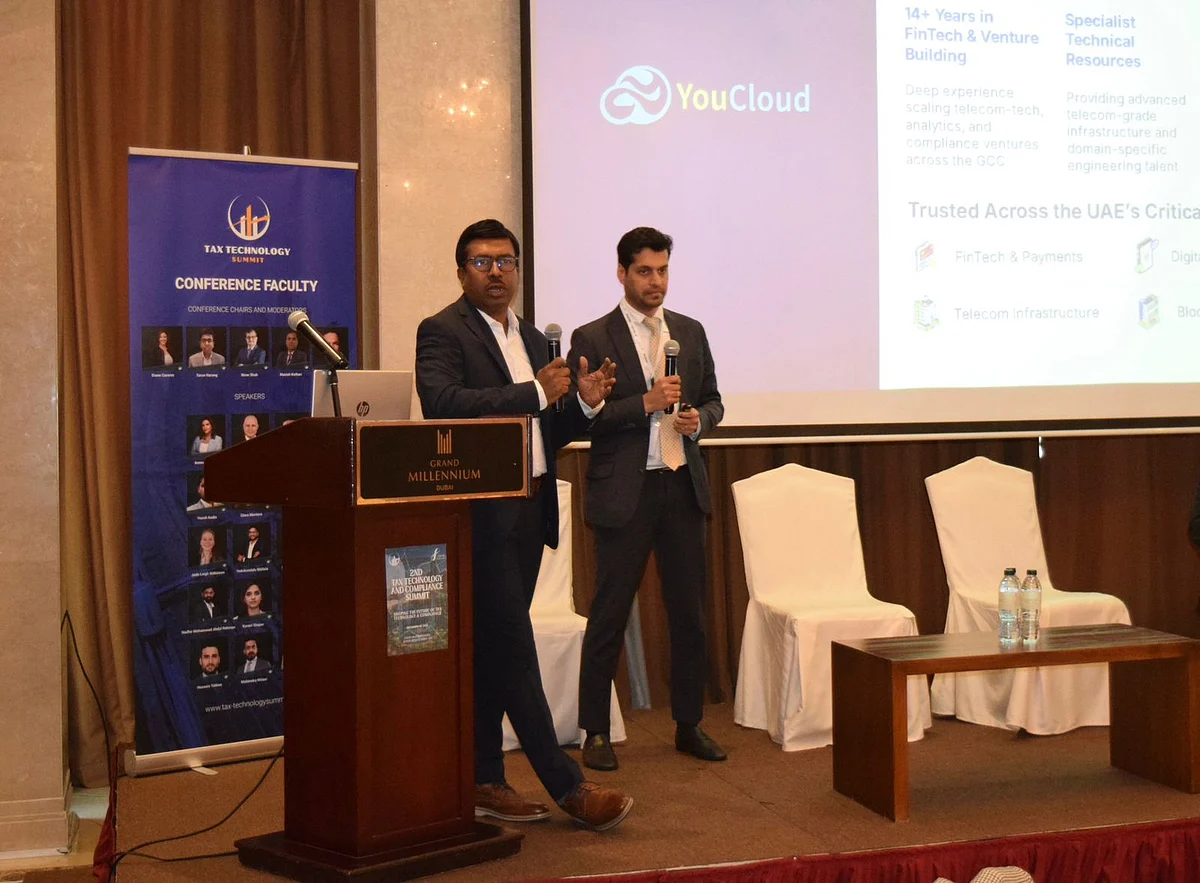
During the Tax Technology Summit 2025, held on 6 December in Dubai, Debasish Guha Roy, Director, COVORO YouCloud and Paresh Bafna, Director, COVORO YouCloud offered their insights about how tax technology is evolving to meet these demands. As a Diamond Sponsor, COVORO YouCloud showcased its FTA aligned e-invoicing platform, ERP integrations, and real-time compliance capabilities.
Recommended For YouParesh Bafna, Director, COVORO YouCloud:
What role do AI and machine learning play in enhancing tax automation solutions?
AI is most effective in non-deterministic processes. If a process moves directly from point A to point B, it can be handled through predefined rules and logic without the need for AI. However, when there are multiple, unpredictable paths between point A and point B, intelligence is required.
Tax compliance operates in this non-deterministic environment. While some rules are straightforward and can be managed through defined logic, many require interpretation, contextual understanding, and learning. This is where AI becomes essential.
Enterprises also receive vast volumes of transactional documents in multiple formats. Traditional OCR solutions struggle with extreme variation, such as processing tens of thousands of invoice formats from tens of thousands of vendors. Agentic AI is specifically designed to handle such variability. It understands unstructured patterns, identifies critical data elements across formats, and processes documents accurately.
COVORO YouCloud's proprietary platform uses multiple self-learning mechanisms combined with a human-in-the-loop framework. The system continuously learns from corrections, reduces errors, and minimizes hallucinations over time.
What is the USP of your solution, considering that many providers will be offering similar services?
YouCloud has been operating in this domain for over 14 years. During this time, we have worked closely with both tax authorities and enterprises across multiple countries. This experience has allowed us to observe a clear and consistent pattern in how tax technology evolves once e-invoicing is introduced.
Typically, within five to ten years of invoicing implementation, a much broader compliance ecosystem becomes necessary to manage filing, reconciliation, audits, notices, and litigation. Our key differentiator is that we offer a single, unified platform that addresses all of these requirements from one place.
In most cases, enterprises purchase one solution to solve one problem and then add additional solutions later. This results in fragmented systems that operate in silos and do not communicate with each other. As a consequence, CFOs struggle with limited visibility, delayed insights, and incomplete data.
COVORO YouCloud's platform is singular, unified, and agent-enabled by AI. All modules are fully integrated and communicate seamlessly, enabling multiple departments to work from the same data source. This unified architecture is our core USP.
Could you briefly explain the other modules within your platform?
Once e-invoicing is implemented, transactional sales data begins flowing to the tax authority. When a seller issues an invoice, that transaction becomes a purchase for the buyer. This visibility allows the authority to start auto-populating tax returns by calculating input VAT from recorded transactions.
However, automation introduces complexity. Not all transactions are eligible for tax credits, and companies calculate VAT based on their own interpretations. They do not have visibility into how their suppliers or customers are complying. While enterprises see only their own data, the Federal Tax Authority sees all parties and identifies mismatches. This often results in compliance notices.
To address this lifecycle, our platform includes multiple advanced modules, such as automated tax filing, notice management, and reconciliation systems. Reconciliation is critical because when a notice is issued, enterprises must validate their records, generate accurate data points, and submit structured responses. Our tools enable reconciliation both reactively, after a notice is received, and proactively, to reduce the likelihood of notices altogether.
In addition, the platform offers export–import automation. The UAE is a highly trade-driven economy, and export-import compliance is particularly sensitive. Transactions must be evaluated against sanctions lists, country-of-origin rules, free trade agreements, and other regulatory requirements. This complexity requires intelligent automation.
COVORO YouCloud's export–import module is designed to manage these challenges comprehensively, enabling enterprises to remain compliant while operating efficiently in global trade environments.
Debasish Guha Roy, Director COVORO YouCloud
What was the thought process, the concept, and the motivation behind starting the company? How did it all begin?
It has been a long journey. I have been in the UAE for nearly 30 years. I began my career as a telecom professional and went on to run a large systems integration company in the UAE.
In 2011, we started YouCloud with a very clear mandate. We did not want to resell products, which was the common approach in the region. Instead, we wanted to build our own product intellectual property. That decision led us to focus on product development from day one.
Our first product was in the payments space, which gave us a solid foundation. From there, we identified the domains we wanted to expand into. Payments came first, telecom was our base, and then we added blockchain and regulatory technology.
We formed several joint ventures to support this vision. One of these is a regulatory technology joint venture between YouCloud and COVORO, which we announced at the Tax Technology Summit. For blockchain, we partnered with Print-to-Block, focusing on tax solutions. These tax solutions are integrated with payments and retail tax platforms to enable supplier financing and SMB financing.
All of these systems are interconnected. We are now adding blockchain as an additional layer to enhance security. One consultant recently highlighted the need to secure invoices while they are in transit to the Federal Tax Authority, and blockchain significantly strengthens this capability.
Ultimately, I see myself as a technology entrepreneur with a clear mandate to build proprietary products and technology ventures, rather than operate solely as a system integrator or reseller. Very few companies take this path.
How does your ERP integration capability support large enterprises with complex systems?
ERP integration is often described as simple, but in reality, it is quite complex. The most critical aspect is understanding every data field that the ERP system generates, which by itself is a significant undertaking.
However, because we have executed these integrations across multiple countries, most data structures already align. Typically, about 90 to 95 percent of the required data fields match out of the box. If there is any variation, we simply add the missing fields.
On one side, we connect with ERP systems such as SAP, Oracle, and Microsoft. On the other side, we integrate with the taxation systems. Once both ends are connected, we fine-tune the integration to ensure accuracy and compliance.
What challenges do you face during the fine-tuning phase of integration?
Integration is a shared responsibility. It does not depend solely on us. If the ERP vendor is slow to respond or implement changes, deployment timelines can be affected.
We occasionally face such challenges with large vendors like SAP and Oracle. This is why it is essential for enterprises to select the right Access Service Provider (ASP) partner, one who actively manages alignment with ERP version upgrades.

Legal Disclaimer:
MENAFN provides the
information “as is” without warranty of any kind. We do not accept
any responsibility or liability for the accuracy, content, images,
videos, licenses, completeness, legality, or reliability of the information
contained in this article. If you have any complaints or copyright
issues related to this article, kindly contact the provider above.
Most popular stories
Market Research

More Story








Comments
No comment