




403
Sorry!!
Error! We're sorry, but the page you were looking for doesn't exist.
Qatar Museums Unveil Big-Scale Exhibitions, Performances And Cultural Activities
(MENAFN- Khaleej Times)
What is Islamic architecture - how do you define it and what is the essence of it?' It was a question that preoccupied I.M. Pei in the twilight of his great life. The Chinese-American architect, whose bold designs and geometric purity reshaped skylines from Hong Kong to Washington, embarked on a series of extensive travels from the Gulf region to North Africa, with the explicit aim of unlocking the sacred mysteries behind the beauty of Islamic architecture. Finally, his search ended in Cairo, where he fell under the spell of the ninth-century mosque of Ibn Tulun. Egypt's oldest mosque, particularly its ablution fountain, inspired the Pritzker Prize-winning Pei's design for what is today one of Qatar's most iconic buildings and, undoubtedly, Doha's very own crown jewel - the Museum of Islamic Art (MIA).
Since its opening in 2008, this museum on Doha's sun-dappled Corniche has rivalled Pei's finest masterpieces that lay scattered across the globe, such as Suzhou Museum in China, the Pyramid of Louvre Museum in Paris and the East Building of the National Gallery of Art in Washington. The MIA project started - and would go on to become what Dezeen magazine dubbed“the first mega-museum in the Gulf” - with a competition in 1997. But when that did not bear fruit, Qatar's ruler Hamad bin Khalifa Al Thani, or Father Amir as he's fondly known, suggested Pei's name. During the initial research and building process that began in earnest around the 2000s, Pei read Islamic texts and architecture. Working closely with Amir and guided by both Qatar's ambitious vision and its famous hospitality, he developed a close relationship with Qatar's royal family. All these encounters changed Pei's life, proving so transformative that he himself once admitted that it was the toughest commission of his career but ultimately the most rewarding as MIA was more than just a museum, it became his window into one of the world's greatest religions and cultures.
Recommended For You US President Trump warns Israel against 'interfering' in SyriaNo wonder that Pei cut a cake designed to resemble the MIA on his momentous hundredth birthday. When asked why, he replied that working on MIA revealed to him a“whole new world” that he knew little about. Shortly after, Pei passed away in 2019 (aged 102), leaving behind a visionary body of work. Now, all these incredible anecdotes behind the museum, alongside his rich modernist legacy, are being celebrated spread across two extraordinary retrospectives in Doha. Presented in collaboration with M+ Hong Kong, the first one is a travelling exhibition titled I. M. Pei: Life Is Architecture at ALRIWAQ, which assembles over 400 works (including original drawings, architectural models, photographs, films, and archival documentation) spanning six thematic sections, painting a picture of an architect whose work has remained timeless and universal. On the other hand, it is fitting that the second exhibition, entitled I.M. Pei and the Making of the Museum of Islamic Art, is being held within the very halls of the Museum of Islamic Art that he helped design. Through rare original sketches, models, early photographs and archival documents, it traces the creative and conceptual journey behind one of the 21st century's most acclaimed architectural marvels.
Jointly organised by MIA, upcoming Art Mill Museum and ALRIWAQ and curated by Aurélien Lemonier and Zahra Khan of Art Mill Museum, in close collaboration with MIA's deputy director of curatorial affairs Dr Mounia Chekhab Abudaya, this sweeping show focuses mainly on Pei's creative fireworks for the MIA. Though initially hesitant, the Guangzhou-born architect famously came out of retirement to design MIA. There's a sense of simplicity and beauty in Islamic geometry and it was precisely these elements, along with the local context of Qatar's desert landscape, that Pei sought to immortalise in his design approach. Apparently, he requested the Father Amir for a specially constructed island in the bay so that he could channelise Doha's stark sunlight and ensure that future buildings would not block the desert sun from shining on his most cherished creation.“He was very forward thinking. In fact, when you look at the photographs of one of the major design inspirations for MIA - the sabil of Ibn Tulun - it stands within a large, empty courtyard,” co-curator Zahra Khan tells wknd.“Pei believed the essence of Islamic architecture was brought out by geometry and hard angles, desert sun and water, motifs that he included in the design for the Museum of Islamic Art,” adds Khan. Pei opted for cream-coloured limestone from France with jet-mist granite from the US, making the MIA an austere-yet-grand museum complex that today houses one of the most comprehensive collections of Islamic art in the world.
The Museum of Islamic Art's success also tells us something about Qatar's cultural ascent - both have evolved alongside each other, with MIA serving as a beacon of hope and inspiration for this nation. And while Qatar has flourished over the decades, it is commendable that it has sought to pour its oil-based riches into cultural infrastructure. This commitment to art and architecture is evident elsewhere, too. You merely need to look at the well-intentioned, nicely-researched Countryside: A Place to Live, Not to Leave at the Qatar Preparatory School and the National Museum of Qatar (both on view until mid-next year) and you will realise that Qatar regards art and architecture as the ultimate soft power that can be harnessed to build communities, create unity in diversity and inspire social change. A brainchild of the Office of Metropolitan Architecture aka OMA, a global architectural firm and its research think-tank AMO, this project has been curated by the legendary Dutch architect Rem Koolhaas along with Samir Bantal.
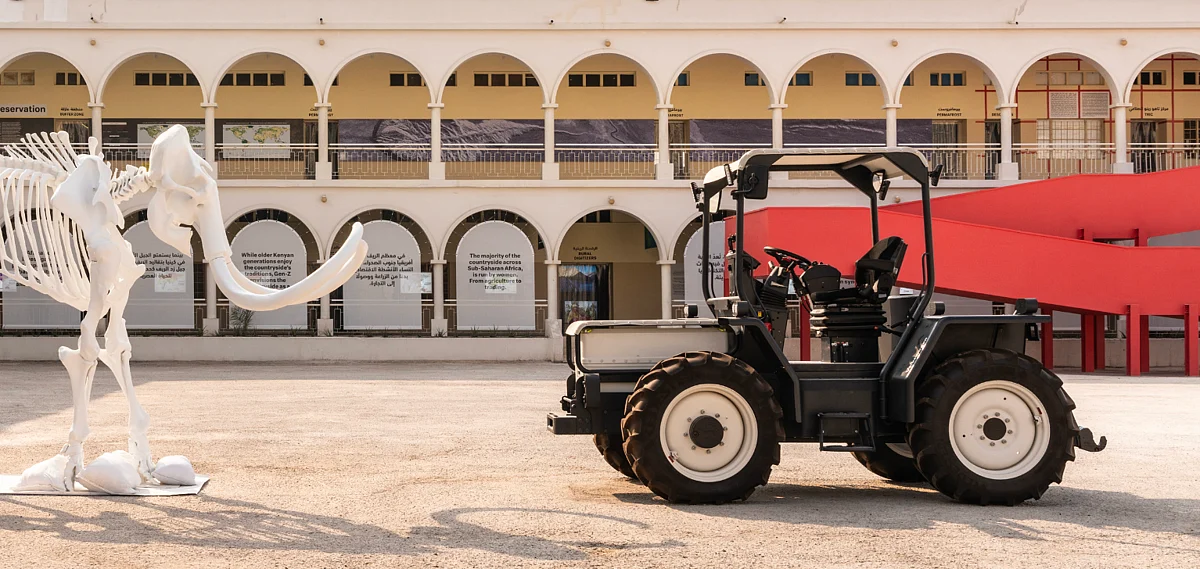
Building on a version first unveiled at the Guggenheim New York in 2020, Countryside: A Place to Live, Not to Leave confronts the ills of modern living versus the dynamic rhythms of rural ways of living. It argues that global urbanisation, increased digital connectivity and rapid modernisation ought to make us pause and reconsider an alternative, more so in the post-Covid era - what if village and rural life can complement urban paradigms in the future, eventually bridging the gap between rural innovations and urban technologies and between traditional wisdom and modern, scientific knowledge? As part of the exhibition's conceptual device, Koolhaas and Bantal have drawn an electrifying arc that spans geographies from Middle East, Africa, Central Asia to the uninhabited realms of China - these routes were once historically united by the Silk Route - to show us that the real action might, perhaps, reside in the countryside. On the grounds of the Qatar Preparatory School, visitors can observe a range of different prototypes and experiments, where new technologies in irrigation and sustainable food practices, hydroponics and greenhouse design converge, reflecting how sustainable progress is being made through locally adapted solutions these days. For example, Volkswagen Group has installed an electric tractor at the exhibition's outdoor site. First shown as a model concept during the Countryside's first iteration at the Guggenheim museum, it is today proudly operating under real-world conditions in Rwanda. The solar-powered e-Tractor serves as a tangible proof of innovation turned into reality.
From MIA and the 1960s Qatar Preparatory School (the alma mater of none other than Hamad bin Khalifa Al Thani himself) to the poetic National Museum of Qatar (designed by Jean Novel to evoke the forms of desert rose), this is the high art season in Doha with cultural experiences to be found almost anywhere - across museums, galleries and even public parks. Literally, amidst the green haven of the MIA park, the Thai contemporary artist Rirkrit Tiravanija gave audiences a taste of a shared meal in the form of a live artwork. Everyone was invited to break bread with a stranger. Last but not the least, now in its 15th year, Mathaf: Arab Museum of Modern Art is commemorating its anniversary by hosting two remarkable shows. Resolutions: Celebrating 15 Years of Mathaf offers a fresh perspective on the museum's renowned permanent collection, mapping the evolution of Arab modernism through key moments in Mathaf's institutional history. Mathaf opened in 2010 to fulfil the need for a global representation of modern and contemporary art from the Arab world and surrounding regions. Today, both these exhibitions reflect on the museum's evolving narrative as well as its reputation as one of Qatar's most authentic spaces that continues to champion Arabic voices.
A confluence of cultural, economic and technological changes have transformed Doha in recent decades. Much of it is led by Qatar Museums and its charismatic chairperson, Sheikha Al Mayassa bint Hamad bin Khalifa Al Thani. Since its founding in 2005, Qatar Museums and Sheikha Al Mayassa have helped Qatar steer a different and distinct path in the global landscape - she has spearheaded her nation into what one might call 'cultural modernity'. In her speech for 'Evolution Nation' recently, which also marked the 50th anniversary of the National Museum of Qatar and the 20th anniversary of Qatar Museums, she told a packed gathering,“We curate our own narratives - layer after layer, and with each project and platform, we amplify the voices of talent in our region.” What stood out, though, was that she started her keynote addressing the guests as fellow“creatives, friends and dreamers”. Dreamers - that's the operative impulse and 'dreaming big' could well be the reason why Qatar has emerged as one of the 21st century's leading cultural superpowers.
...

Legal Disclaimer:
MENAFN provides the
information “as is” without warranty of any kind. We do not accept
any responsibility or liability for the accuracy, content, images,
videos, licenses, completeness, legality, or reliability of the information
contained in this article. If you have any complaints or copyright
issues related to this article, kindly contact the provider above.
Most popular stories
Market Research

More Story


Comments
No comment