










403
Sorry!!
Error! We're sorry, but the page you were looking for doesn't exist.

Kashmir's Quiet Warning: The Dark Side Of The Global Green Push
(MENAFN- Kashmir Observer)
Representational Photo
Representational Photo
By Falak Aslam
In a sleepy hamlet of Gurez, where apple trees bloom against receding snowlines, Abdul Rehman tends to his orchard with quiet worry.
“Snow used to fall in November,” he says, pulling his shawl tighter.“Now it waits till January, and the flowers bloom too early.” The shift has disrupted pollination, lowered yields, and deepened uncertainty.
Rehman is no climate policy expert. Yet, his life, like millions across the Global South, is shaped by a crisis born far from his orchard and intensified by solutions that increasingly exclude him.
As the world accelerates toward“green” innovation, the reality beneath the slogans is more complicated. Behind every electric car and solar panel lie hidden environmental costs, extractive supply chains, and deepening inequalities.
Read Also No Content AvailableIn places like Kashmir, where clean energy transitions are hailed as the future, questions persist: who gets to be green, and who pays the price?
The historical imbalance is stark. The United Kingdom, often celebrated for its 2008 Climate Change Act and global climate diplomacy, remains the fifth-largest historical emitter of carbon dioxide, according to the Energy and Climate Intelligence Unit. Its industrial ascent relied on coal-fired progress, resource extraction from colonies, and vast deforestation campaigns.
Today, even as it cuts emissions domestically, it exports much of its environmental footprint through supply chains anchored in the Global South.
Green technology has become the new frontier of global power. Developed nations dominate patents, set prices, and impose tariffs.
In India, solar energy, a sector with vast potential, is slowed by a 40% customs duty on imported solar modules and 25% on solar cells. The goal is to encourage domestic manufacturing, but the result is delayed adoption and inflated costs for startups and communities eager to transition.
Shazia Qadir, an engineering graduate in Pulwama, South Kashmir, runs a modest rooftop solar installation business.“We want to build locally,” she says,“but the components are still imported, and prices have risen. People are interested, but affordability is a hurdle.”
In Kupwara district, an off-grid village near the Line of Control recently installed a micro-hydel power unit funded by a grassroots NGO. For the first time, students are studying at night under consistent lighting. Yet such projects remain rare and underfunded. Kashmir, despite its topographical potential for hydro and solar power, is still heavily dependent on electricity imported from the northern grid. In winters, daily power cuts last up to 10 hours in many rural areas.
Even more troubling is the human cost behind green commodities. In the Democratic Republic of Congo, an estimated 40,000 children work in hazardous cobalt mines, according to UNICEF. Cobalt is essential for electric vehicle batteries. A 2024 investigative report, Beneath the Green, revealed that 56 percent of women living near industrial mining zones have experienced severe reproductive health issues - conditions linked to prolonged exposure to toxic metals.
In theory, green technologies are designed to reduce harm. In practice, they often relocate it.
An electric vehicle, for instance, emits up to 60 percent more carbon during production than a conventional petrol car, largely due to the energy-intensive mining and refining processes of lithium, cobalt, and nickel. For every tonne of lithium extracted, between five and fifteen tonnes of carbon are released. Water use is equally intensive. In South America's lithium triangle, evaporation ponds used in lithium mining have contributed to groundwater depletion, threatening indigenous farming communities.
India, meanwhile, has set an ambitious target: 80 million electric vehicles by 2030. Yet much of the electricity to charge them still comes from coal-fired power plants. While EVs may reduce tailpipe emissions, they don't eliminate upstream pollution. And they risk sidelining simpler, lower-impact alternatives like public transport, cycling infrastructure, or biogas - solutions that are accessible, affordable, and time-tested.
In Ladakh, high in the Trans-Himalayas, 32-year-old schoolteacher Sonam Angmo commutes daily by bicycle.“It's not about being modern or backward,” she says.“It's about what works without hurting the mountains.”
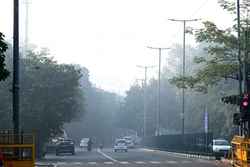
Kashmir, despite its potential, remains largely excluded from national-level green pilot projects. There is no major EV policy tailored to the region's terrain and climatic needs. Srinagar, a city of over 1.2 million people, continues to battle choking winter smog - made worse by diesel-run gensets and unregulated brick kilns that emit particulate matter in large quantities. In a 2023 study by the Jammu and Kashmir Pollution Control Board, PM2.5 levels in Srinagar exceeded safe limits on over 60 percent of winter days.
The problem extends beyond urban centers. In Pahalgam, a famous tourist spot in South Kashmir, the introduction of more diesel-run transport vans to meet visitor demand has spiked local air pollution.“Tourism boosts our economy,” says Fayaz Ahmad, a hotelier in the area,“but no one is talking about sustainable practices. There's no electric public transport option. No incentives. Not even a waste segregation system.”
Meanwhile, in the wetlands of Hokersar, one of Kashmir's designated Ramsar sites, degradation has accelerated. Once a thriving bird sanctuary and natural flood buffer for Srinagar, the wetland now struggles under encroachments, waste dumping, and shrinking water levels. Green transitions that ignore local ecosystems are not only incomplete - they can be actively destructive.
Some countries have taken different paths. Norway, often cited as a model, generates 96 percent of its electricity from hydropower - much of it designed to minimize methane emissions by locating reservoirs in high-altitude, low-vegetation zones.
These projects are decades in the making, built with long-term environmental safeguards. India's approach, in contrast, increasingly leans on expanded mining initiatives under the newly launched Critical Mineral Mission. The 2024–25 Union Budget allocates significant resources toward domestic extraction of rare earths. The aim is strategic autonomy; the risk is replicating old, extractive patterns in a new key.
International agreements like the Sustainable Development Goals call for“the promotion, transfer, and dissemination of environmentally sound technologies” to developing countries. But mechanisms for meaningful technology sharing remain vague, underfunded, or politically blocked. A recent UNCTAD report noted that fewer than 20 percent of green tech patents are shared across borders - and most of those flow between wealthy countries.
“If the Global North is serious about equity,” says a climate policy researcher at Jawaharlal Nehru University,“then it must dismantle the barriers to access. Until then, the Global South is being asked to green its future with tools it cannot afford.”
In Budgam, central Kashmir, a pilot project converting cow dung into biogas has enabled 14 families to cook without firewood or LPG.“It's clean, it's ours, and it works,” says Ruqaya Bano, a mother of three. Such small-scale, community-based projects often achieve more impact with fewer resources - yet receive less attention and funding than flashy tech solutions.
In the village of Larnoo in Anantnag district, local youth have started a volunteer-led afforestation drive after flash floods swept through their fields in 2022.“The floods destroyed our crops. We realized we had to protect our own,” said Bilal Dar, a recent graduate. Over 2,000 saplings have been planted so far, mostly local species like walnut, willow, and deodar.
India's transition must be more than a change of engines. It must include systemic changes in urban design, rural livelihoods, and lifestyle aspirations. Instead of mimicking the consumer-heavy models of the West, policymakers could draw from grassroots practices - from community forests in the Northeast to off-grid solar co-ops in Rajasthan - and certainly from Kashmir's own underreported innovations.
Going green is not just about technology. It's about justice. And justice requires listening - to orchardists in Gurez, to miners in Katanga, to engineers in Pulwama, to wetland watchers in Hokersar, to mothers in Budgam, to sapling planters in Larnoo.
The green revolution will only be clean when it is shared.
-
Writer is a Masters Student, Department of Political Science, University of Kashmir.

Legal Disclaimer:
MENAFN provides the
information “as is” without warranty of any kind. We do not accept
any responsibility or liability for the accuracy, content, images,
videos, licenses, completeness, legality, or reliability of the information
contained in this article. If you have any complaints or copyright
issues related to this article, kindly contact the provider above.
Most popular stories
Market Research



Comments
No comment