

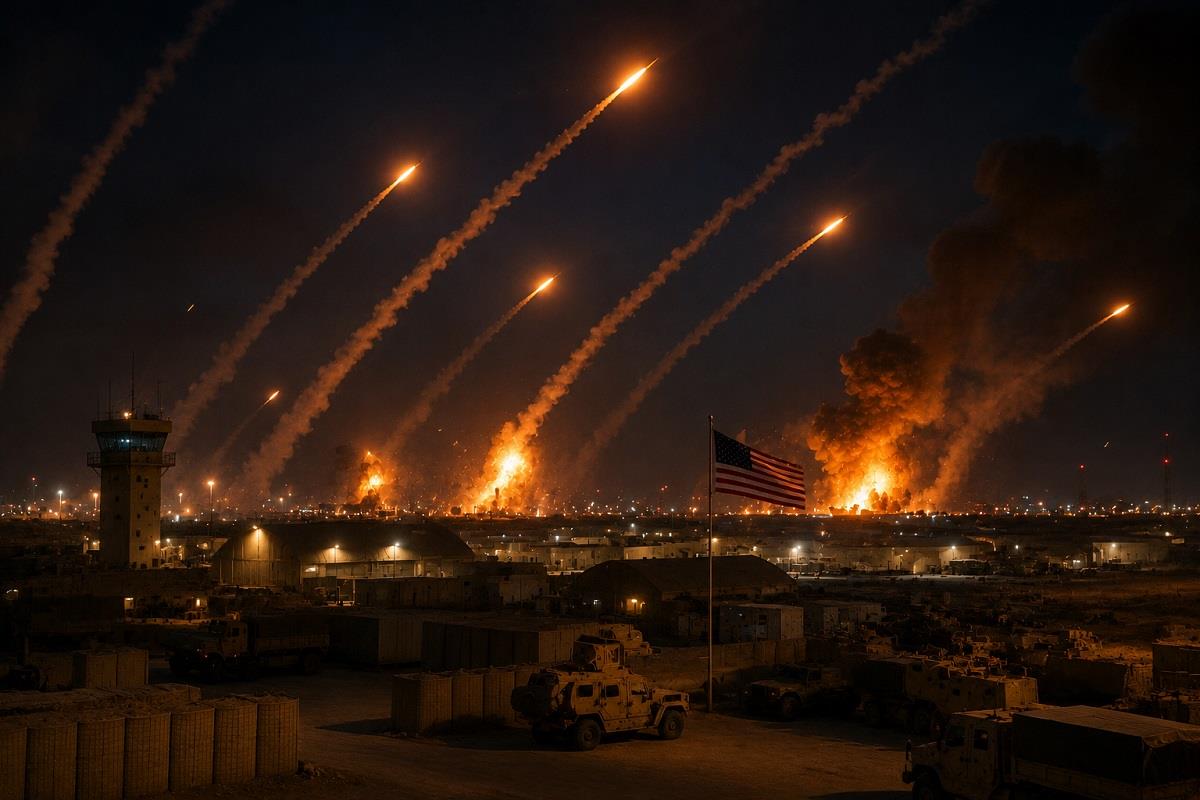
Iran Strikes US Targets Across Gulf Region


The escalation came amid mounting regional tensions that have strained a fragile ceasefire announced by U.S. President Donald Trump earlier this month and complicated indirect negotiations aimed at preventing a broader Middle East conflict.
ADVERTISEMENT
In a statement released by its Public Relations Office, the Islamic Revolutionary Guard Corps (IRGC) said an Iranian oil tanker near the Strait of Hormuz was struck late Tuesday by what it described as an American aerial projectile.
“Late last night, the aggressive U.S. military struck an Iranian oil tanker with an aerial projectile in the vicinity of the Strait of Hormuz, causing damage to the vessel's engine room,” the statement said.
“In response to this aggression and violation of the regulations governing the Strait of Hormuz, an American-Zionist enemy vessel named Panaya was targeted by missiles launched by the IRGC Navy,” the statement said.
The Guard Corps also accused U.S. forces of striking an IRGC communications tower in southern Qeshm Island.
“In a renewed act of aggression, the American enemy targeted an IRGC communications tower in the southern part of Qeshm Island with aerial projectiles,” the statement added.
The IRGC said its Aerospace Force subsequently launched missile and drone attacks against what it described as“their air and helicopter base stationed in one of the countries of the region, as well as the headquarters of the U.S. Fifth Fleet.”
The statement warned against further military action.
“We had previously warned that any act of aggression would be met with a different and heavier response, and we acted accordingly. These responses should serve as a lesson,” the IRGC said.
ADVERTISEMENT“We reiterate that disrupting the security of the Strait of Hormuz will carry a heavy price for the aggressive U.S. military.”
SATELLITE IMAGERY AND KUWAIT STRIKES
Reports citing satellite imagery said portions of Ali Al Salem Air Base in Kuwait sustained significant damage following Iranian missile and drone strikes early Wednesday.
According to the reports, at least one aircraft hangar at the U.S.-operated facility was destroyed.
The Kuwaiti Ministry of Defence acknowledged retaliatory attacks and said Iran used a combination of cruise missiles, ballistic missiles and unmanned aerial vehicles to target locations linked to the earlier strikes, according to reports.
The U.S. Central Command (CENTCOM) also confirmed that American military facilities across West Asia had come under missile attack, though it did not immediately provide details regarding damage assessments.
Western media outlets have previously reported extensive damage at approximately 20 U.S. military facilities across the region from repeated Iranian strikes, although U.S. officials have not publicly confirmed the scale of the reported destruction.
KUWAIT AIRPORT DISRUPTION
Reports from Kuwait said the country's main international airport was briefly shut down on Wednesday after Iranian drones struck and heavily damaged part of a terminal building reportedly used by the US military.
Airport operations later resumed, according to local reports.
The incident marked the latest exchange in a series of retaliatory actions between Tehran and Washington that have repeatedly tested the viability of the ceasefire framework announced earlier this month.
CEASEFIRE TALKS UNDER PRESSURE
Iranian news agencies Fars and Tasnim, both considered close to the IRGC, reported on Tuesday that Iranian negotiators had halted communications with mediators involved in ceasefire discussions.
A regional official involved in mediation efforts, speaking on condition of anonymity, told The Associated Press that Iran had informed intermediaries that a ceasefire in Lebanon must be effectively enforced before Tehran would resume substantive discussions.
According to the official, Iranian representatives did not communicate with mediators on Tuesday following those demands.
Trump dismissed reports that talks had ceased.
“The conversations between us have been going on continuously, including four days ago, three days ago, two days ago, one day ago and today,” Trump wrote in a social media post on Tuesday.
Iran has linked broader regional de-escalation efforts to developments in Lebanon, where fighting between Israel and Hezbollah has intensified despite the existence of a declared ceasefire.
LEBANON EMERGES AS MAJOR STICKING POINT
Israeli forces have pushed deeper into Lebanon than at any point in more than 25 years, while Hezbollah has continued launching rockets and drones against Israeli military positions and settlements.
Although neither side has formally withdrawn from the ceasefire arrangement, continued military exchanges have raised questions about its viability.
Iran has insisted that any broader agreement with the United States must include an end to hostilities in Lebanon.
Israeli Prime Minister Benjamin Netanyahu has sought to separate the Lebanon conflict from discussions involving Iran and faces domestic political pressure to continue military operations against Hezbollah ahead of elections expected later this year.
The dispute has exposed differences between Washington and its close ally Israel, with the United States increasingly pressing for restraint.
TRUMP CONFIRMS HE CONFRONTED NETANYAHU
Read Also Trump Explodes at Netanyahu:“You're F*ing Crazy!” Talks with Iran Continuing at Rapid Pace: TrumpIn an interview released Wednesday on the New York Post's“Pod Force One” podcast, Trump confirmed reports that he had angrily confronted Netanyahu during a recent phone call.
Asked whether he had called the Israeli leader“f*** crazy,” Trump responded:“I did.”
“I was a little bit perturbed at his constantly fighting with Lebanon,” Trump said.
The U.S. president said ongoing Israeli operations against Hezbollah were complicating diplomatic efforts aimed at reaching a wider agreement with Iran and reducing tensions across the region.
Despite the sharp criticism, Trump said his relationship with Netanyahu remained strong.
“We've worked very well together,” he said.
Earlier reports by Axios said Trump had lashed out at Netanyahu during the conversation, warning that continued escalation in Lebanon risked undermining diplomatic progress.
According to the report, Trump told Netanyahu:“Everybody hates you now. Everybody hates Israel because of this.”
The phone call reportedly came after Iran warned that a renewed Israeli offensive in Beirut would trigger a response from Iranian forces and further jeopardize the already fragile ceasefire with the US.
Netanyahu subsequently ordered renewed strikes in Beirut's southern Dahiya district, according to the reports.
Trump also said he had communicated with Hezbollah through intermediaries in an effort to contain the crisis and preserve diplomatic channels.
Nevertheless, fighting continued on Wednesday, with Israeli aircraft carrying out strikes across southern Lebanon and Hezbollah responding with rocket and drone attacks against Israeli military targets.
The latest developments underscore the growing interconnectedness of conflicts stretching from the Gulf to Lebanon, raising concerns among regional governments and international mediators that any further escalation could trigger a wider confrontation across the Middle East.
Trump Says He Would Like to Meet Iran's Supreme Leader
U.S. President Donald Trump has expressed interest in meeting Iran's Supreme Leader, saying that negotiations between Tehran and Washington are progressing positively.
In an interview with the New York Post, Trump said he would welcome a meeting with Iran's leader if circumstances allow.
“I'd like to meet him. I'd like to meet everyone,” Trump said when asked about the possibility of such a meeting.“Depending on how things go, we'll probably see each other at some point.”
Trump also claimed that Iran's Supreme Leader is involved in the ongoing negotiations and suggested that key decisions regarding the talks are being approved at the highest level in Tehran.“It seems like we're getting along very well,” he said.
The U.S. president further stated that he has never had the opportunity to meet Iran's leader in person and went on to make remarks about his health.
Despite recent tensions between Tehran and Washington, including disputes in the region and actions taken by the United States against Iranian interests, Trump argued that relations are improving rapidly and predicted a positive outcome.
He also said there is currently no need for deploying U.S. ground forces in Iran. Commenting on the maritime blockade imposed on Iran, Trump said it could remain in place until September, although he considers that scenario unlikely.
Asked whether the blockade might still be in effect by Labor Day in the United States, Trump responded:“I think it's possible, but I don't think it's likely. I believe we can handle it, and I think the situation will be resolved relatively quickly.”
Trump also claimed that gasoline prices are expected to fall in the near future despite ongoing regional tensions.
In another part of the interview, he discussed his relationship with Israeli Prime Minister Benjamin Netanyahu and voiced frustration over the continued conflict involving Israel and Lebanon.
“The ongoing conflict between Netanyahu and Lebanon concerns and bothers me,” Trump said.
The U.S. president concluded by repeating his long-standing claims regarding Iran's nuclear program, asserting that Iran has agreed not to possess nuclear weapons. Iranian officials, however, have repeatedly stated that the country's nuclear activities are exclusively for peaceful purposes and that Tehran is not seeking nuclear weapons.

Legal Disclaimer:
MENAFN provides the
information “as is” without warranty of any kind. We do not accept any
responsibility or liability for the accuracy, content, images, videos,
licenses, completeness, legality, or reliability of the information
contained in this article. If you have any complaints or copyright issues
related to this article, kindly contact the provider above.
Comments
No comment