




403
Sorry!!
Error! We're sorry, but the page you were looking for doesn't exist.
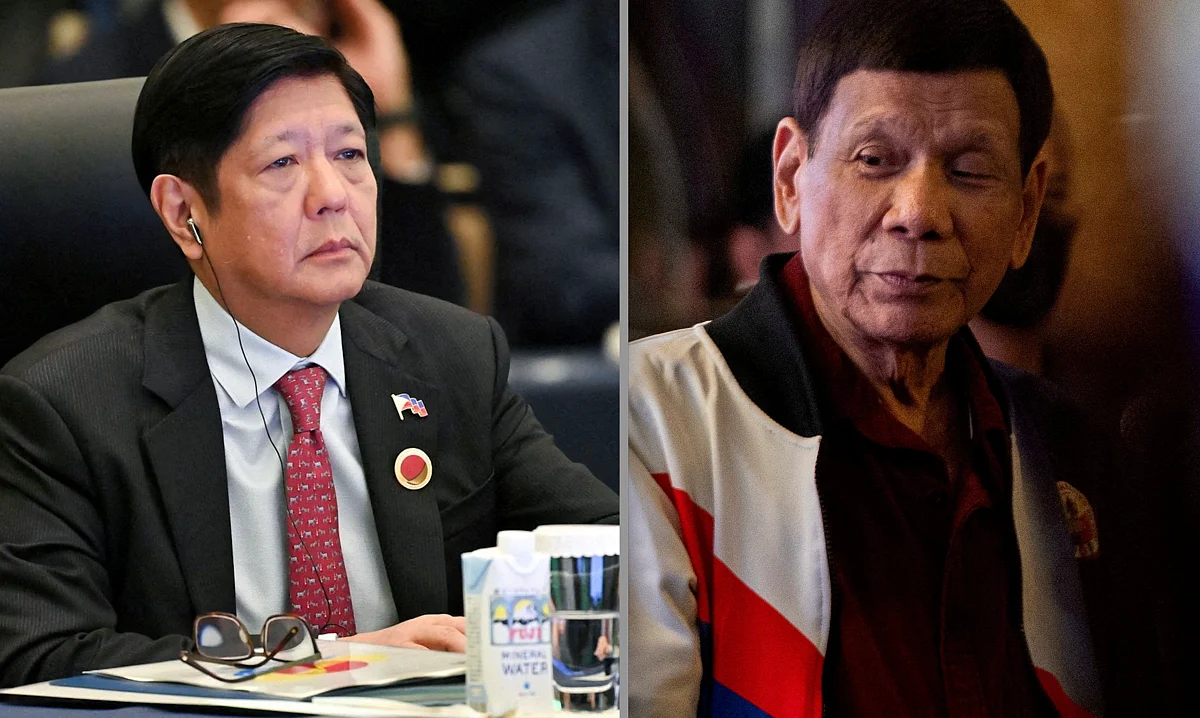
Commentary: Philippines' Marcos Doesn't Have An ICC Policy He Has Duterte Policy
(MENAFN- Khaleej Times) [The author is an independent human rights researcher and journalist in the Philippines. He founded and now edits Rights Report Philippines, a nonprofit journalism project. He was the Philippines researcher for Human Rights Watch and a former Manila correspondent for The New York Times.]
On the morning of May 11, two things happened simultaneously in Manila, and one of them was about Ferdinand Marcos Jr. 's agenda.
Recommended For YouThe first: agents of the National Bureau of Investigation (NBI) arrived at the Senate to serve an ICC arrest warrant against Senator Ronald“Bato” dela Rosa - former police head, chief enforcer of Rodrigo Duterte's drug war, and now wanted for crimes against humanity.
The second: the House of Representatives voted 257 to 26 to impeach Vice President Sara Duterte - for the second time - on charges that include misusing confidential government funds and allegedly plotting the assassination of Marcos, his wife, and former House Speaker Martin Romualdez.
The ICC warrant drew international headlines. The impeachment vote is what Marcos woke up wanting.
Stay up to date with the latest news. Follow KT on WhatsApp Channels.
By early Thursday morning, dela Rosa was gone. He slipped out of the Senate in the wee hours of May 14, using the chaos created by an exchange of gunfire between NBI agents and Senate security personnel - chaos that, whatever its proximate cause, was made possible by three days of government inaction while an ICC fugitive sat inside a public building. The NBI director called him a fugitive. Malacañang, with characteristic precision, said there was no active operation to arrest him. Both statements are true. That is the problem.
This is what happens when the International Criminal Court becomes a lever rather than a court, and the man holding the lever decides, for now, to let it rest.
Marcos's relationship with the ICC has always been transactional. The Philippines withdrew from the Rome Statute in 2019 under Duterte, who initiated the process a month after the court opened a preliminary examination into his drug war.
Since then, Marcos has consistently refused to bring the country back. As recently as last month, Malacañang confirmed the position hadn't changed, offering only the diplomatic non-answer that the President“is not closing the door” on future discussions. His stated reasoning - that the Philippines has a functioning justice system, that foreigners shouldn't dictate who Filipino police arrest - has been consistent. The problem is that consistency isn't the same as principle.
Removal of political rivalWhen Duterte was arrested in March 2025 and flown to The Hague on the same day, Marcos reached for Interpol membership as his legal cover, allowing him to claim the government wasn't technically cooperating with the ICC at all. Yet the man the court wanted was delivered anyway. What guided that decision wasn't accountability. It was the removal of his most dangerous political rival, the patriarch whose arrest would destabilise the entire Duterte dynasty.
Now the same logic, applied to a different set of facts, produces a different outcome - and Marcos wants you to believe that's coherent.
Dela Rosa's case was legally straightforward. The Department of Justice confirmed that Republic Act 9851 - the same law passed in 2009 by several of the senators who now want to protect the Dutertes and their ilk from it - provides the mechanism to surrender him to the ICC. There was no serious legal ambiguity. Only political calculation - and then, days later, an empty Senate building and an ICC suspect who has vanished.
The calculation was this: Surrendering Bato dela Rosa gives Marcos nothing he needs right now, and costs him something he cannot afford to lose.
Dela Rosa resurfaced at the Senate on May 11 specifically to back the election of Alan Peter Cayetano as Senate president - a Duterte-era foreign secretary whose allies have since seized the Senate presidency, giving them command of the chamber that will conduct Sara Duterte's impeachment trial.
Making a spectacle of dela Rosa's transfer to The Hague would inflame exactly that bloc, at precisely the moment Marcos needs it manageable. More than that, it would hand Sara's camp a gift: The narrative that the ICC is Marcos's instrument, not an independent court, and that the Duterte family is its target.
That narrative, inconveniently, would not be entirely wrong.
Sara Duterte is the actual threat. She leads polling for the 2028 presidential race and announced her candidacy in February. A Senate conviction removes her permanently from that contest. No other move available to Marcos accomplishes as much. The impeachment charges - the alleged assassination plot, the unexplained wealth, the misuse of funds - are serious on their own terms. But it requires real effort not to notice that the drive to remove Sara has intensified in direct proportion to her rise as his most credible successor.
None of this means dela Rosa is innocent. The ICC's Pre-Trial Chamber found reasonable grounds to believe he bore criminal responsibility for the murders of 32 people between 2016 and 2018, carried out under his command. The families of thousands killed in the drug war have waited years for something resembling accountability. They are waiting for a worse position today than they were a week ago.
Drug-related killings continueWhat makes that worse still is that the drug war never actually stopped. People are still being killed in drug-related raids – 1,144 of them from July 2022 through December 2025, according to DahasPH - under Marcos, not Duterte.
The executive orders and issuances that institutionalised the drug war as the anti-drug policy were never rescinded. Oplan Double Barrel's final iteration is still on the books. Nearly three years into this presidency, Marcos has not touched a single instrument of the apparatus that brought the ICC to the Philippines in the first place. The killings go on. They continue without Duterte's bravado to make the body count legible.
This is the core of what Marcos is evading, and it is more damning than anything in the dela Rosa warrant. He has not just failed to cooperate with the ICC - he has failed to give it any reason to stay away. Changing the rhetoric while leaving the orders intact is not reform. It is rebranding.
There is a version of this presidency that could have been clarifying. Marcos could have rejoined the Rome Statute - a move that would have cost him little in practice but signalled a genuine break from what came before. He could have rescinded the executive orders and formally declared the drug war over. The families of its victims have gotten bureaucratic silence instead. He could have treated the dela Rosa warrant as the straightforward legal matter it was. Instead, the warrant went unenforced long enough for the man it named to disappear - not in spite of the government's posture, but because of it.
Call that inaction if you want. The result is the same as obstruction.
When Rodrigo Duterte was useful to deliver to The Hague, Marcos found the mechanism. When delivering dela Rosa was inconvenient, the mechanism became invisible - and the fugitive became a ghost. The pattern is too clean to be a coincidence and too sustained to be incompetence. The court is a tool he reaches for when rivals are in range. Accountability is for rivals.
Before he fled the Senate, dela Rosa addressed Marcos directly.“We don't know, one day, you might face the same hurdle, Mr. President,” he said.“You will know, you will feel what I feel right now.” The Palace waved it off. But that warning - meant as a threat - is in fact a checklist: rescind the orders, declare the drug war over, bring the Philippines back into the ICC. The only way Marcos keeps that threat from becoming a prophecy is by ensuring the conditions that brought the court here no longer exist.
He has had three years. The orders are still standing. The bodies are still accumulating. And Bato dela Rosa is in the wind.
ALSO READ- How Philippine Sen. Bato dela Rosa escaped again after Senate shootout Commentary: Filipino lawmaker sprinting in the halls, an ICC warrant, Senate reduced to a joke Watch: Gunshots rock Philippine Senate amid ICC arrest for Senator dela Rosa

Legal Disclaimer:
MENAFN provides the
information “as is” without warranty of any kind. We do not accept
any responsibility or liability for the accuracy, content, images,
videos, licenses, completeness, legality, or reliability of the information
contained in this article. If you have any complaints or copyright
issues related to this article, kindly contact the provider above.
Most popular stories
Market Research

More Story







Comments
No comment