




403
Sorry!!
Error! We're sorry, but the page you were looking for doesn't exist.
UK Assets Markets Starting To Feel The Heat
(MENAFN- ING)
What's happening
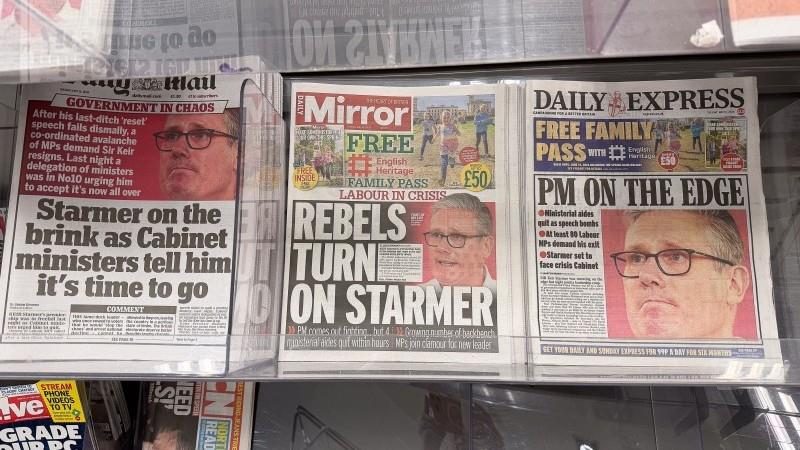
UK markets were under pressure on Friday as the leadership battle within the ruling Labour Party starts to open up.
To recap, this week's turmoil follows a very weak, but not totally unsurprising, set of local election results for Labour earlier this month. With Nigel Farage's Reform Party dominating the polls, and the Green Party increasingly dividing Labour's share of the vote, there's growing pressure on the party to change direction as it looks ahead to the next General Election in three years' time.
So far, formally at least, no leadership contest has been triggered. Keir Starmer remains both Labour leader and prime minister. But it is only a matter of time.
Wes Streeting, until this week the Health Secretary, has resigned and is expected to stand, though it remains unclear whether he has support from the 81 Labour MPs required to trigger a contest. Comments from Streeting today suggest he has acknowledged a leadership battle will need to wait for the summer.
That's because Andy Burnham, Mayor of Manchester and favourite to become Labour leader, needs to be an MP in Westminster to be eligible to compete in a leadership contest. He has announced he'll be standing in Makerfield, a newly-vacated seat in the north of England, in a by-election that's likely to take place in the second half of June.
That in itself is no easy feat. Polls suggest that, in the absence of Burnham, Reform would win comfortably in Makerfield. Farage's party dominated the local elections in the area. Burnham will be banking on his local popularity to get him elected.
Assuming he does, that opens up a leadership contest that's likely to take place through the summer, with the results sewn up before the Labour Party conference in late September.
What gilt markets are watchingUntil now, politics has not been the primary driver of gilt yields, which suggests there's still plenty of upside risk.
The Bank of England policy path has been lifted by higher oil prices over recent weeks. And we also have the Bank's Quantitative Tightening flooding the market with gilt supply at a pace of £70bn per year. Higher US Treasury yields, amidst very healthy US market sentiment, is spilling over to gilt yields, too.
But as of Friday, there are signs that political uncertainty is starting to fuel those Bank of England rate hike expectations, too. Two rate hikes are priced by November and a third by March 2027. And even more interestingly, markets are not pricing in subsequent rate cuts over a two- or three-year horizon. Perceptions of the neutral rate – the level neither expansionary nor restrictive for the economy – have been repriced higher.
That tells us investors are most focused on the impact a leadership contest might have on Britain's fiscal trajectory, gilt issuance over the next couple of years, and its interplay with inflation. Burnham has said there's a case for exempting defence spending from the main fiscal rules, implying higher borrowing. Other Labour figures have flirted with extending the timeline of when the fiscal rules need to be met – which again makes it easier to boost borrowing in the near-term.
The biggest risk here is that investors begin to question the UK's longer-term fiscal discipline. Gilt markets rely on foreign investors and any signs that fiscal dynamics risk turning unsustainable could quickly turn sentiment. We've already seen that the uncertainty around the Autumn Budget last November added a risk premium of around 25bp to 10Y gilts. Right now, we estimate the premium to be around 10bp, higher than a few weeks ago, but still less than around November's budget.
Until we get a better understanding around the fiscal path forward, political risk premium is likely to keep rising. A rise towards 5.30% is quite possible in the near term.
The reality might be differentWith bond markets already under pressure, we suspect all leadership candidates will come until intense pressure to rule out big changes to the fiscal rules over the next few weeks. The memories of the 2022 mini-budget crisis haven't gone away.
We'd also note that fiscal changes are unlikely before the Autumn Budget. And until then, the Bank of England can only react to what is existing government policy. That suggests the leadership drama is unlikely to drastically alter the BoE's rate hiking path this summer.
Beyond politics, we also think Bank of England rate hike expectations look overblown. We expect one rate hike this year, but more importantly perhaps, a return to rate cuts in 2027. Once the near-term political noise has blown over, the direction for gilt yields is likely to be downwards across the medium term. We're forecasting the 10-year bond yield down to 4.5% through the middle of next year.
EUR/GBP versus 10-year gilt-bund spread Sterling is dragged into the sell-offWhat has been noticeable over the last week is that sterling has finally been dragged into this political crisis. Up until recently, traded EUR/GBP volatility had been exceptionally low, near 4%, and the FX option market's view over its direction had not really changed much at all over the last year. Now participants in the FX options market are prepared to pay 1.1% extra for the right to buy over the right to sell EUR/GBP over the next three months. That is virtually matching last year's 'Liberation Day' highs, when global equity markets were hit hard and the growth-sensitive pound fell 5% against the euro.
Behind that recent stability in the pound might have been the BoE's relatively high policy rate of 3.75% (helpful in a carry-seeking environment) and perhaps ongoing interest from M&A activity. Year-to-date pending and completed target acquisitions of UK companies are up over 100% this year, compared to around 20% for Europe as a whole.
Yet the focus now shifts to the long, hot summer of the Labour leadership crisis and the question is how far sterling could fall if international investors really turned bearish on the pound. Over the years, we have found our Financial Fair Value model as a useful vehicle to evaluate the size of risk premium that could emerge in EUR/GBP. The model looks at where EUR/GBP is actually trading versus where it might be trading were typical relationships with short-term rate differentials and equity performance to hold.
By our current reckoning, EUR/GBP is currently trading around 1% above fair value. As our chart below shows, EUR/GBP can trade as much as 5% over fair value in extreme conditions – such as in August 2019 when it looked like the UK would be leaving the EU without a deal. An extra 4% on EUR/GBP today warns that 0.90 is not out of the question this summer for EUR/GBP. For reference, the FX options market now attaches a 25% probability to EUR/GBP trading to 0.90 within the next three months.
Our baseline is for a slightly more modest advance in EUR/GBP to 0.88/89 in late summer – but the risks are clearly skewed to the upside.
EUR/GBP Financial Fair Value model
Legal Disclaimer:
MENAFN provides the
information “as is” without warranty of any kind. We do not accept
any responsibility or liability for the accuracy, content, images,
videos, licenses, completeness, legality, or reliability of the information
contained in this article. If you have any complaints or copyright
issues related to this article, kindly contact the provider above.
Most popular stories
Market Research

More Story








Comments
No comment