




403
Sorry!!
Error! We're sorry, but the page you were looking for doesn't exist.
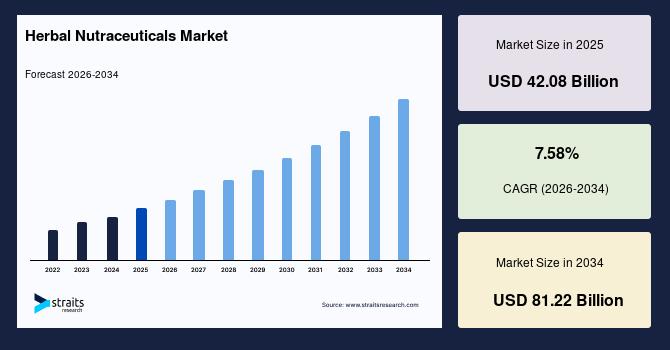
Herbal Nutraceuticals Market Size, Share & Growth Graph By 2034
| Market Metric | Details & Data (2025-2034) |
|---|---|
| 2025 Market Valuation | USD 42.08 Billion |
| Estimated 2026 Value | USD 45.27 Billion |
| Projected 2034 Value | USD 81.22 Billion |
| CAGR (2026-2034) | 7.58% |
| Study Period | 2022-2034 |
| Dominant Region | North America |
| Fastest Growing Region | Asia Pacific |
| Key Market Players | Bio Botanica, Inc, Gaia Herbs Farm, Herbochem, Pure Encapsulations, LLC |
Download Free Sample Report to Get Detailed Insights.
Emerging Trends in Herbal Nutraceuticals Market Shift toward Clinical-grade Botanical Standardization & Biomarker ValidationA key herbal nutraceuticals market trend is the shift toward clinical-grade botanical standardization, where products are developed with strict quality and consistency benchmarks. Companies are focusing on identifying active compounds and linking them with measurable biomarkers to validate real health outcomes. This shift improves trust among healthcare professionals and supports wider acceptance in evidence-based medicine. Advanced testing methods are being used to ensure batch-to-batch, and research collaborations with clinical labs are helping to establish scientifically measurable efficacy for herbal ingredients.
Shift toward Neuro-Wellness Herbal Blends for Cognitive PerformanceThe shift toward neuro-wellness herbal blends is another herbal nutraceutical market trend, which is gaining momentum as consumers increasingly seek natural solutions for mental clarity, memory support, and stress management. Ingredients such as ginseng, bacopa, and ashwagandha are being incorporated into targeted formulations for cognitive and emotional wellness. Manufacturers are expanding adaptogenic and nootropic herbal products across capsules, drinks, and gummies for convenient consumption. Rising awareness of preventive brain health among students, professionals, and aging populations is further supporting demand.
Herbal Nutraceuticals Market Drivers Rising Preference for Evidence-backed Therapy and Increasing Demand for Plant-derived Formulations for Age-related Wellness Management Drives MarketRising preference for evidence-backed herbal therapeutics is driving herbal nutraceuticals market growth as consumers increasingly seek scientifically validated natural health solutions. Growing awareness regarding the effectiveness and safety of clinically studied herbal ingredients is encouraging demand for products targeting immunity, stress management, digestion, and metabolic health. Manufacturers are investing in clinical research, standardized extracts, and transparent labeling to strengthen consumer trust and product credibility. Support from healthcare professionals and increasing integration of herbal supplements into preventive healthcare routines are further accelerating market adoption.
Growing focus on age-related wellness management is driving the herbal nutraceuticals market demand. This increases demand for health-focused beverage choices among older consumers, as they offer natural support for energy maintenance, digestion balance, and general vitality. They help reduce dependency on synthetic additives, which improves consumer trust in daily wellness products. Elderly populations and middle-aged individuals benefit most from these solutions as they focus on preventive health and long-term well-being.
Herbal Nutraceuticals Market Restraints Inconsistent Herbal Raw Material Quality and Limited Large-scale Clinical Validation of Herbal Claims Restrain MarketInconsistent herbal raw material quality is emerging as a key herbal nutraceuticals market restraint. The quality of herbs often varies due to differences in soil conditions, climate, and harvesting methods. Poor storage and handling practices further reduce the potency of active compounds in plant materials. Adulteration and contamination issues also affect the purity and safety of herbal inputs and lack of uniform global standards makes it difficult for manufacturers to ensure consistent product efficacy. This variability limits consumer trust and slows down large-scale adoption of herbal nutraceutical products.
Standardization and limited large-scale clinical validation of herbal claims continue to restrain the market by creating trust gaps among consumers and healthcare professionals. Many herbal products lack uniform composition because active compounds vary with geography, harvesting methods, and processing techniques. This inconsistency makes it difficult to ensure the same therapeutic effect across batches. Clinical evidence for several herbal ingredients remains limited, especially in long-term human studies with large sample sizes. Without strong scientific validation, regulatory approvals become slower and more complex in multiple regions.
Herbal Nutraceuticals Market Opportunities Expanding Applications in Preventive Oncology & Immune-Modulation and Bioengineered Optimization of Plant-based Actives Offer Growth OpportunitiesA key herbal nutraceuticals market opportunity stems from expanding use in preventive oncology and immune-modulation applications. This creates opportunities for nutraceutical manufacturers, botanical extract suppliers, oncology wellness brands, and preventive healthcare companies. Consumers are increasingly seeking plant-based formulations containing ingredients such as curcumin, medicinal mushrooms, green tea extracts, and astragalus to support immune resilience and long-term wellness during cancer prevention and recovery. Rising interest in adjunctive wellness solutions is also encouraging healthcare-focused nutraceutical brands to develop clinically supported formulations targeting inflammation management, oxidative stress reduction, and immune support.
Bioengineered optimization of plant-based active compounds is creating opportunities for biotech firms, ingredient manufacturers, contract research organizations, and premium herbal supplement brands. Companies are increasingly using precision extraction, plant cell culture, and biotechnology platforms to improve the potency, consistency, and bioavailability of herbal actives. This enables the development of standardized high-efficacy nutraceutical formulations with better absorption and targeted health benefits. Growing demand for scientifically validated and traceable herbal ingredients is further accelerating investment in advanced botanical engineering technologies.
Regional Insights North America: Market Leadership through Expansion of Sports Recovery Herbal Nutrition Products and Adoption of Regulated Natural Health ProductsThe North America herbal nutraceuticals market accounted for the largest regional share of 28.42% in 2025, supported by strong consumer awareness, advanced retail infrastructure, rapid adoption of digital health and tele-nutrition platforms, which actively guide consumers toward plant-based dietary choices. These platforms integrate personalized nutrition tracking, AI-driven diet recommendations, and real-time health monitoring, making it easier for individuals to shift toward plant-based food and beverage consumption. The healthcare providers and wellness apps increasingly promote plant-forward diets for preventive health and lifestyle management. This digital influence has strengthened consumer trust and accelerated demand for clean-label, functional plant-based products.
The herbal nutraceuticals market in the US is supported by the expansion of sports recovery and performance-focused herbal nutrition products. Athletes and fitness enthusiasts are increasingly shifting toward plant-derived protein blends, adaptogenic herbs, and functional beverages designed to enhance stamina and muscle recovery. The rising popularity of fitness culture, gym memberships, and endurance sports has created sustained demand for clean-label performance nutrition, herbal ingredients such as ashwagandha, turmeric, and ginseng are being widely incorporated into recovery drinks and supplements.
Canada's herbal nutraceuticals market is driven by the expansion of regulated natural health product frameworks that enhance consumer confidence and product safety. The country maintains one of the most structured regulatory systems for natural health products, which ensures quality control, proper labeling, and standardized ingredient approval. This strong governance has encouraged both domestic and international companies to introduce plant-based food and beverage innovations with greater compliance assurance.
Asia Pacific: Fastest Growth Driven by Expansion of Functional Herbal Beverages and Rapid Commercialization of Ayurveda-based ProductsThe Asia Pacific herbal nutraceuticals market is expected to grow at a CAGR of 10.13% during the forecast period, driven by strong cultural acceptance of herbal nutrition and its integration into daily lifestyle management practices. The growing adoption of herbal products in daily nutrition is deeply linked with traditional systems like Ayurveda, Traditional Chinese Medicine, and other indigenous wellness practices, which are increasingly being modernized for urban consumers. This shift is especially strong where consumers actively include herbal supplements in food, beverages, and routine health regimens, rising awareness of long-term wellness benefits and preference for natural alternatives further accelerates demand.
The herbal nutraceuticals market expansion in China is driven by rapid expansion of functional herbal beverages across urban and semi-urban regions. Consumers are increasingly preferring drinks that combine traditional Chinese medicinal herbs with modern wellness benefits such as immunity and energy support. Domestic manufacturers are innovating with herbal teas, botanical drinks, and low-sugar formulations, while retail modernization and e-commerce growth are improving product accessibility.
The India herbal nutraceuticals market is growing through the rapid commercialization of Ayurveda-based products in domestic and international markets. Manufacturers are focusing on research-backed formulations and standardized extracts to improve efficacy and global acceptance. Rising demand for preventive healthcare products targeting immunity, digestion, and stress management is further driving growth, supported by favorable government initiatives and export promotion efforts.
Herbal Nutraceuticals Market Segmentation Analysis By Product TypeBy product type, herbal dietary supplements accounted for a share of 35.22% in 2025 due to faster adoption driven by simple dosage formats such as capsules, tablets, and softgels, which make daily consumption easy and consistent. Their convenience of use supports adherence to wellness routines, encouraging repeat purchases across all age groups.
The herbal functional beverages segment is expected to grow at a CAGR of 9.3% during the forecast period, driven by increasing demand for hydration products and increasing consumer preference for those who actively seek beverages that provide both fluid replenishment and natural wellness support in a single product.
By IngredientBy ingredient, green tea accounted for the largest share of 48.32% in 2025 due to rising demand for antioxidant-rich functional beverages, including RTD drinks, wellness shots, and fortified hydration products. Green tea extracts are increasingly used to support detoxification, metabolism, and vitality through convenient health-focused beverage formats.
The ashwagandha segment is expected to grow at a CAGR of 11.14% during the forecast period, fueled by its increasing use in stress management and mood-support beverage formulations. Ashwagandha-based RTD teas are gaining popularity due to their adaptogenic positioning and compatibility with wellness-focused lifestyles.
By NatureBy nature, the conventional segment is expected to grow at a CAGR of 16.7% during the forecast period due to its widespread industrial adoption and long-standing usage history in mainstream nutraceutical and herbal product development. This enables manufacturers to build established formulations with proven commercial acceptance. This continuity supports large-scale production stability and predictable supply chains across global markets.
The organic segment is expected to grow at a CAGR of 8.15% during the forecast period, fueled by rising demand for pesticide-free and chemical-free herbal ingredients among health-conscious consumers. Manufacturers are increasingly adopting certified organic farming and controlled cultivation practices to ensure ingredient purity and supply chain transparency.
By FormBased on form, capsules & tablets accounted for the largest share of 56.33% in 2025 due to strong adoption across clinical and pharmacy-based distribution channels. Healthcare professionals prefer these formats for standardized dosing, ease of recommendation, and consistent administration in preventive and therapeutic wellness routines.
The gummies segment is expected to grow at a CAGR of 6.12% during the forecast period, supported by rising demand for convenient nutrition formats that avoid swallowing difficulty especially children and older adults. They prefer gummies because they are easier to consume than tablets or capsules while also offering improved user comfort, better taste appeal, and higher compliance in daily nutritional intake.
By Distribution ChannelBased on the distribution channel, supermarkets & hypermarkets accounted for a share of 46.50% in 2025, as they offer multi-brand comparison, improved consumer product accessibility, and higher purchase convenience. Consumers can evaluate different flavors, price ranges, packaging formats, and ingredient profiles in a single shopping location. They also benefit from organized shelf placement and promotional displays that increase product visibility.
The online retail segment is expected to grow at a CAGR of 11.8% during the forecast period, fueled by the expansion of mobile commerce and digital payment ecosystems. The secure and seamless digital payment systems further enhance consumer trust and purchasing convenience.
Competitive LandscapeThe herbal nutraceuticals market landscape is highly fragmented, with a mix of global dietary supplement corporations, regional herbal extract manufacturers, Ayurveda and traditional medicine-based companies, contract manufacturers, and emerging D2C wellness startups operating across different value chains. Established players compete mainly on scientific validation, product standardization, global certifications, brand trust, and extensive distribution networks across pharmacies, supermarkets, and international markets. In contrast, emerging players focus on product innovation, niche herbal formulations, digital-first marketing strategies, affordability, and faster adaptation to changing consumer wellness trends. The herbal nutraceuticals market is further intensified by the rising demand for clean-label and preventive health solutions, pushing companies to differentiate through quality, efficacy, and transparency.
List of Key and Emerging Players in Herbal Nutraceuticals Market Bio Botanica, Inc Gaia Herbs Farm Herbochem Pure Encapsulations LLC Sydler India Pvt Pharmaca Archer Daniels Midland Company Solaray Bio Thrive Sciences Sampre Nutrition Rama Exports Tolaram Wellness Reliance Consumer Products Limited (RCPL) Naturedge Beverages Recent Developments-
In August 2025, Sampre Nutrition signed a 3-year manufacturing agreement with Rama Exports for nutraceuticals and herbal food products, strengthening production and supply of herbal-based wellness formulations.
In August 2025, Sampre Nutrition also entered an international supply agreement with Tolaram Wellness (Nigeria) to expand herbal nutraceutical exports, enhancing global distribution reach for plant-based supplements.
In August 2025, RCPL acquired a majority stake in a joint venture with Naturedge Beverages, expanding into herbal nutraceutical–infused functional products using Ayurvedic botanicals like Ashwagandha, Brahmi, and green tea.
| Report Metric | Details |
|---|---|
| Market Size in 2025 | USD 42.08 Billion |
| Market Size in 2026 | USD 45.27 Billion |
| Market Size in 2034 | USD 81.22 Billion |
| CAGR | 7.58% (2026-2034) |
| Base Year for Estimation | 2025 |
| Historical Data | 2022-2024 |
| Forecast Period | 2026-2034 |
| Report Coverage | Revenue Forecast, Competitive Landscape, Growth Factors, Environment & Regulatory Landscape and Trends |
| Segments Covered | By Product Type, By Ingredient, By Nature, By Form, By Distribution Channel |
| Geographies Covered | North America, Europe, APAC, Middle East and Africa, LATAM |
| Countries Covered | US, Canada, UK, Germany, France, Spain, Italy, Russia, Nordic, Benelux, China, Korea, Japan, India, Australia, Taiwan, South East Asia, UAE, Turkey, Saudi Arabia, South Africa, Egypt, Nigeria, Brazil, Mexico, Argentina, Chile, Colombia |
Download Free Sample Report to Get Detailed Insights.
Herbal Nutraceuticals Market Segments By Product Type-
Herbal Dietary Supplements
Herbal Functional Foods
Herbal Medical Nutrition Products
Herbal Functional Beverages
-
Ginger
Garlic
Turmeric
Aloe vera
Green Tea
Ashwagandha
Ginseng
-
Conventional
Organic
-
Capsules & Tablets
Powder
Liquid
Gummies
Softgels
-
Pharmacies & Drug Stores
Supermarkets & Hypermarkets
Specialty Stores
Online Retail
Others
-
North America
Europe
APAC
Middle East and Africa
LATAM

Legal Disclaimer:
MENAFN provides the
information “as is” without warranty of any kind. We do not accept
any responsibility or liability for the accuracy, content, images,
videos, licenses, completeness, legality, or reliability of the information
contained in this article. If you have any complaints or copyright
issues related to this article, kindly contact the provider above.
Most popular stories
Market Research

More Story








Comments
No comment