




403
Sorry!!
Error! We're sorry, but the page you were looking for doesn't exist.
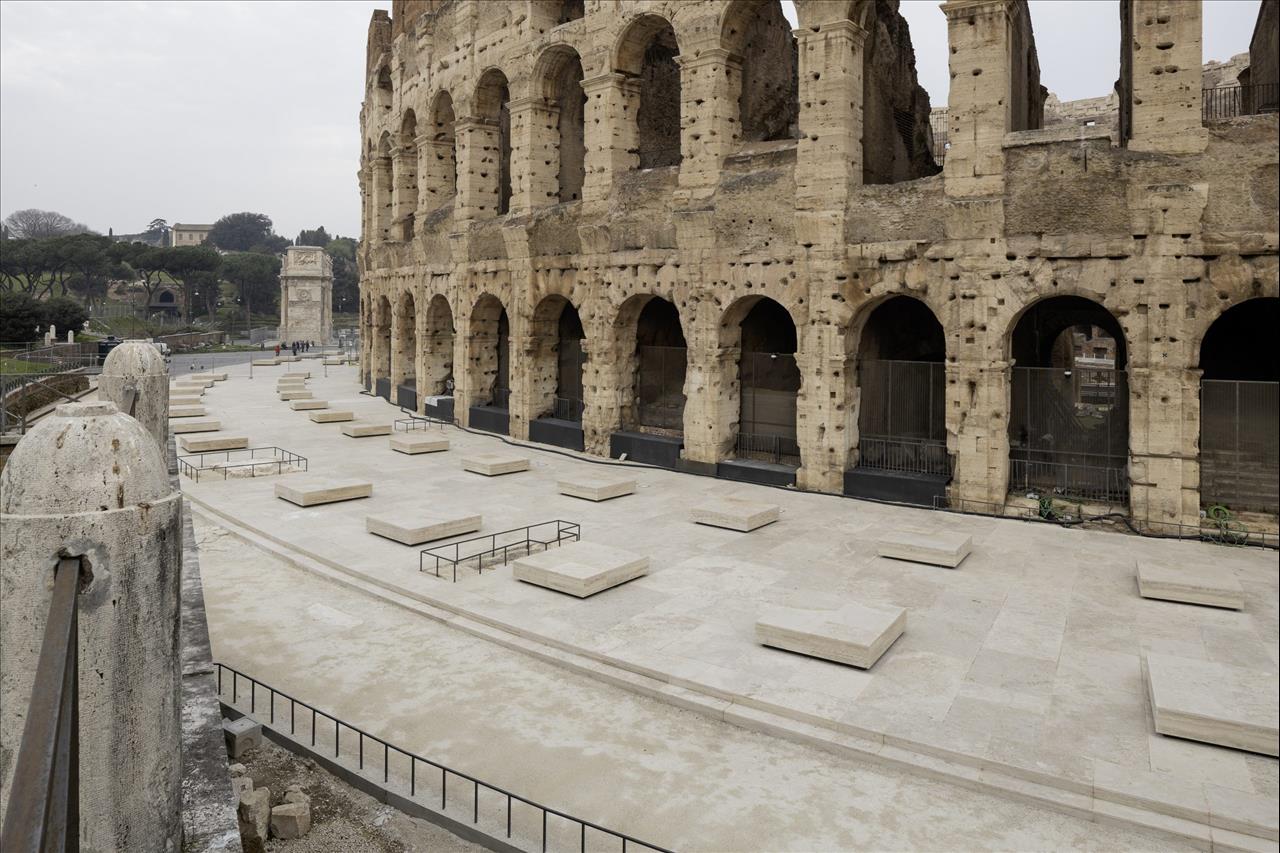
Colosseum Facelift Restores Ancient Southern Entrance To Its Former Glory
(MENAFN- USA Art News)
Colosseum's Southern Entrance Restored to Its Ancient Scale After Four Years
Rome's Colosseum has regained a more legible sense of its original architecture. After a four-year restoration, the southern entrance piazza has been lowered back to its ancient floor level, resurfaced in travertine, and reconfigured to reflect the monument's historic proportions more closely.
The project, led by Stefano Boeri Interiors, did not attempt to reconstruct the Colosseum's lost columned arcades. Instead, it restored the piazza's height, reintroduced a pair of approaching stairs, and laid new paving stone sourced from Tivoli quarries, the same region long associated with Roman building materials. Where the pillars once stood, square travertine blocks now offer seating for visitors. Roman numerals beneath each arch mark the former seating sections, turning the ground plane itself into a readable map of the arena's social order.
Stefano Boeri said in a statement that the intervention“has finally restored the perception of the monument's original size and floor level.” He added that it allows the public to approach the walls and imagine the rhythm of the ambulatories and arches that have since disappeared. The architect described the work as a“respectful and useful project” that completes research carried out by archaeologists at the Colosseum Archaeological Park.
One section of the piazza, between arches 65 and 71, was deliberately left untouched. That preserved area exposes the structure's foundations and has helped researchers better understand the Colosseum's hydraulic system. During excavation to reach the southern entrance's original level, archaeologists uncovered coins, statues, animal bones, and gold jewelry, a reminder that even a highly studied monument can still yield material evidence of daily life and ritual.
The restoration was partly financed through funds tied to the development of a new metro line in Rome, including a station being built deep beneath the Colosseum. It follows the public opening of the Commodus Passage in October last year, a secret underground route that once allowed Roman rulers to enter the arena away from the crowd. Together, the projects are gradually revealing the Colosseum not as a static ruin, but as a layered civic machine whose architecture, circulation, and power structures remain visible in the ground beneath it.

Legal Disclaimer:
MENAFN provides the
information “as is” without warranty of any kind. We do not accept
any responsibility or liability for the accuracy, content, images,
videos, licenses, completeness, legality, or reliability of the information
contained in this article. If you have any complaints or copyright
issues related to this article, kindly contact the provider above.
Most popular stories
Market Research

More Story







Comments
No comment