




403
Sorry!!
Error! We're sorry, but the page you were looking for doesn't exist.
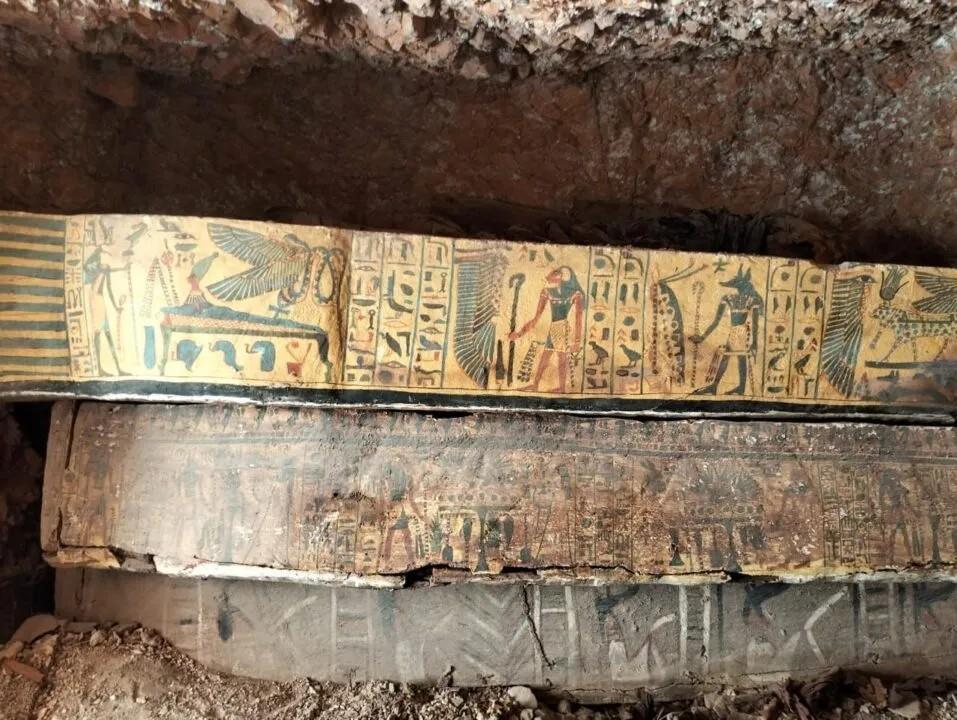
Egyptian Archeologists Find 3,000-Year-Old Coffins Of Temple Chanters
(MENAFN- USA Art News)
Near Luxor, Archaeologists Uncover 22 Painted Coffins With Mummies, Plus Sealed Papyrus Scrolls
A tightly packed chamber in the Theban Necropolis has yielded an arresting discovery: 22 painted wooden coffins, each containing a mummy, dating to Egypt's Third Intermediate Period (1077–664 BCE). The find was made during excavation work at a previously known tomb on the Nile's west bank near Luxor, within the sprawling burial zone where rulers, officials, and nobles were interred during Egypt's Pharaonic period.
The archaeological mission behind the excavation is affiliated with the Supreme Council of Antiquities and the Zahi Hawass Foundation for Heritage and Antiquities. Alongside the coffins, the team also recovered a group of eight papyrus scrolls that had been placed inside a pottery jar; some of the scrolls were found with their seals intact, suggesting they were stored with care and may retain valuable administrative or ritual information.
What makes the coffin cache especially notable is not only its scale but its condition and arrangement. The sarcophagi were discovered crowded into a rock-cut chamber, separated from their lids and stacked in a way that appears designed to save space. That configuration has led researchers to believe the coffins were moved from their original location at some point in antiquity, then reassembled in a compressed deposit.
The inscriptions and identifiers on the coffins add another layer of intrigue. Rather than emphasizing personal names, many of the coffins bear professional titles. The most common are“Chanter” and“Chantress of Amun,” pointing to individuals connected to temple music and ritual performance.
Those titles carry particular weight in the Third Intermediate Period, when the god Amun had become one of Egypt's most powerful deities. In Thebes, the high priests of Amun effectively governed Middle and Upper Egypt, wielding authority that rivaled royal power. Zahi Hawass, who heads the mission, has said the discovery offers new insights into the period, while Hisham El-Leithy, Secretary-General of the Supreme Council of Antiquities, noted that researchers are now working to unravel the circumstances behind the cache.
If the coffins and papyri can be studied in tandem, the group may help clarify how religious institutions shaped social identity in Thebes - and how temple singers and chanters, often glimpsed only in titles, participated in the machinery of Amun's cult during a politically complex era.

Legal Disclaimer:
MENAFN provides the
information “as is” without warranty of any kind. We do not accept
any responsibility or liability for the accuracy, content, images,
videos, licenses, completeness, legality, or reliability of the information
contained in this article. If you have any complaints or copyright
issues related to this article, kindly contact the provider above.
Most popular stories
Market Research

More Story








Comments
No comment