




403
Sorry!!
Error! We're sorry, but the page you were looking for doesn't exist.
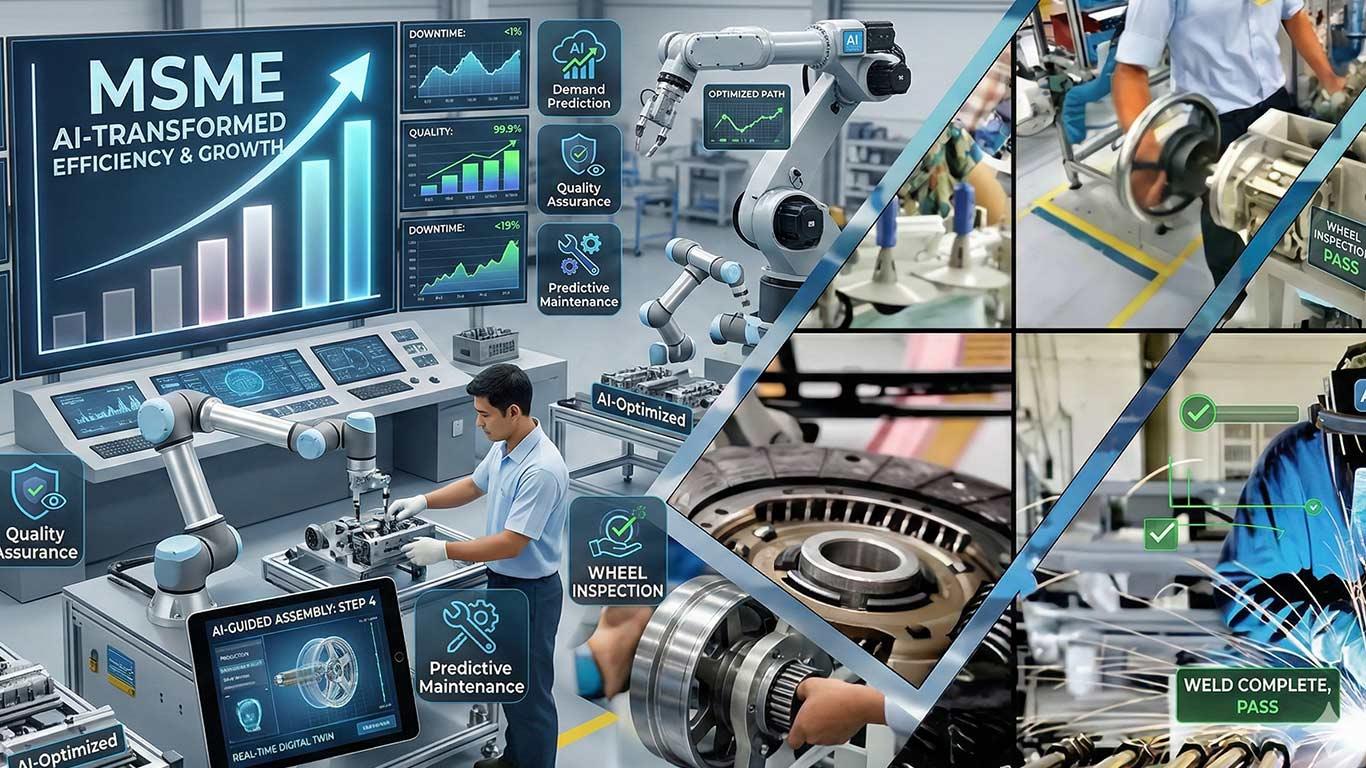
WEF Pushes Edge AI Adoption To Power MSME Growth
(MENAFN- KNN India)
New Delhi, Feb 28 (KNN) Noting the role of MSMEs in economic growth and job creation as India marches ahead to become global manufacturing powerhouse, a World Economic Forum (WEF) report has highlighted the role of edge AI as a viable pathway for productivity enhancement.
The report said that unlike conventional cloud-based AI systems designed for large enterprises with extensive IT infrastructure, edge AI enables real-time data processing directly on or near industrial machines.
The report claimed that edge AI approach reduces latency, minimises dependence on uninterrupted connectivity and lowers data transmission costs, factors particularly relevant for MSMEs operating in resource-constrained environments.
It further said that the deployment of edge AI-enabled visual inspection systems can allow manufacturers to detect product defects instantly during production, thereby reducing scrap, rework and material losses.
Productivity Gains Essential for Next Growth Phase
While India has articulated comprehensive artificial intelligence (AI) policy frameworks, large-scale implementation across MSMEs remains uneven. Stakeholders note that the primary challenge is no longer technological intent but effective execution at the shopfloor level.
Indian MSMEs currently face volatile input costs, skilled labour shortages, rising compliance requirements and intensifying domestic and global competition.
Traditionally, firms have relied on manual oversight and experience-driven decision-making. However, thin margins and increasing quality demands are pushing enterprises to explore predictive and technology-driven solutions.
Edge AI Emerging as Practical Solution
The Forum's recent AI Playbook for India's MSMEs highlights the role of edge AI as a viable pathway for productivity enhancement. Unlike conventional cloud-based AI systems designed for large enterprises with extensive IT infrastructure, edge AI enables real-time data processing directly on or near industrial machines.
This approach reduces latency, minimises dependence on uninterrupted connectivity and lowers data transmission costs, factors particularly relevant for MSMEs operating in resource-constrained environments.
For example, the deployment of edge AI-enabled visual inspection systems can allow manufacturers to detect product defects instantly during production, thereby reducing scrap, rework and material losses.
Cluster-Based Pilots Underway
The Forum has recommended a cluster-led adoption strategy, recognising that MSMEs often operate within established industrial ecosystems such as automotive components, textiles, food processing and electronics. Clusters enable shared learning, cost efficiencies and faster diffusion of technology adoption.
Through its MINDS programme, the Forum aims to build cluster-level capabilities while recognising early adopters, creating a feedback loop to support responsible and scalable AI implementation.
The emphasis on AI adoption comes at a time when India is positioning itself as a global manufacturing and supply-chain partner amid shifting geopolitical and economic dynamics. Analysts suggest that MSMEs can play a significant role in this transition, provided productivity improvements keep pace with market opportunities.
MSMEs Form Backbone Of Economy
Long regarded as the backbone of the Indian economy, MSMEs contribute nearly one-third of the country's GDP and support over 250 million jobs. The sector remains central to India's manufacturing capacity, services expansion and export competitiveness.
Policy recognition of this importance has gained further momentum with the Rs 100 billion allocation for MSMEs in the Union Budget 2026–27, signalling that India's future growth trajectory will depend not only on large enterprises but also on unlocking productivity within MSME clusters and supply chains.
(KNN Bureau)

Legal Disclaimer:
MENAFN provides the
information “as is” without warranty of any kind. We do not accept
any responsibility or liability for the accuracy, content, images,
videos, licenses, completeness, legality, or reliability of the information
contained in this article. If you have any complaints or copyright
issues related to this article, kindly contact the provider above.
Most popular stories
Market Research

More Story








Comments
No comment