




403
Sorry!!
Error! We're sorry, but the page you were looking for doesn't exist.
Why Xi Purged China's Top Military General
Author: Kerry Brown
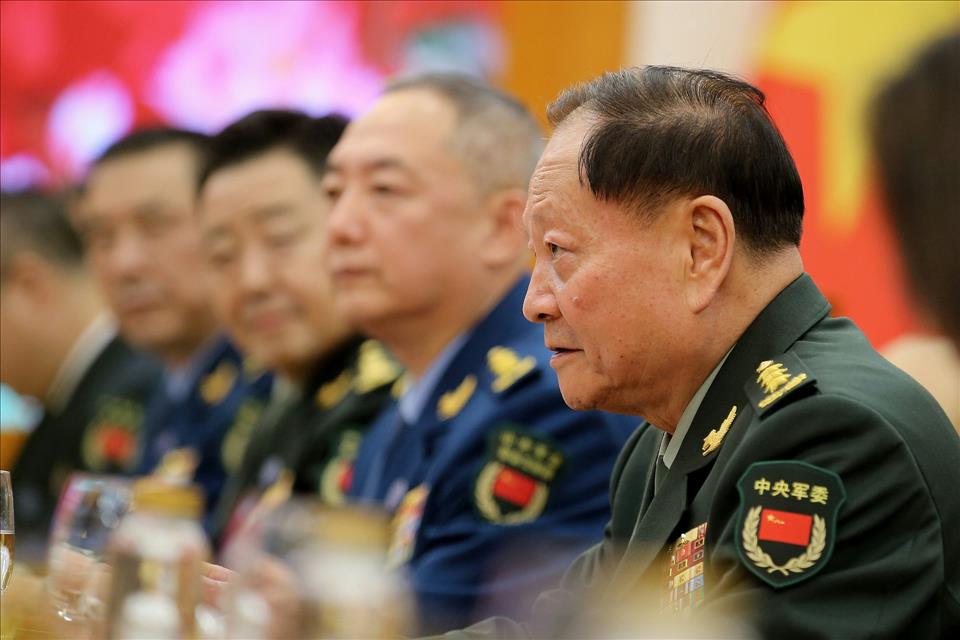
(MENAFN- The Conversation) Zhang Youxia, a top military general and vice-chairman of the body in overall command of China's military forces, was removed from office on January 23. His departure means all but one of the seven members of the central military commission (CMC), which is chaired by Chinese president Xi Jinping, have lost their positions in the last three years.

Xi has an established record of purging senior officials. Back at the dawn of his tenure as head of the Chinese Communist party in the early 2010s, there were a series of high-level fellings. Bo Xilai, a fellow politburo member who was convicted on bribery and embezzlement charges, was perhaps the most commented on.
But even Zhou Yongkang, a former senior party leader, was taken in under corruption charges in 2013 and expelled from the party. The slogan used by party leadership at the time was that even tigers needed to be afraid, not just flies. There were no exceptions when it came to party loyalty – no one was exempt and no one was safe.
Xi then turned his attention to the party's armed wing, the People's Liberation Army (PLA), which has been undergoing a series of abrupt personnel changes in recent years. In mid-2023, the then-minister of defence, Li Shangfu, disappeared from public view before being removed from office. This was followed by the removal of a number of senior military figures, largely on corruption claims.
The formal announcement of Zhang being under investigation was issued in the official party newspaper, the People's Daily. He was accused with fellow CMC member Liu Zhenli of having severely fuelled political and corruption problems that threaten the party's absolute leadership over the armed forces. It has thus led to external speculation of power struggles and internal fights.
No one really knows what is happening in the inner circle of Chinese leadership at the moment. It is a largely watertight place. Stories of Zhang leaking nuclear secrets to the US and plotting a coup against Xi that led to a gunfight in Beijing thus need to be treated with a great deal of scepticism. What is less contentious is the claim that the PLA is afflicted with ongoing structural issues.
China's military issuesZhang is in his seventies and is one of the very few senior military figures in China with actual combat experience, having served in the war against Vietnam in the late 1970s. He is also reportedly a native of an area near to where Xi's family hailed from in the Shaanxi province of north-west China. This has been given as reason for the claim that the two are long-term friends.
But in the uppermost reaches of Chinese politics, sentiments and emotional links are unlikely to have much currency. For Xi, the priority is to deal with a world undergoing dramatic change. The US has become unpredictable and is now fighting not just with its enemies but also its friends.
That unpredictability is not welcome to a China that is dealing with significant economic, environmental and demographic issues. It does not want to become burdened with international obligations before it feels it can manage these.
And while many China-watchers have talked of 2027 marking the date when China may launch an invasion of Taiwan, over which it continues to claim sovereignty, the reality is that China's military is untested in combat in recent decades. No one, including the Chinese themselves, know how it might perform.
The unease of China's leaders at the poor showing of the much more experienced Russian forces in Ukraine underlines this. Several months after the invasion, an article in the People's Daily criticised Russia's performance, concluding that its military was too weak and its capabilities too limited to achieve its objectives. An amphibious operation in Taiwan will be far more difficult than Russia's ground invasion of Ukraine.
Xi has demanded absolute loyalty and discipline from his political colleagues. The same extends to the PLA. The main objective is that it is battle-ready and able to deploy should opportunities arise, even if these were not expected to happen. The military must be ideologically and practically ready to move. It cannot be distracted by divisions and fractures within.
Zhang is clearly a man with rich and extensive experience, but there have been rumours for some time that he and Xi had disagreed on specific issues. As the Chinese saying goes, there can never be two tigers on the same mountain – Xi can only tolerate so much dissent, even from a figure with huge stature and seemingly incontestable credentials.
In the short term, all of this shows that the PLA is likely to be viewed as not yet fully ready to undertake major tasks such as mounting operations against Taiwan that are expected of it. In the longer term, the key thing is to watch is who replaces the figures already felled.
The coming year is likely to be one of generational change in China, at the provincial and then national level. China's current key leaders are all in their late sixties and early seventies. While Xi himself is unlikely to move aside any time soon, those around him are going to experience a reshuffle.
The military will be seeing new core leaders. Who is appointed, what their backgrounds are and what that may mean for the overall posture of the country will be crucial things to track in the weeks and months ahead.
Institution:King's College London

Legal Disclaimer:
MENAFN provides the
information “as is” without warranty of any kind. We do not accept
any responsibility or liability for the accuracy, content, images,
videos, licenses, completeness, legality, or reliability of the information
contained in this article. If you have any complaints or copyright
issues related to this article, kindly contact the provider above.
Most popular stories
Market Research

More Story



Comments
No comment