




403
Sorry!!
Error! We're sorry, but the page you were looking for doesn't exist.
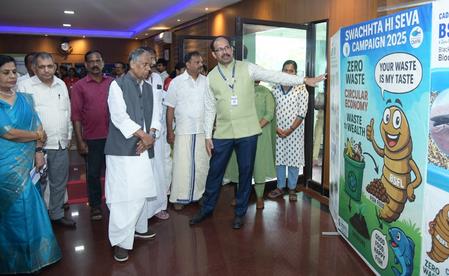
Scientific Backing Essential For Policy Shift In Pokkali Farming: Union Minister Ramnath Thakur
(MENAFN- IANS) Kochi, Jan 6 (IANS) The Centre has called for a comprehensive scientific and socio-economic assessment before considering year-round integrated paddy–fish farming in Kerala's ecologically sensitive Pokkali fields, signalling a cautious approach to policy changes that could have wide-ranging economic and environmental implications.
Union Minister of State for Agriculture and Farmers' Welfare Ramnath Thakur on Tuesday said a detailed study was essential to evaluate whether round-the-year fish farming could sustainably enhance farm incomes without disrupting the fragile Pokkali ecosystem or the livelihoods linked to it.
The minister was responding to demands from farmers seeking permission to extend fish farming beyond the current seasonal framework during his visit to the Pokkali fields.
At present, Pokkali farming follows a traditional alternating cycle: paddy cultivation from June to October during the low-salinity monsoon period, followed by fish farming from November to April when salinity levels rise.
Farmers have argued that allowing fish farming throughout the year could significantly improve returns, especially amid rising input costs and climate-related uncertainties affecting rice yields.
The minister, however, underlined that any policy shift must be preceded by a thorough review of existing laws, environmental consequences and long-term socio-economic impacts.
"Science-based assessments are crucial to strike a balance between productivity, farmers' income, the interests of traditional fishing communities, and ecosystem conservation," he said, adding that extending fish farming without adequate evidence could have unintended repercussions.
The visit was coordinated by the Ernakulam Krishi Vigyan Kendra (KVK) under the ICAR–Central Marine Fisheries Research Institute (CMFRI).
CMFRI Director Dr Grinson George said the institute, through the KVK, was ready to undertake a detailed scientific and socio-economic study if the state government grants approval.
He proposed a pilot project covering 50 acres of Pokkali fields to generate evidence-based data that could inform future policy decisions.
Later, during his visit to CMFRI, Thakur urged scientists to ensure that research outcomes translate into tangible benefits for farmers and rural communities.
He also released CMFRI's new product, Cadalmin, BSF Green Organic Compost, developed using zero-waste bioconversion technology based on black soldier fly larvae, alongside other fisheries-related technology publications.
The minister also reviewed the functioning of CMFRI and the Coconut Development Board, underscoring the Centre's focus on innovation-led, sustainable growth in the agri-fisheries sector.

Legal Disclaimer:
MENAFN provides the
information “as is” without warranty of any kind. We do not accept
any responsibility or liability for the accuracy, content, images,
videos, licenses, completeness, legality, or reliability of the information
contained in this article. If you have any complaints or copyright
issues related to this article, kindly contact the provider above.
Most popular stories
Market Research

More Story





Comments
No comment