

Tuesday, 02 January 2024 12:17 GMT

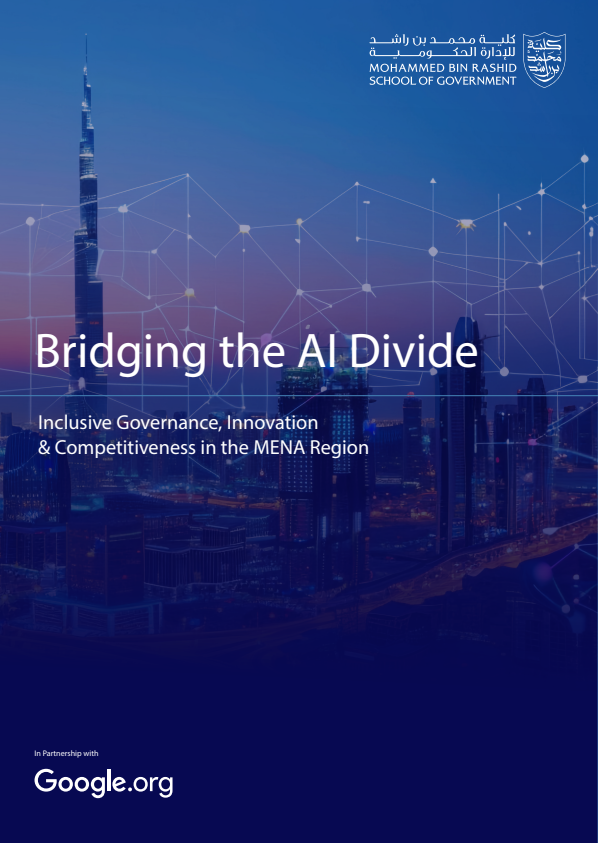
MBRSG Unveils New Landmark Research Report On Bridging The AI Divide In The Arab Region, With Support From Google


(MENAFN- Mid-East Info) The UAE and Saudi Arabia lead the Arab world in terms of AI economy readiness.


  • The study sheds light on the challenges the region faces in ensuring AI governance, building digital infrastructure, and shaping regulatory frameworks to support the sector and bridge the AI divide.
  • The report calls for strengthening research and investment to support startups in the AI sector and boost their global competitiveness.

Dubai, UAE – December, 2025 – The Mohammed Bin Rashid School of Government (MBRSG) announced the launch of its new report,“Bridging the AI Divide: Governance, Innovation & Competitiveness in the MENA Region”, which provides an in-depth analysis of the artificial intelligence (AI) landscape across the Middle East and North Africa.

The report was unveiled during the 2nd UN Arab Public Administration Forum hosted by MBRSG in Dubai, in collaboration with the United Nations Economic and Social Commission for Western Asia (ESCWA).

The landmark study, developed by MBRSG with support from Google, is based on a comprehensive survey of 327 AI and digital SMEs across 10 MENA countries, highlights the region's dynamic yet uneven AI ecosystem. The survey response distribution provided broad regional representation, and included AI companies in 10 Arab countries: the UAE, Saudi Arabia, Morocco, Bahrain, Jordan, Qatar, Kuwait, Egypt, Oman and Tunisia.

Findings indicate that the UAE and Saudi Arabia are emerging as regional leaders in terms of readiness in AI governance and AI start-up ecosystem, supported by robust infrastructure, significant investment, and clear policy direction, that are helping the two countries overcome existing transformation challenges. In contrast, other MENA countries continue to navigate challenges such as fragmented regulations, limited funding access, and talent gaps. Despite these disparities, the report underscores a prevailing optimism among AI businesses and a shared recognition of AI's pivotal role in driving innovation and economic growth across the region.

A strong majority (69%) of respondents rated their country's AI ecosystem positively, signalling confidence in the region's AI potential, driven by supportive government strategies, a tech-savvy population, and global AI momentum. This cautious optimism aligns with the region's recent AI investments (national strategies, innovation hubs, etc.). Many professionals believe the basic building blocks of a viable AI ecosystem are emerging in the region.

MBRSG's Executive President His Excellency Dr. Ali bin Sebaa Al Marri said:“Our region stands at a pivotal moment in its AI journey. While there's immense potential and a clear appetite for innovation, the research team leading this regional project at MBRSG's Centre for Future of Government observed a significant disparity in governance and actual AI adoption on the ground, creating a distinct 'AI divide' within the region. The study's important findings call for bridging this divide through concerted effort to cultivate truly inclusive governance, build robust infrastructure, secure critical funding, and establish a supportive regulatory environment that inherently integrates ethical frameworks. By advocating for inclusive, context-specific governance that genuinely reflects regional values and enables sustainable innovation, this report builds on the MBRSG Research Department's two-decade legacy of developing impactful research and evidence-based foundation that informs future roadmaps for policymakers and stakeholders to harness AI's transformative power for sustainable economic growth and broad societal benefit.”

For her part, Rasha El Hallak, Head of Government Affairs and Public Policy UAE at Google, said:“The research project offers a truly valuable look into MENA's growing AI startup ecosystem as well as AI governance. It highlights the ongoing challenges and incredible innovation being driven by regional entrepreneurs, showing the real potential to shape the future of AI across the region. Understanding this helps us empower these innovators further.”

The report revealed that AI adoption is well underway among MENA's tech-oriented firms, though the level of maturity varies significantly. A portion of companies report having deployed AI solutions into their core business processes. Small and medium-sized enterprises (SMEs) are at the forefront of AI adoption, with many identifying as“AI-native” startups. They are actively implementing machine learning, deep learning, natural language processing (NLP), and computer vision, with emerging interest in generative AI.

Critical barriers to AI development in the region include limited access to funding, high cost of infrastructure and reliability issues related to electricity and internet services, and a notable incidence of intellectual property (IP) infringement. An overwhelming majority of AI SMEs in the region have not registered any patents, intellectual property, or digital assets outside their home country (93% of respondents). This suggests that relatively few MENA AI firms are yet at the stage of protecting IP in global markets. At the same time, a significant number of companies have already encountered IP infringement issues. Nearly 43% of respondents said they have experienced some form of intellectual property theft or misuse related to their digital assets or outputs.

While regulations are seen as building trust and opening markets, they also present challenges, including increased operational costs (22%), slowed innovation (21%), and restrictions on data use. Cybersecurity, data privacy, AI explainability, and bias and fairness are top concerns for businesses.

According to the findings, enabling AI SMEs and startups in the region requires several enablers, including prioritising increased investment in AI research and development (25%), improved AI education and training (24%), clearer and more supportive AI regulations (22%), and financial incentives (17%). In essence, the private sector is essentially asking for a stronger enabling ecosystem engineered by policymakers. Furthermore, most companies are on a journey towards implementing AI ethics standards, with budget limitations and a lack of specialised expertise identified as key constraints.

The report emphasises that MENA's ability to participate in and benefit from the AI revolution will significantly impact its economic development and technological sovereignty. It advocates for engaging proactively in the evolving global AI discourse to ensure that the region's perspectives and interests are adequately represented, amplifying MENA's voice in shaping global AI norms and standards. Successfully bridging the AI divide and achieving sustained competitive advantage in the coming years will hinge on effectively marrying its abundant optimism and burgeoning talent with inclusive governance and comprehensive support systems.

The Mohammed Bin Rashid School of Government is an academic research and teaching institution focused on government administration and public policies in the Arab world. It aims to support the advancement of government excellence in the UAE and the Arab region through an integrated ecosystem of educational and training programmes, research studies, and initiatives to facilitate the exchange of knowledge among government institutions. As a policy research centre for future of government research, the School leads dedicated policy research projects and research teams working on AI governance, AI safety and AI ecosystem enablement. The full report and other key outputs of these projects are available on MBRSG's research website:

MENAFN08122025005446012082ID1110453449


Mid-East Info

Legal Disclaimer:
MENAFN provides the information “as is” without warranty of any kind. We do not accept any responsibility or liability for the accuracy, content, images, videos, licenses, completeness, legality, or reliability of the information contained in this article. If you have any complaints or copyright issues related to this article, kindly contact the provider above.

Search