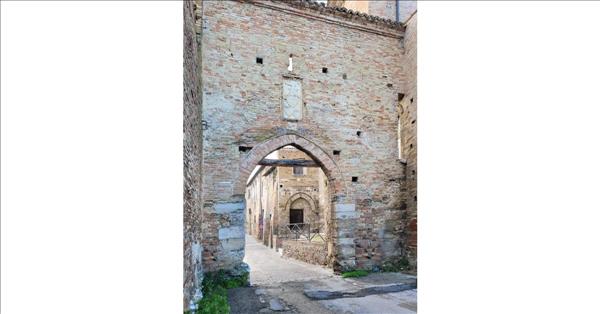
(MENAFN- EIN Presswire) The ancient monastery entrance will soon welcome visitors to the new Abruzzo Ancient Wine History Center.
Producer Who Has Mastered Re-Creation of Ancient Roman Wines Will Now Recover Historic Gem Long Hidden Behind Licorice Factory Façade
It may be impossible to imagine a king or an emperor enjoying this property because it has deteriorated so badly. However, someday soon, this will be a place where history comes to life.” - Piero PavoneATRI, TERAMO, ITALY, April 3, 2023/einpresswire.com / -- It's a story that won't be found in Napoleonic history books. It's also a perfect example of the adage,“Truth is stranger than fiction.” In 1806, the Napoleonic Code mandated the suppression of Italian religious orders and the sale of their properties. With the stroke of his pen, an 800-year-old, historically consequential monastery in Atri, Italy, abruptly stopped saving souls and started making licorice just a few decades later.
Locally known as“San Domenico,” the 65,000-square-foot monastery-turned-licorice-factory will soon shed its candy-coated façade and reemerge as a massive, multi-function cultural center dedicated to the conservancy of abruzzo heritage and Roman wine history. Reimagination of the derelict property has been a long-time obsession of Abruzzo native Piero Pavone, who has been trying to purchase the long-abandoned 15-acre compound for the last three years.
From the property's vantage point, the breathtaking view of Abruzzo's rolling hills, farmland, and majestic mountains is as spiritually inspiring today as it must have been for the Dominican monks who lived there until receiving Napoleon's eviction notice in 1806. However, inside the complex, it's not a pretty picture. For the past two centuries, world-renowned licorice was produced there, and after the factory closed 15 years ago, deterioration of the abandoned property became unstoppable. But“unstoppable” also describes Piero Pavone's determination to turn the property into the ultimate Roman wine history lesson.
Pavone, the founder of vinum hadrianum Wines, explains it this way.“Our mission is unique because we are singularly focused on accurately re-creating the wines once beloved by ancient Romans. But to fully appreciate these wines, we've made it our mission to resurrect art, architecture, and culture that gives our ancient wines context. The former monastery provides the essential ingredients necessary to ensure unparalleled success and make this a world-class destination.
At the beginning of the 13th century, the property became the home of Federico II, King of Sicily from 1198, King of Germany from 1212, and Holy Roman Emperor from 1220. Federico II met his wife Isabelle of England, the daughter of King John of England, on the property. His style is evident in the main door and the windows above.
A century later, Charles of Anjou became the first king of the Angevin dynasty when he received the Sicilian crown in 1282. Almost immediately after he became king, the Angevins successfully extended their influence over a large part of Europe and gifted the monastery land to the Dominican Friars, who began constructing the monastery in 1298. It was built mainly from ancient roman ruins on the property that had once been part of a vast Roman theatre complex, part of which still exists just 300 meters away. The ruins are believed to have also come from a massive amphitheater that completely vanished centuries before the monastery was constructed.
In redeveloping the site, Vinum Hadrianum aims to create a living museum where visitors can learn about the history of wine in its historically-accurate context. The historical center will feature quaint shops, restaurants, a media center, 30 ancient history-themed hotel rooms, meeting space, banquet facilities, a spa, ancient art, and artifact displays, performing arts space, multi-media presentations, and a rooftop garden, where wine and cocktails can be savored while enjoying an unparalleled panoramic view. The plan includes tours, exhibitions, tastings, educational programs, and access to an unequaled body of Roman wine history.
Then, of course, there is the winemaking. Vinum Hadrianum wines will be produced on the premises when the center is completed. All wines will be aged and stored in giant terracotta pots that perfectly replicate vessels used 2000 years ago at the height of the Roman Empire. Each pot is made from clay extracted from the same soil the grapes are grown in.
Vinum Hadrianum intends to embark on this ambitious project with the highest respect for its unique heritage and a passionate commitment to protecting its future. Pavone says,“This is not just about restoring a historical building complex; it is about preserving more than 2000 years of cultural heritage and better understanding our rich history.”
We respond to all inquiries between 9 AM and 5 PM in all US time zones.
Check out our new video!
.David Wilson
Grape Encounters
+1 213-716-1964
email us here
Visit us on social media:
facebook
linkedin
instagram
other
The Lost Secret of Ancient Roman Wines
MENAFN03042023003118003196ID1105938446
Legal Disclaimer:
MENAFN provides the
information “as is” without warranty of any kind. We do not accept
any responsibility or liability for the accuracy, content, images,
videos, licenses, completeness, legality, or reliability of the information
contained in this article. If you have any complaints or copyright
issues related to this article, kindly contact the provider above.















Comments
No comment