







403
Sorry!!
Error! We're sorry, but the page you were looking for doesn't exist.
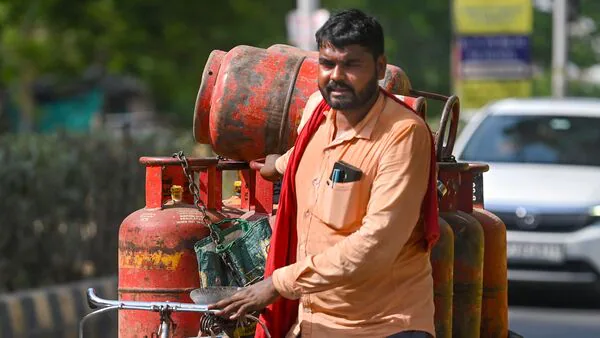
LPG Cylinder Prices Hiked By Another ₹29 As West Asia War Drives Up Import Costs
(MENAFN- Live Mint) State-run oil marketing companies (OMCs) have raised domestic liquified petroleum gas (LPG) cylinder prices by ₹29, effective 7 June. This is the second hike since the start of the West Asia war. It comes after India's LPG consumption fell to 2.13 million tonnes in May, the lowest since the covid pandemic, and almost three months after oil companies hiked LPG prices by ₹60 a cylinder on 7 March.
After the latest revision, a 14.2-kg domestic LPG cylinder will now cost ₹942 in Delhi, ₹941.50 in Mumbai, ₹994 in Hyderabad, ₹968 in Kolkata and ₹944.50 in Bengaluru, according to industry estimates.
Also Read | OMCs tap tax data to tighten LPG subsidy amid energy crunchAfter the OMCs raised prices, the union government said in a statement that the added cost of supplying a 14.2-kg domestic LPG cylinder hasn't been transferred completely to consumers and that Indian households continue to pay among the lowest cooking gas prices in the world.
A beneficiary under the Pradhan Mantri Ujjwala Yojana will continue to receive the direct benefit transfer of ₹300 a cylinder on the first four refills each year. A typical Ujjwala household gets four refills a year and effectively pays ₹642 for those refills, according to the government.
The government said the under-recovery on the sale of each domestic LPG cylinder was around ₹700 before the price hike. It said if domestic LPG prices were linked to international rates, each cylinder would cost ₹1,600. Under-recovery is the gap between the international cost of the molecule and the domestic retail price. The gap is usually absorbed by the public sector marketing companies and compensated in part by the exchequer. By the end of the last financial year, the cumulative under-recovery on domestic LPG reached ₹60,000 crore, up from ₹41,338 crore the year before.
The latest price increase follows disruptions in global energy markets caused by blockades of the Strait of Hormuz, a critical trade route that handles one-fifth of the world's oil and natural gas exports. Since the US-Iran war started on 28 February, the fuel prices have been volatile around the world, with Brent crude, the global oil benchmark, trading around $100 per barrel.
Also Read | Govt weighs LPG stock mandate as West Asia war hits supplyCommercial LPG prices have seen a much sharper increase in the past few months, as they are linked directly to the international benchmark. In the national capital, a 19-kg commercial cylinder, mostly used in hotels and restaurants, is priced at ₹3,113.50.
LPG hit hardest by warLPG supplies have been worst-affected due to the war and the blockade of the Strait of Hormuz as India used to import 60% of its LPG before the war, with about 90% these imports coming from West Asia. The landed cost of those imports tracked the Saudi Contract Price (CP), set by Saudi Aramco at the start of each month. The Saudi CP has been set at $790 a tonne in June, about 46% higher than pre-war levels in February. India is making efforts to diversify imports, tapping the US, Russia and Norway, among others.
Prashant Vashisht, senior vice president and co-group head, corporate ratings, ICRA Ltd, said: "The daily under-recovery on LPG sales of the three OMCs put together would be around ₹300 crore, which is the major part of the overall under-recovery of around ₹520 crore. The elevated levels of under-recovery continues due to high benchmark Saudi CP."
OMCs have already raised the price of petrol and diesel four times in the past three weeks, taking the cumulative hike to about ₹7.5 per litre. However, it must be noted that the three OMCs-Indian Oil Corp. Ltd, Bharat Petroleum Corp Ltd, and Hindustan Petroleum Corp. Ltd-reported a cumulative net profit of over ₹77,000 in FY26 amid low prices of crude oil.
Inflation worriesThis increase in retail prices is expected to fuel inflation and reduce spending, thereby affecting growth. On Friday the Reserve Bank of India (RBI) revised its inflation forecast upward to 5.1% for FY27 from the previously projected 4.6%.
RBI governor Sanjay Malhotra said heightened global uncertainty, potential supply-chain disruptions, commodity price shocks, uncertainty surrounding the southwest monsoon, and the possibility of El Nino conditions posed risks to inflation.
N.R. Bhanumurthy, director of Madras School of Economics said, "In the first round of impact either inflation or fiscal deficit would grow (if the increased prices are not transferred to the consumers and absorbed by the government). However, in the second round of impact, inflation is bound to increase, as a widening of the fiscal deficit would itself lead to higher inflation. So, the OMCs will have to transfer the hike in global prices to consumers. The growth in inflation can only be delayed but eventually its impact will be felt."
LPG consumption fell to multi-year lows in May as the government implemented demand management measures. The government has mandated a 45-day timeline for booking domestic LPG in rural areas and 25 days in urban areas to manage demand. Domestic LPG production has also been increased, with most of it being diverted for household consumption.
Also Read | Mint Quick Edit | Commercial LPG price hike: Not as benign as it looksData from the Petroleum Planning and Analysis Cell showed India's total LPG sales stood at 2.13 million tonnes, 4% lower than the 2.21 million tonnes consumed in April and 19% lower than ₹2.68 million tonnes used in May 2025. Consumption in May was the lowest since the 2.10 million tonnes used in April 2021, amid the second wave of the pandemic.

Legal Disclaimer:
MENAFN provides the
information “as is” without warranty of any kind. We do not accept
any responsibility or liability for the accuracy, content, images,
videos, licenses, completeness, legality, or reliability of the information
contained in this article. If you have any complaints or copyright
issues related to this article, kindly contact the provider above.
Most popular stories
Market Research

More Story





Comments
No comment