

AR In Agriculture Market Size, Share, Growth, Forecast, 2034


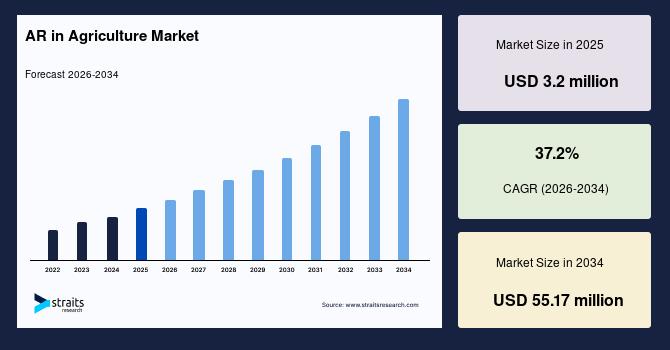
| Market Metric | Details & Data (2025-2034) |
|---|---|
| 2025 Market Valuation | USD 3.2 million |
| Estimated 2026 Value | USD 4.39 million |
| Projected 2034 Value | USD 55.17 million |
| CAGR (2026-2034) | 37.2% |
| Study Period | 2022-2034 |
| Dominant Region | North America |
| Fastest Growing Region | Europe |
| Key Market Players | Augmenta, Grow Glide, EON Reality, Nedap N.V., Plant Vision |
Download Free Sample Report to Get Detailed Insights.
AR in Agriculture Market Dynamics Market DriversGrowth of Indoor & Vertical Farming and Rising Demand for Higher Crop Productivity Drives Market
The growth of indoor and vertical farming is driving demand for AR in agriculture technologies as operators increasingly require real-time visualization and monitoring of lighting, humidity, temperature, and crop health in controlled environments. AR solutions help improve operational precision, space utilization, and resource efficiency in technologically advanced farming systems. Rising urban agriculture initiatives and increasing investment in smart greenhouses are further accelerating adoption of AR-enabled farm management tools.
Rising demand for higher crop productivity is encouraging farmers to adopt AR-assisted precision farming solutions for improved field monitoring and decision-making. AR technologies enable visualization of soil conditions, irrigation patterns, nutrient deficiencies, and pest activity, helping optimize agricultural inputs and reduce wastage. AR technologies such as smart glasses, drone-integrated AR mapping, GPS-based field visualization systems, and mixed reality farm monitoring platforms are being used to optimize agricultural operations. This supports higher yields, efficient resource utilization, and data-driven farming practices across large-scale agricultural operations.
Market RestraintsHigh Initial Implementation Costs and Data Privacy Concerns Restrain AR in Agriculture Adoption
High initial implementation costs remain a major restraint in the AR in agriculture market, as deployment requires investment in smart glasses, AR software platforms, sensors, drones, and connected farm infrastructure. Small and medium-scale farmers often face budget limitations that restrict adoption of advanced digital farming technologies. Additional maintenance, training, and system integration expenses further increase the overall operational cost burden.
Data privacy and cybersecurity concerns are limiting adoption of AR-enabled agricultural platforms due to increasing reliance on cloud connectivity, IoT devices, and real-time farm data collection. Farmers and agribusinesses remain cautious about unauthorized access to sensitive operational data, crop information, and yield analytics. Growing concerns regarding cyber threats and data ownership create challenges for large-scale deployment of connected AR farming systems.
Market OpportunitiesGrowing Adoption of Precision Farming and Smart Farming Methods Offer Lucrative Opportunities for AR in Agriculture Market Players
The growing adoption of precision farming techniques presents a significant opportunity in the AR in agriculture market for AR software developers, agri-tech startups, and agricultural equipment manufacturers. Precision farming relies on real-time data from sensors, drones, and GPS-enabled systems to optimize inputs such as water, fertilizers, and pesticides, and AR can translate this complex data into intuitive visual overlays directly in the farmer's field of view. This creates strong commercial potential for AR platform providers offering crop health visualization, soil condition mapping, and yield prediction interfaces that simplify decision-making at the farm level.
The rise of smart farming methods, enabled by IoT, AI, and connected agricultural systems, is creating strong opportunities for AR technology developers, farm management solution providers, and agricultural machinery companies. Smart farming generates large volumes of real-time data from connected devices such as irrigation controllers, greenhouse sensors, and autonomous machinery, which can be effectively visualized and acted upon through AR interfaces. This allows agronomists and farm operators to receive real-time digital overlays for irrigation scheduling, pest control alerts, and equipment diagnostics, improving productivity and operational accuracy.
Market ChallengesLimited Digital Infrastructure in Rural Areas and Environmental Challenges in Outdoor Use Constraint Growth
Limited digital infrastructure in rural areas creates a major challenge for AR adoption in agriculture, as many farming regions still lack reliable internet connectivity, cloud access, and 5G network coverage. Real-time AR visualization and data synchronization depend heavily on stable digital infrastructure for smooth operation. This limits the effectiveness of advanced AR farming solutions in remote agricultural locations.
Environmental challenges in outdoor use affect the performance and reliability of AR devices in agricultural environments exposed to dust, rain, sunlight glare, humidity, and extreme temperatures. Harsh field conditions can reduce device visibility, sensor accuracy, and operational durability during long farming cycles. These limitations create practical challenges for continuous AR usage across open-field agricultural operations.
Regional AnalysisBased on region, the global AR in agriculture market is bifurcated into North America, Europe, Asia Pacific and Japan, the U.K., China, Asia-Pacific (APAC), and Rest-of-the-World (RoW).
North America Dominates the Global MarketNorth America is the most significant global AR in agriculture market shareholder and is anticipated to exhibit a CAGR of 39.8% over the forecast period. North America is one of the most well-known regions for digital technology adoption in the agriculture market. The region is one of the largest markets for the entire immersive reality ecosystem leading the world in development due to the presence of market-leading AR development companies such as Microsoft and Google. It is also home to some of the largest agricultural original equipment manufacturers (OEMs), such as John Deere, AGCO, and Massey Ferguson. In addition, John Deere and Massey Ferguson have launched AR applications for consumers to experience their products in real life without needing a physical machine. AGCO has implemented AR smart glasses in its production lines and has reported a 25% reduction in production time on low-volume and complex assemblies. Such case studies suggest that these companies are willing to invest in the technology, which will also impact farmers' adoption. Further, the growing popularity of agricultural technology among farmers in the region is a key growth enabler for the market.
Europe is estimated to exhibit a CAGR of 30.9% over the forecast period. Europe has a mature industrial and commercial ecosystem and is a pioneer in adopting Industry 4.0 technologies, including AR. The Europe market also enjoys support from EU initiatives. The European Union started various projects with a total budget of USD 27.4 million in 2019 under the XR4all initiative. This will eventually lead to multiple new developments and boost the entire spectrum of extended reality, including AR. The European Union has recognized the advantages of implementing technology in the agricultural sector, and through consistent policy implementation, it has somehow positively fostered a culture in EU countries. Simultaneously, many companies and universities continuously develop products that increase knowledge among growers and cultivators. Therefore, the region is expected to see enormous demand for AR in agriculture with government backing and increased awareness in the coming years.
The Asia-Pacific and Japan region has one of the biggest economies in the world, with more than one-third of the total population living in the region. Historically, the region has always been an opportunity for new technological advancements. Due to the high population and diversified demographics, adopting any technology would mean a widespread acceptance of products amongst one-third of the world's population. In addition, the region has some of the very fast-growing economies in the world. The growing purchasing power and standard of living in the region have led to the widespread adoption of smartphones, which could have a massive impact on the market in the future.
The Rest-of-the-World includes countries in South America and the Middle East and Africa. Since the past decade, the Middle East and Africa region has been developing as a global economic hub, especially the Middle East. The region is the leading oil and gas producer, among other mined minerals. However, the entire Middle East expects Iran to have agricultural capabilities, and they mostly rely on exports from other countries. That is why AR in agriculture has minimal scope in the Middle East. In addition, Africa has some of the most agriculture-dependent economies, such as Ethiopia, Liberia, Sierra Leone, Chad, and the Central African Republic. Almost all these countries have a high dependence on agriculture, which accounts for more than 40% of the GDP. These countries have a better future in the AR in the agriculture market.
Furthermore, South America is one of the laggards regarding infrastructure and technological developments; however, it is one of the high-potential markets. The region has been facing an economic slowdown for the past couple of years. Countries such as Brazil, Argentina, Columbia, and Chile have all witnessed an economic recession. Nevertheless, governments are putting a lot of effort into modernizing agriculture practices in the region, enhancing market growth.
Segmental AnalysisThe global AR in agriculture market is segmented by application and solution.
Based on application, the global AR in agriculture market is bifurcated into outdoor farming and indoor farming.
The indoor farming segment dominates the global market and is predicted to exhibit a CAGR of 36.0% over the forecast period. Outdoor farming is a collection of practices performed outside containment or on large fields and land. These farming practices are very conventional, and in some parts of the world, still practiced in a way that is centuries old. Most of these farming practices have stayed the same except for adopting mechanized agriculture equipment such as tractors, combines, and harvesters. However, the agriculture industry has a massive potential for digital transformation as agriculture is a trillion-dollar industry, as per Goldman Sachs, which suggests the enormous size and potential of prospects. In addition, augmented reality can integrate with other digital technologies such as big data analytics, IoT and sensors, AI, and other relevant technologies. This gives augmented reality an edge in terms of operability. Apart from this, augmented reality can be deployed in the entire value chain of agriculture, supporting various crucial operations such as batching, input/feed calculation, and harvesting.
Indoor farming is referred to as the future of urban agriculture, or it can also be seen as an alternative conventional commercial farming practice. As the global population increases exponentially, the total food supply must be increased; otherwise, food shortages could cause significant sociopolitical problems. Many indoor farming techniques include vertical farming, aquaponics, hydroponics, and terrace farming. These farming techniques offer a wide range of benefits over commercial farming techniques. In addition, AR could play a significant role in indoor farming practices. Since farming is a labor-intensive operation, AR can reduce the dependence on labor by increasing the efficiency of a single person. Time-consuming jobs like monitoring the health of plants could become more effective using AR because it expands the region under surveillance. It can help fetch necessary information from sensors and help immediately deploy essential input/feed.
Based on the solution, the global AR in agriculture market is segmented into hardware, software, and service.
The software segment owns the highest market share and is predicted to exhibit a CAGR of 35.2% during the forecast period. AR software and platform tools play a supportive role in visualizing computer-generated experiences through dedicated hardware. AR can be directly deployed through these platforms and tools on various mainstream devices such as smartphones and tablets. These platforms play a huge role in the growth of AR adoption and popularity. In addition, the evolution of platforms and tools, such as ARcore and ARkit developed by Google and Apple, have led to the mass development of applications and tools dedicated to smartphones and tablets, becoming a pivotal contributor to AR in agriculture market. AR development packages include tools and platforms, also known as software development kits (SDKs). Further, many investments are also driving the development of SDKs, which will further push the growth of the augmented reality market and eventually become a driving force for the adoption of AR in agricultural practices.
AR, unlike virtual reality, does not require specialized hardware. AR applications can be deployed on mainstream smartphones and tablets. However, specific applications, such as field monitoring, equipment handling, and maintenance, require more interaction. This makes AR hardware crucial for such applications. Almost all dedicated AR hardware has transparent lenses, as the objective of AR is to overlay virtual information into the real world. In addition, AR devices include displays, sensors, and various haptics components that allow users to interact with the 3D holographic content and information displayed. AR hardware includes head-mounted displays, such as smart glasses and near-eye display headsets, and AR-based head-up-display that have a wider field of view.
Competitive LandscapeThe AR in agriculture market landscape is moderately fragmented, with participation from agritech companies, AR hardware providers, precision farming technology firms, drone analytics companies, and software platform developers. Established players in the AR in agriculture market compete primarily on integrated digital farming ecosystems, advanced analytics, IoT connectivity, and large-scale agricultural technology deployment. Emerging players and startups are focusing on affordable AR applications, wearable smart glasses, AI-integrated crop monitoring, and niche precision farming solutions tailored for specific agricultural operations. Increasing investments in smart farming, automation, and connected technologies are further intensifying competition across the AR in agriculture market.
List of Key and Emerging Players in AR in Agriculture Market-
Augmenta
Grow Glide
EON Reality
Nedap N.V.
Plant Vision
Visual Logic
LLC
Think Digital
Rams Creative Technologies Pvt. Ltd.
Queppelin Technology Solutions Private Limited
Visartech Inc.
VSight UAB
Trimble Inc.
Microsoft Corporation
Infosys Limited
April 2026: Pusa Krishi and ACCESS Development Services signed an MoU focusing on field validation of agricultural innovations, startup incubation for agri-tech tools, and digital agriculture experimentation frameworks.
March 2026: Avio Smart Market Stack and Kissan Agri Mall signed an MoU, which focuses on digitized agri-retail ecosystems, farmer advisory integration platforms, and phygital (physical + digital) agricultural service delivery.
December 2025: DCM Shriram and Bayer CropScience includes development of digital advisory platforms for farmers, precision farming tools and field-level data systems, and integrated crop management systems.
July 2025: Cropin and Wipro expanded a strategic collaboration to build AI-driven and digitally immersive agribusiness systems, enabling farm visualization systems using AI + spatial data, real-time crop monitoring interfaces suitable for AR-enabled dashboards, and digital twin–style farm intelligence for decision-making.
July 2025: ICAR–Central Coastal Agricultural Research Institute (CCARI) signed an MoU with Business Kendra to deploy sensor-driven farm monitoring systems, AI + IoT-based decision support tools, and real-time agricultural visualization systems.
Report Scope| Report Metric | Details |
|---|---|
| Market Size in 2025 | USD 3.2 million |
| Market Size in 2026 | USD 4.39 million |
| Market Size in 2034 | USD 55.17 million |
| CAGR | 37.2% (2026-2034) |
| Base Year for Estimation | 2025 |
| Historical Data | 2022-2024 |
| Forecast Period | 2026-2034 |
| Report Coverage | Revenue Forecast, Competitive Landscape, Growth Factors, Environment & Regulatory Landscape and Trends |
| Segments Covered | By Applications, By Solution |
| Geographies Covered | North America, Europe, APAC, Middle East and Africa, LATAM |
| Countries Covered | US, Canada, UK, Germany, France, Spain, Italy, Russia, Nordic, Benelux, China, Korea, Japan, India, Australia, Taiwan, South East Asia, UAE, Turkey, Saudi Arabia, South Africa, Egypt, Nigeria, Brazil, Mexico, Argentina, Chile, Colombia |
Download Free Sample Report to Get Detailed Insights.
AR in Agriculture Market Segments By Applications-
Outdoor Farming
Indoor Farming
-
Hardware
Software
Services
-
North America
Europe
APAC
Middle East and Africa
LATAM

Legal Disclaimer:
MENAFN provides the
information “as is” without warranty of any kind. We do not accept any
responsibility or liability for the accuracy, content, images, videos,
licenses, completeness, legality, or reliability of the information
contained in this article. If you have any complaints or copyright issues
related to this article, kindly contact the provider above.
Comments
No comment