(MENAFN- GlobeNewsWire - Nasdaq) MONTREAL, May 19, 2026 (GLOBE NEWSWIRE) -- Troilus Mining Corp. (“Troilus” or the“Company”, TSX: TLG; OTCQX: CHXMF; FSE: CM5R) is pleased to announce the first batch of results from the West Rim Zone (“West Rim”) as part of its ongoing 2026 Exploration Program (see March 31, 2026 press release ) at its copper-gold Troilus Project located in northcentral Quebec, Canada. The now concluded West Rim drill program followed up on the newly discovered West Rim Zone, identified in 2024 within 200 metres of the North Reserve Pit outlined in the Company's 2024 Feasibility Study (see May 14, 2024 press release ). The latest drilling significantly expands and strengthens the original discovery, returning some of the strongest near-pit grade-thickness intercepts drilled to date at Troilus.
Importantly, all reported intercepts remain entirely outside the current mineral resource estimate while being located in close proximity to planned mining and infrastructure areas contemplated in the 2024 Feasibility Study. The results continue to support the potential for both open pit and underground development scenarios at West Rim.
Assays from several holes in the West Rim drill program remain pending. All grades are uncut, and true thicknesses are approximately 75% to 90% of drilled length.
West Rim Intercept Highlights (see Figure 1) :
2.92 g/t gold equivalent (“AuEQ”) (2.69 g/t Au, 3.24 g/t Ag, 0.03 % Cu) over 19 m, including 7.82 g/t AuEQ (7.76 g/t Au, 3.66 g/t Ag, 0.01 % Cu) over 5 m starting at 99 m downhole in hole WR-26-016.
1.97 g/t gold equivalent (“AuEQ”) (1.94 g/t Au, 1.22 g/t Ag, 0.01 % Cu) over 20 m, including 5.96 g/t AuEQ (5.92 g/t Au, 2.1 g/t Ag, 0.01 % Cu) over 6 m starting at 48 m downhole in hole WR-26-019.
Justin Reid, CEO of Troilus, commented,““Discovered less than two years ago immediately adjacent to our planned reserve pits, West Rim is rapidly emerging as one of the most exciting near-mine discoveries made at Troilus in recent years. The latest drilling has significantly outperformed the initial discovery intercepts announced in 2024 and returned some of the strongest near-pit grade-thickness results encountered to date on the property. What makes these results particularly compelling is that the mineralization remains entirely outside the current resource estimate while sitting within 200 metres of the reserve pits outlined in our 2024 Feasibility Study. This type of near-surface, high-grade discovery has the potential to positively influence the project over time while reinforcing the broader district-scale opportunity that continues to emerge across the Troilus property.”
West Rim Drilling
West Rim was initially discovered in 2024 during near-mine exploration drilling targeting underexplored stratigraphy located west of the North Reserve Pit. The discovery highlighted the prospectivity of the western margin of the Troilus intrusion, an area that had historically seen limited drill testing despite its proximity to planned reserve pits and existing infrastructure.
The latest phase of drilling successfully expanded and strengthened mineralization identified during the initial discovery program, including several high-grade intercepts that significantly outperform the original discovery hole of 1.37 g/t AuEq over 11 metres announced in May 2024.
Drillhole WR-26-016 returned 2.92 g/t AuEq over 19 metres including 7.82 g/t AuEq over 5 metres, representing the strongest intercept returned from West Rim to date in terms of linear grade (grade multiplied by width). The intercept extends high-grade mineralization north of previous drilling and remains hosted within a highly sheared and altered volcanic sequence cut locally by porphyritic felsic dykes.
Mineralization is associated with bands of semi-massive pyrite and pyrrhotite with local sphalerite mineralization. Alteration presents as foliation-parallel sericite bands with chlorite and garnet enrichment in the footwall of the mineralized zone (see Figure 2). Mineralization is interpreted as volcanogenic in nature and continues to demonstrate the potential for high-grade shoots within the system.
Importantly, the entire West Rim mineralized trend remains outside the current mineral resource estimate outlined in the 2024 Feasibility Study despite being located within 200 metres of the North Reserve Pit.
Drillhole WR-26-019 returned 1.97 g/t AuEq over 20 metres including 5.96 g/t AuEq over 6 metres and further extended high-grade mineralization north of hole WR-26-016. The latest drilling continues to outperform previous drilling completed in the area and supports the potential for additional high-grade discoveries within the broader West Rim corridor.
Furthermore, drillhole WR-26-023 returned 0.71 g/t AuEq over 26 metres including 2.54 g/t AuEq over 4 metres from the northernmost hole drilled to date along the West Rim trend, indicating the zone remains open along strike to the north.
Next Steps
Assays remain pending for several drillholes completed as part of the first phase of the 2026 West Rim drill program. Upon receipt of all assays, the Company expects to design and execute a second phase of drilling in 2026 aimed at further expanding the mineralized footprint and targeting higher-grade shoots within the system.
To date, significant mineralization has been identified along a greater than one-kilometre trend at West Rim, with limited drilling completed along strike to the south and at depth. Most drillholes completed to date have tested the zone to less than 75 vertical metres depth, with the deepest hole testing mineralization to approximately 185 vertical metres.
The continuity, grade, and proximity of mineralization to the North Reserve Pit continue to support the emerging potential for both open pit and underground development scenarios at West Rim.
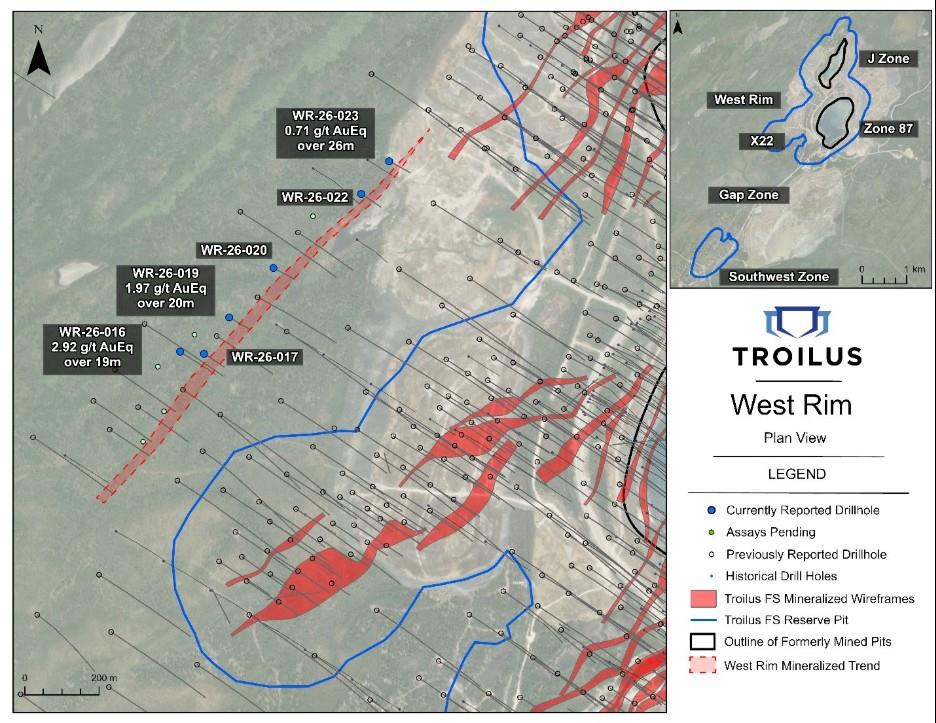
Figure 1. Plan map with the reported drill hole locations relative to the North reserve pit:
![260519_Figure=]()













Comments
No comment