




403
Sorry!!
Error! We're sorry, but the page you were looking for doesn't exist.
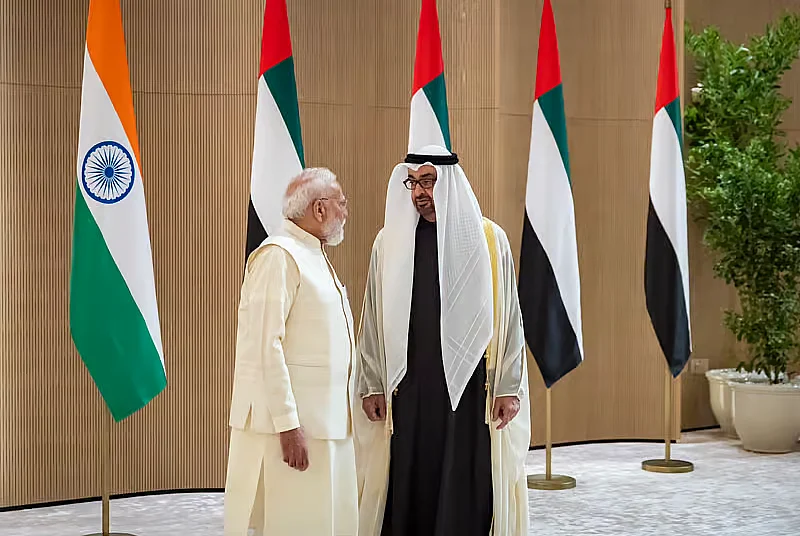
PM Modi's Visit Propels UAE-India Ties Towards $200-Billion Trade Goal
(MENAFN- Khaleej Times) Indian Prime Minister Narendra Modi's latest visit to the UAE has underscored the rapid transformation of India-UAE ties into one of the world's most strategically important economic partnerships, as both countries move beyond the $100-billion trade milestone and target bilateral trade of $200 billion over the next decade.
The visit, which produced a sweeping set of agreements in energy security, defence, artificial intelligence, infrastructure and maritime cooperation, comes at a time of heightened geopolitical uncertainty in the Middle East and growing concerns over global supply-chain resilience.
Recommended For YouStay up to date with the latest news. Follow KT on WhatsApp Channels.
Analysts say the agreements signal a decisive shift from a traditional oil-and-trade relationship to a deep strategic alliance built around energy security, sovereign investments, advanced technology and geopolitical coordination.
At the heart of the visit was energy security - a critical issue for India as disruptions linked to the ongoing US-Iran conflict and instability in the Strait of Hormuz continue to threaten global oil flows.
India imports nearly 90 per cent of its crude oil requirements, making it highly vulnerable to supply disruptions and price volatility. The UAE, meanwhile, has emerged as one of India's most dependable energy partners.
Among the most significant agreements signed during the visit was a strategic collaboration between Indian Strategic Petroleum Reserves Limited and Abu Dhabi National Oil Company (Adnoc) to expand the UAE's participation in India's strategic petroleum reserves to 30 million barrels.
The agreement includes existing Adnoc storage at Mangaluru as well as potential new storage facilities at Visakhapatnam and Chandikol in Odisha. It also opens the possibility of India storing crude oil in Fujairah while jointly exploring LNG and LPG storage projects.
India currently maintains strategic crude reserves of about 5.33 million metric tonnes - equivalent to roughly 38 million barrels - spread across underground caverns in Visakhapatnam, Mangaluru and Padur. The expanded UAE participation would substantially strengthen India's emergency energy buffer against future geopolitical shocks.
The UAE already supplies around 11 per cent of India's crude imports and nearly 40 per cent of its LPG requirements, making it one of New Delhi's most important energy suppliers.
According to Kpler trade-flow data, India's crude imports from the UAE rebounded strongly during April and May despite regional tensions, highlighting the close operational coordination between the two countries amid a volatile shipping environment.
Analysts say the UAE's recent exit from Opec+ production restrictions could further benefit India by giving Abu Dhabi greater flexibility to increase oil production capacity and secure long-term Asian market share.
Sultan Ahmed Al Jaber, Managing Director and Group CEO of Adnoc, described India as“one of the defining energy markets of our time”.
“As demand accelerates alongside a rapidly expanding population, the strength of the UAE-India energy partnership becomes ever more critical,” Al Jaber said.
The visit also delivered agreements in defence manufacturing, maritime security, cyber defence and advanced technologies.
India and the UAE signed a framework for a strategic defence partnership aimed at expanding cooperation in military training, secure communications and defence innovation.
A separate agreement between Cochin Shipyard and Drydocks World will establish a major ship repair and maritime infrastructure cluster at Vadinar in Gujarat, supporting India's ambitions to become a regional maritime services hub.
In artificial intelligence, UAE-based G42 and India's Centre for Development of Advanced Computing agreed to deploy one of India's largest AI supercomputing clusters, reflecting growing cooperation in digital infrastructure and next-generation technologies.
The UAE also announced investments worth $5 billion in India, including $3 billion by Emirates NBD in RBL Bank, $1 billion by Abu Dhabi Investment Authority alongside India's National Infrastructure & Investment Fund, and another $1 billion investment by International Holding Company in Sammaan Capital.
Economists say the agreements represent the natural evolution of the Comprehensive Economic Partnership Agreement (CEPA), signed in 2022, which dramatically accelerated bilateral trade.
Trade between the two countries has already crossed the $100 billion target well ahead of schedule, with officials now aiming for $200 billion by 2032.
The UAE is India's third-largest trading partner and one of its largest investors, while India remains the UAE's second-largest trading partner globally.
Dr Azad Moopen, founder chairman of Aster DM Healthcare, said the relationship had reached“new heights” under the leadership of Modi and UAE President Sheikh Mohamed bin Zayed Al Nahyan.
Faizal Kottikollon, chairman of UAE-India Business Council, said education, healthcare, innovation and skills development were becoming central pillars of the bilateral partnership.
Analysts say the India-UAE relationship is now evolving into a powerful economic corridor linking South Asia, the Middle East and Africa - one increasingly shaping global energy security, logistics, digital infrastructure and investment flows in an increasingly fragmented world.
ALSO READ- India says UAE to invest $5 billion in different sectors Modi's UAE visit signals strategic energy, defence pivot amid Gulf tensions Modi in UAE: 'Close bond' with Mohamed bin Zayed to drive high-level talks

Legal Disclaimer:
MENAFN provides the
information “as is” without warranty of any kind. We do not accept
any responsibility or liability for the accuracy, content, images,
videos, licenses, completeness, legality, or reliability of the information
contained in this article. If you have any complaints or copyright
issues related to this article, kindly contact the provider above.
Most popular stories
Market Research

More Story





Comments
No comment