



403
Sorry!!
Error! We're sorry, but the page you were looking for doesn't exist.
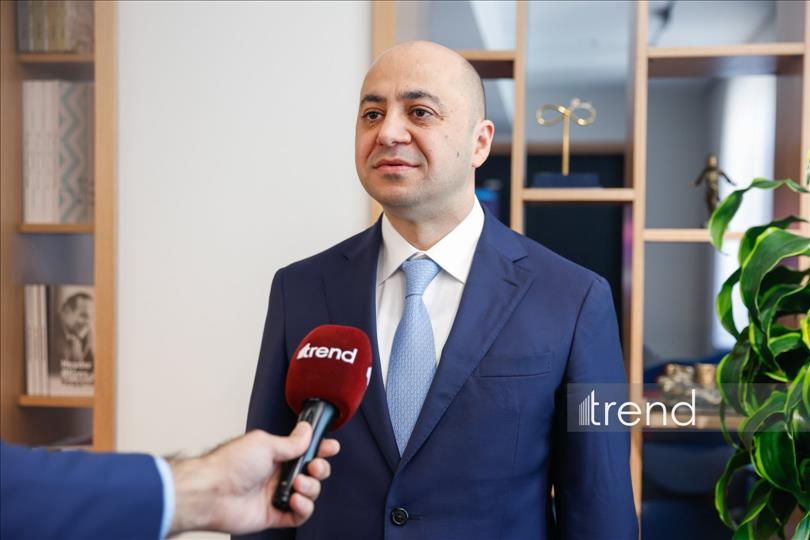
Baku Metro Announces Steps Toward Unified Transport System (Interview)
(MENAFN- Trend News Agency)
BAKU, Azerbaijan, May 12. Passengers will use a
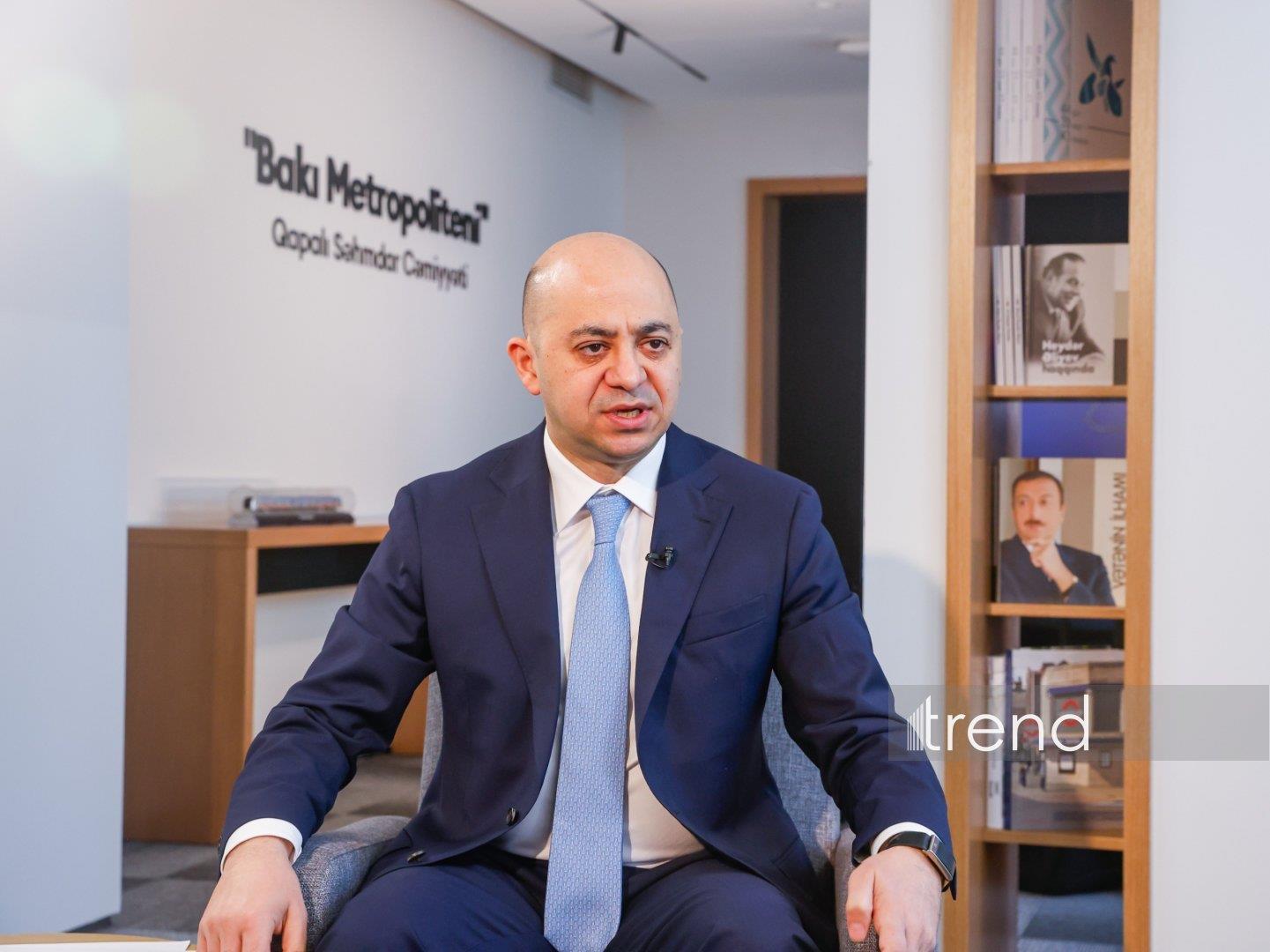
unified transport network, Chairman of Baku Metro CJSC, Vusal
Aslanov, said in an interview with Trend News Agency and Azad Azerbaijan
Independent Television and Radio Company.
He noted that the reorganization of Baku Metro CJSC in the form of the merger of BakuBus and Baku Taxi Service LLCs is the beginning of a qualitatively new stage in the development of public transport in the country, especially in the capital city.
According to him, today the world is discussing not individual means of transport, but the general mobility of cities as a whole.
"This mechanism, which has been applied in leading cities of the world for more than 15 years, aims to provide passengers with more accessible, more coordinated, more comfortable transport.
Passengers will no longer use the metro, bus, tram, and other modes of transport separately, but as elements of a single transport network that complements each other. The data obtained from the modes of transport will be processed and analyzed in a single center and will serve to make data-based decisions. This practice has been applied for a long time in cities such as London, Paris, Berlin, Hong Kong, and Singapore. This decision is also a strategic step in that direction.
Our main goal is that metro, bus, and taxi services do not duplicate each other, but rather complement each other. When a passenger leaves the metro and moves to a bus or taxi stop, he should feel the continuation of a single service chain. This will further facilitate the implementation of both a single payment system and single travel schedules in the future.
This decree covers the companies BakuBus and Baku Taxi. BakuBus is a state-owned company that operates many routes in Baku, as well as in the cities of Ganja and Khankendi. Baku Taxi consists of special taxis that our passengers call London taxis. The decree covers this area. Other routes, other bus services will continue their independent activities.
Aslanov pointed out that passengers will be able to switch between modes of transport more easily.
"In the cities I cited as an example, there are weekly, hourly, and monthly packages. This is one of the first steps towards launching these payment solutions. In the future, we'll be able to move towards the goal of implementing complex payments," he explained.
Tram coming back
Aslanov said that the tram has been one of the topics that has been discussed for a long time.
"The 2025–2030 state program includes special provisions on the tram. Currently, a conceptual plan for the tram is being prepared. Initially, it is planned to lay a tram from the Mehdiabad area to the center of Baku, discussing several alternative options. It is planned to have a tram in Baku in the future, in 5 different directions. The initial perspective is to lay a tram in densely populated areas that do not have access to mass public transport solutions. The goal is for the tram not to replace the metro and buses, but rather to be a means of connecting them," he clarified.
Baku metro preparing for major changes
According to Aslanov, the 2025–2030 State Program has defined specific tasks for all agencies related to road and transport infrastructure.
"We can mainly summarize the tasks related to the Baku Metro into three groups: ensuring the stable operation of the existing infrastructure, its modernization, and expanding the metro network.
According to this, current operational work is focused on reducing passenger density. Currently, if we compare the Baku Metro with 213 metros operating in the world, it is in the top 10 in terms of density. Considering that it is impossible to expand the infrastructure in a short time, work is being done to partially eliminate passenger density by reducing the intervals.
Previously, 30 pairs of trains operated in the direction of Hazi Aslanov - 28 May, the busiest route of the Baku Metro. For a long time, this was considered the maximum limit of the technical capabilities of the Baku metro. From 2025, we began to gradually reduce the intervals: first to 32 pairs of trains, then to 34, and now to 36 pairs of trains during the evening peak hours. This is based on infrastructure improvements and the digitalization of the timetable. This is, in fact, the new upper limit of our existing infrastructure.
Besides, we reduced the intervals on the Purple line from the Khojasan station to the Avtovağzal station from 16 minutes to 8 minutes, and from the Avtovağzal to the 8 Noyabr station from 10 minutes to 5 minutes. We reduced the 12-minute interval to 7 minutes on the Jafar Jabbarli - Khatai section of the Green Line. In the Hazi Aslanov - Ahmadli direction, our 10-minute interval was reduced to 5 minutes during peak hours.
How to reduce the interval between trains?
The chairman of Baku Metro CJSC noted that the separation of the Red and Green lines is one of the main conditions for further reducing the interval.
"We have already approached the maximum that our current infrastructure allows. We need to do fundamental work to reduce the interval even further.
Firstly, the signaling system that controls the trains must be updated - a tender will be held this year, and the implementation of this project will allow us to shorten the distance between trains and reduce the interval.
Secondly, there is the issue of line separation. Our Red and Green lines merge at the 28 May station, and in the 28 May - Hazi Aslanov area, an interval of 100–110 seconds is required to ensure technical safety. Considering that these trains come alternately from the Icherisheher and Darnagul directions, our interval in the opposite direction will automatically be less than 200 seconds. If we don't separate these lines, we won't be able to reduce this interval to less than this.
Each line must operate independently and have an independent depot. The construction of the Darnagul depot is ongoing. After the separation of the lines, the 28 May station will be used only by passengers using trains going in the Icherisheher direction. Passengers going in the Darnagul direction will use the Jafar Jabbarli station. We'll even put into operation the construction of an additional passenger tunnel connecting Jafar Jabbarli and 28 May in the summer months. This will be the first completed work under the separation of lines project.
One of the elements affecting the reduction of intervals is the 'return' issue. Construction work has begun behind the Icherisheher station - after the work is completed there, the train will enter the station, move to the cul-de-sac behind the station, and the next train to the Sahil station will arrive much faster. This project also has an interesting aspect in terms of urban planning: a car park will be built on the underground infrastructure, and greenery and a park area will be prepared above ground," he said.

10 new metro stations are being built in Baku
Aslanov stressed that the construction of 10 new metro stations in the capital is planned within the framework of the state program.
"The station, whose code name is B4, is expected to be commissioned by the end of this year, as the main engineering work has been completed there and the interior design process has begun. Tenders will be announced for the other 9 stations this year, and construction work will start next year.
The development on the Green Line will mainly cover the eastern part of the city, and by 2030, the gap from Khatai station to Hazi Aslanov station will be filled with the construction of four new stations - Y-14, Y-15, Y-16, and Y-17. These stations will be located at strategic points such as Agh Sheher (Baku White City), 8 Noyabr avenue, and Nargila circle. On the Purple Line, it is planned to build 6 new stations - B-4 to B-8 - in order to create diversification in the city center. Stations B-5 (Nizami), B6A (Sahil), and B7 (Khatai) will intersect with the existing lines and perform the function of junctions and transitions.
The lack of metro construction in areas such as Binagadi, Yasamal, and Khirdalan is explained by technical reasons. If lines are built directly from the outskirts of the city without branching out to the central part of the city with alternative connections, the existing central infrastructure may be overloaded and paralyzed. According to simulations conducted on the 'digital twin' of Baku, first of all, the goal is to fully integrate the Purple line into the city center. After this line is fully extended to the center, it will be possible to effectively meet the flow of passengers coming from Khirdalan, Masazir, Sumgayit, and Baku-Shamakhi," he said.
What will change at the 28 May station?
The chairman of Baku Metro CJSC announced that the operation of the 28 May station won't be completely stopped within the framework of the line separation project.
"This means that the Green line will operate between the Darnagul and Nizami stations within the framework of the line separation project. 28 May will continue its operation. However, passengers using the Green line will not be able to get to 28 May directly, because construction work will be carried out in the tunnels between 28 May and Nizami. Nizami will actually act as the last station of the Green line.
Certain restrictions are inevitable when separating lines in urban transport. We have analyzed the departure and arrival data of our passengers with artificial intelligence-based digital solutions. We have an analysis of line changes from 20 Yanvar, Ganjlik, and all other stations. We have shared this information with the Azerbaijan Land Transport Agency, and alternative bus lines will be determined.
About 1,600 passengers are transported on one train arriving at the Nizami station at 3-minute intervals. To transfer them to 28 May, 20 buses would be needed every 3 minutes, which is both a technically difficult issue and can create serious congestion in the city center. Therefore, it is planned to regulate this issue with alternative bus routes. Detailed information about this will be provided to the public in cooperation with the Azerbaijan Land Transport Agency," he said.
According to him, the Hazi Aslanov-2 station is envisaged in the conceptual plan under the conditional name Y-17.
"Hazi Aslanov-2 is a station designated in our conceptual plan under the conditional name Y-17. That station will not operate independently - it must be connected to the Khatai station, and for this it's necessary to build tunnels with the next three stations. The new tender package that has been prepared also includes that station. Active construction work will begin next year, and it will be commissioned by 2030," he said.

In the complex geological territory of the city, how will the B-5 station be built?
Aslanov emphasized that the area where the B-5 station will be located has been seriously analyzed from a geological point of view.
--
Legal Disclaimer:
MENAFN provides the
information “as is” without warranty of any kind. We do not accept
any responsibility or liability for the accuracy, content, images,
videos, licenses, completeness, legality, or reliability of the information
contained in this article. If you have any complaints or copyright
issues related to this article, kindly contact the provider above.
Most popular stories
Market Research

More Story




Comments
No comment