




403
Sorry!!
Error! We're sorry, but the page you were looking for doesn't exist.
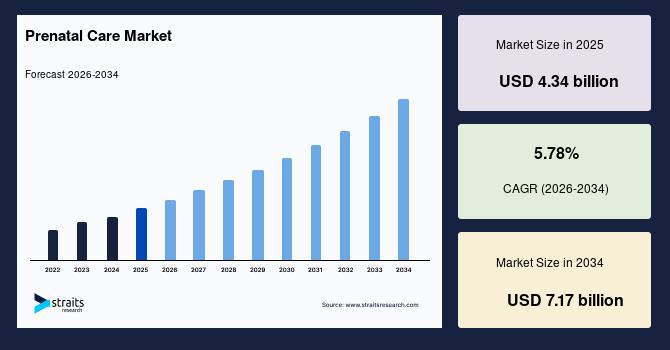
Prenatal Care Market Size, Share & Growth Graph By 2034
| Market Metric | Details & Data (2025-2034) |
|---|---|
| 2025 Market Valuation | USD 4.34 billion |
| Estimated 2026 Value | USD 4.57 billion |
| Projected 2034 Value | USD 7.17 billion |
| CAGR (2026-2034) | 5.78% |
| Dominant Region | North America |
| Fastest Growing Region | Asia Pacific |
| Key Market Players | Siemens Healthcare, Philips Healthcare, Fisher & Paykel Healthcare Limited, Nine Naturals LLC., Mama Mio US Inc. |
to learn more about this report Download Free Sample Report
Emerging Trends in Prenatal Care Market Targeted Prenatal Care for Improved Clinical OutcomesPrenatal care is moving beyond generalized products toward trimester-specific supplements and condition-based interventions such as anemia-focused or high-risk pregnancy formulations, which is reshaping demand toward more targeted offerings and improving clinical outcomes. This shift is pushing manufacturers to develop differentiated product lines with precise ingredient combinations and evidence-backed positioning, increasing product complexity while enabling premium pricing strategies.
Inclination toward Continuous Observation Outside Clinical SettingsThere is a growing trend of integrating home-based fetal monitoring devices and digital tracking tools with routine prenatal care, allowing continuous observation outside hospital settings and improving early detection of complications. This evolution is expanding the market beyond traditional clinical environments while requiring manufacturers to invest in connected devices, user-friendly interfaces, and data integration capabilities to remain competitive.
Market Drivers Rising Clinical Emphasis on Early Prenatal Intervention and Increasing Maternal Age Drives MarketHealthcare systems are increasingly prioritizing early-stage prenatal screening and continuous monitoring to reduce complications, which is driving consistent demand for diagnostic equipment, supplements, and routine care services throughout pregnancy. This sustained demand cycle is encouraging manufacturers to expand product portfolios that cater to multiple stages of pregnancy, ensuring repeat usage and long-term customer engagement.
A steady rise in maternal age is leading to a higher incidence of high-risk pregnancies, which is intensifying the need for advanced diagnostics, specialized supplements, and frequent monitoring. This dynamic is pushing manufacturers to innovate in high-precision equipment and specialized nutritional products while also creating opportunities for premium and high-margin offerings tailored to complex pregnancy needs.
Market Restraints Limited Standardization Across Prenatal Product Formulations and Access Disparities in Prenatal Care Infrastructure Restrains Prenatal Care Market GrowthThe lack of uniform global standards for prenatal supplements and care practices leads to variability in product composition and clinical recommendations, which creates confusion among consumers and limits consistent adoption across regions. This inconsistency forces manufacturers to navigate diverse regulatory environments and adapt formulations for different markets, increasing operational complexity and slowing global scalability.
Significant gaps in healthcare infrastructure, especially in rural and low-resource settings, restrict access to advanced prenatal diagnostics and consistent care services, which limit overall market penetration. This uneven access challenges manufacturers to balance affordability with innovation, often requiring the development of low-cost alternatives while maintaining product efficacy and quality.
Market Opportunities Expansion of Personalized Prenatal Nutrition and Growth of Wellness-oriented Care Products Offer Growth Opportunities for Prenatal Care Market PlayersThe growing availability of health data and diagnostics is enabling the development of personalized prenatal nutrition plans tailored to individual deficiencies and risk factors, which enhances treatment effectiveness and patient compliance. This trend is opening new avenues for manufacturers to create customized supplement solutions and subscription-based models, allowing deeper consumer engagement and differentiation in a competitive market.
There is increasing demand for products that focus on prevention and overall maternal wellness rather than only addressing deficiencies or complications, including skincare, mental well-being, and recovery solutions. This shift is expanding the scope of the prenatal care market and encouraging manufacturers to diversify into adjacent categories, creating new revenue streams while strengthening brand positioning across the pregnancy journey.
Regional Insights North America: Market Leadership Driven by Advanced Maternal Health Monitoring Systems and Policy InterventionsNorth America dominated the market with a 43.21% share in 2025 driven by structured maternal health programs and continuous monitoring of pregnancy outcomes. The region benefits from strong public health tracking systems that guide prenatal care improvements and policy decisions. Persistent focus on reducing maternal mortality and improving early prenatal access is shaping service delivery models. Health systems are increasingly shifting toward personalized prenatal care schedules to improve outcomes. Digital health tools and teleconsultation are being integrated to address care gaps in underserved areas. This evolving care model is strengthening demand for both clinical and home-based prenatal solutions.
The US prenatal care market is influenced by the need to address maternal health risks and disparities across populations. The use of non-invasive prenatal testing (NIPT) and genetic screening is expanding, supported by companies like Natera and Illumina, which improve early risk detection and drives service utilization. Government programs and insurance coverage, including Medicaid, also make prenatal services more accessible, especially for underserved populations. Healthcare providers are adapting by expanding telehealth and community-based programs. There is a growing emphasis on risk-based prenatal care for high-risk pregnancies. Structural gaps such as maternity care deserts are accelerating innovation in care delivery. These factors collectively drive demand for advanced diagnostics, supplements, and remote care solutions.
Canada's prenatal care market is driven by its universal healthcare system, which ensures widespread access to prenatal services across provinces. The country maintains strong maternal health outcomes, aligning with OECD benchmarks, where maternal mortality remains significantly low compared to global averages. Preventive care models emphasizing early screening and routine monitoring are widely adopted. Government-supported maternal programs promote consistent prenatal visits and nutritional supplementation. There is increasing integration of midwifery services within formal healthcare systems, improving accessibility. Focus on rural and indigenous healthcare delivery is shaping targeted prenatal interventions.
Asia Pacific: Fastest Growth Driven by Community-based Maternal Health Programs and Healthcare Infrastructure ExpansionThe Asia Pacific region is expected to grow at a CAGR of 7.78% during the forecast period due to its high volume of pregnancies, with global estimates indicating around 210 million pregnancies annually, a significant share coming from this region. Rapid expansion of healthcare infrastructure in emerging economies is improving access to prenatal services. Governments are prioritizing maternal and child health through large-scale public health initiatives. Increasing urbanization is leading to higher adoption of institutional prenatal care. There is a noticeable shift toward early diagnosis and nutritional supplementation. Private healthcare providers are expanding their presence, contributing to market growth.
India's prenatal care market is shaped by large-scale digital and community-based maternal health programs. Initiatives such as mobile health platforms are being used to deliver prenatal information and improve engagement among pregnant women. Programs delivering voice-based health messages have demonstrated improved reach and effectiveness in maternal care awareness. Government schemes are focusing on increasing institutional deliveries and early prenatal registration. Rural healthcare expansion through frontline workers is improving service penetration. There is growing adoption of affordable diagnostic tools and supplements. These efforts are strengthening early-stage prenatal care utilization across diverse populations.
China's prenatal care market is driven by the expansion of hospital-based maternity services and increasing focus on high-risk pregnancy management. Urban healthcare systems are integrating advanced diagnostic technologies for fetal monitoring and screening. Rising maternal age in urban populations is increasing the need for specialized prenatal care services. Government policies are supporting maternal health through structured hospital delivery systems. There is strong adoption of imaging technologies and prenatal testing in tier-1 and tier-2 cities. Public awareness around maternal health is contributing to higher utilization of prenatal services.
Japan's prenatal care market is driven by an increasing maternal age profile, which requires more frequent monitoring and specialized care. Advanced healthcare infrastructure supports high adoption of precision diagnostic tools in prenatal care. The country emphasizes regular prenatal checkups and detailed fetal assessments. Low birth rates are shifting focus toward ensuring high-quality outcomes for each pregnancy. Healthcare providers are adopting highly structured prenatal care protocols. Strong clinical standards and technological integration are sustaining demand for premium prenatal services.
By EquipmentThe ultrasound & ultrasonography devices segment dominated the prenatal equipment segment with a share of 42.13% in 2025, as they form the backbone of routine pregnancy monitoring and fetal assessment. Their ability to provide real-time imaging for tracking fetal growth, detecting abnormalities, and estimating gestational age makes them indispensable across all stages of pregnancy. The technology is non-invasive, cost-effective, and widely accessible across both developed and emerging healthcare systems, which strengthens its adoption.
Fetal magnetic resonance imaging is expected to be the fastest-growing segment at a CAGR of 6.12% during the forecast period, as it addresses the limitations of conventional ultrasound in complex diagnostic scenarios. It is increasingly utilized when detailed visualization of fetal organs, particularly the brain and spine, is required for accurate diagnosis. The rising prevalence of high-risk pregnancies and congenital abnormalities is driving the need for advanced imaging solutions, which further accelerates their adoption.
By Prenatal SupplementVitamins dominated the prenatal supplements segment with a share of 55.24% in 2025, as they are universally recommended as part of standard prenatal care. Essential nutrients such as folic acid, iron, and calcium play a critical role in preventing birth defects and supporting maternal health, which makes their consumption highly consistent across pregnancies. Physicians routinely prescribe prenatal vitamins from early pregnancy stages, ensuring strong and sustained demand.
The essential fatty acids segment is expected to grow at a CAGR of 6.45% during the forecast period as increasing attention is being placed on comprehensive fetal development beyond basic nutrition. Nutrients such as DHA are strongly associated with brain and eye development, which is influencing both clinical recommendations and consumer preferences. Expectant mothers are becoming more proactive in adopting supplements that offer long-term developmental benefits for the child. Scientific research supporting these benefits is strengthening product credibility in the market. Premium product positioning and targeted awareness campaigns are further driving adoption. This shift toward enhanced prenatal nutrition is accelerating the growth of this segment.
By Product TypeStretch mark minimizers dominated the segment, with a share of 36.15% in 2025, as they directly address one of the most visible and common physical changes during pregnancy. The high prevalence of stretch marks creates consistent demand for preventive and corrective skincare solutions among expectant mothers. These products are used both during pregnancy and in the postpartum period, which extends their consumption cycle.
The body restructuring gel segment is expected to grow at a CAGR of 6.54% during the forecast period due to increasing focus on postpartum recovery and body restoration. These products are designed to improve skin elasticity and support body toning after childbirth, which appeals to modern consumers seeking holistic care. Increasing awareness about post-pregnancy wellness is encouraging women to adopt such targeted solutions, which further supports its growth.
By Distribution ChannelHospital pharmacies dominated the distribution channel segment with a share of 43.56% in 2025 due to their direct integration with prenatal healthcare services. Pregnant women often prefer purchasing supplements and medical products from hospital settings where they receive care, as it ensures trust and authenticity. Physicians frequently recommend specific products that are readily available within hospital pharmacies, which influences purchasing decisions. Immediate access to required products during consultations adds to patient convenience. The credibility associated with hospital-based dispensing further strengthens consumer confidence. This close alignment with clinical care pathways sustains their leading position.
The online pharmacies segment is expected to grow at a CAGR of 6.88% during the forecast period, as digital healthcare adoption continues to expand among consumers. The convenience of home delivery and easy product comparison is attracting a growing number of expectant mothers. Increasing use of telehealth services has streamlined the process of obtaining prescriptions and purchasing products online. Consumers are also drawn to competitive pricing and subscription-based purchasing options. Wider product availability on digital platforms enhances choice and accessibility, which further is accelerating the shift toward this distribution channel.
Competitive LandscapeThe prenatal care market exhibits a moderately fragmented structure, with a mix of large multinational healthcare companies, specialized maternal health brands, diagnostic equipment manufacturers, and regional supplement and skincare providers. Established players typically compete on clinical credibility, product safety standards, regulatory approvals, integrated care offerings, and strong distribution networks through hospitals and pharmacies, leveraging brand trust and long-standing relationships with healthcare providers. In contrast, emerging players focus on digital engagement, personalized nutrition solutions, clean-label formulations, direct-to-consumer channels, and affordability, often targeting niche consumer segments such as high-risk pregnancies or wellness-oriented mothers. The competitive intensity is further shaped by innovation in diagnostic technologies and the expansion of telehealth-enabled prenatal services. The market will be shaped by the convergence of personalized prenatal care, digital health platforms, and preventive wellness-focused solutions.
List of Key and Emerging Players in Prenatal Care Market Siemens Healthcare Philips Healthcare Fisher & Paykel Healthcare Limited Nine Naturals LLC. Mama Mio US Inc. Clarions Group Expanscience Laboratories INC. Noodle & Boo. Atom Medical Corporation GE Healthcare Getinge AB Masimo Medtronic PLC Natus Medical Incorporated Phoenix Medical Systems (P) Ltd Vyaire Medical Recent Developments-
In February 2026, GE HealthCare entered a collaboration with Diagnoly to integrate AI-driven prenatal screening (Fetoly) into its Voluson ultrasound systems. This agreement focuses on improving fetal ultrasound accuracy, reducing operator variability, and enhancing early detection of congenital conditions.
In September 2025, Philips started advancing AI-enabled handheld ultrasound solutions designed for prenatal care, enabling midwives and frontline workers to assess fetal health parameters such as gestational age and amniotic fluid levels.
| Report Metric | Details |
|---|---|
| Market Size in 2025 | USD 4.34 billion |
| Market Size in 2026 | USD 4.57 billion |
| Market Size in 2034 | USD 7.17 billion |
| CAGR | 5.78% (2026-2034) |
| Base Year for Estimation | 2025 |
| Historical Data | 2022-2024 |
| Forecast Period | 2026-2034 |
| Report Coverage | Revenue Forecast, Competitive Landscape, Growth Factors, Environment & Regulatory Landscape and Trends |
| Segments Covered | By Equipment, By Prenatal Supplements, By Product Type, By Distribution Channel |
| Geographies Covered | North America, Europe, APAC, Middle East and Africa, LATAM |
| Countries Covered | US, Canada, UK, Germany, France, Spain, Italy, Russia, Nordic, Benelux, China, Korea, Japan, India, Australia, Taiwan, South East Asia, UAE, Turkey, Saudi Arabia, South Africa, Egypt, Nigeria, Brazil, Mexico, Argentina, Chile, Colombia |
to learn more about this report Download Free Sample Report
Prenatal Care Market Segments By Equipment-
Ultrasound and Ultrasonography Devices
Fetal Dopplers
Fetal Monitors
Fetal Magnetic Resonance Imaging
-
Minerals
Vitamins
Essential Fatty Acids
Others
-
Body Restructuring Gels
Stressed Legs Products
Stretch Marks Minimizers
Dark Spots Treatment Creams
Skin Toning Lotions
-
Hospital Pharmacies
Online Pharmacies
Supermarkets
Drug Stores
-
North America
Europe
APAC
Middle East and Africa
LATAM

Legal Disclaimer:
MENAFN provides the
information “as is” without warranty of any kind. We do not accept
any responsibility or liability for the accuracy, content, images,
videos, licenses, completeness, legality, or reliability of the information
contained in this article. If you have any complaints or copyright
issues related to this article, kindly contact the provider above.
Most popular stories
Market Research

More Story








Comments
No comment