




403
Sorry!!
Error! We're sorry, but the page you were looking for doesn't exist.
Financial Stress Keeps Singapore Awake, While Overall Well-Being In APAC Lags Behind Global Peers
|
Vitality Score
|
Overall Well-Being
(% rating as "excellent" or "very good") |
Top Three Areas of Well-Being
(% rating as "excellent" or "very good" in 2025) |
|
2025: 61.2
2024: 61.4 |
2025: 34%
2024: 33% |
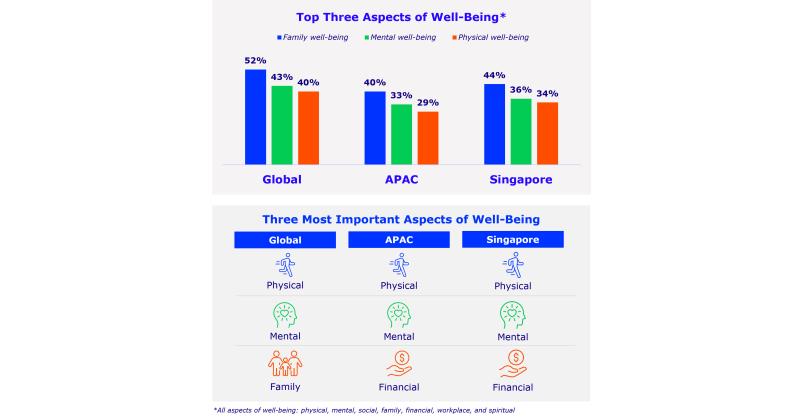
Family well-being: 44%
Mental well-being: 36% Physical well-being: 34% |
On a regional level, overall well-being in Asia Pacific lags behind the global average, with less than three in 10 (28%) Asia-Pacific respondents rating their overall well-being as "excellent" or "very good", compared to four in 10 (41%) globally. While physical and mental well-being are the two most important aspects of well-being for respondents globally, financial well-being is more important for those in Asia Pacific, coming in as the third most important aspect. With financial well-being remaining the weakest aspect across the globe, there is a pressing need for governments and organizations to render support to address financial concerns.
Robert Peat, Chief Executive Officer, Asia Pacific, Cigna Healthcare said: "Asia Pacific continues to be one of the fastest growing regions in the world. To sustain this momentum, communities and employers need to recognize that healthy people are the foundation of a healthy economy and implement measures to close the gaps in their well-being."
Sleepless in Singapore: Financial stress as the sleep killer
While mental well-being in Singapore remains stable with more than a third of respondents rating it as "excellent" or "very good" this year, eight in 10 (79%) respondents are stressed. Their greatest stressors are the current cost of living (53%); uncertainty about the future (47%); and personal finance (43%).
Stress affects more than mental and emotional health and can have huge implications on physical well-being. Our study reveals that disrupted sleep is the most common effect of stress among respondents in the nation, with close to half (48%) of respondents who are stressed reporting this effect, compared to 38% regionally.
Therapy remains underused by Singapore respondents. Despite nearly half (49%) of respondents reporting being negatively impacted by poor mental health, nearly nine in 10 (89%) say they did not receive counselling or therapy in the past 12 months, with 77% believing they do not need it. Given the impacts of stress and poor mental health on physical and overall well-being, more efforts are needed to raise awareness about the benefits of therapy and destigmatize seeking help.
Exercise culture runs strong in Singapore
More than a quarter (26%) of respondents in Singapore rate their exercise habits as "excellent" or "very good".
When asked how they manage their weight, two-thirds (66%) said they exercise regularly, higher than the Asia-Pacific average of 61%; with only 4% of Singapore respondents turning to medication for weight management. The findings underscore a relatively strong exercise culture and the prioritization of healthy habits among those living in the nation. Communities and organizations may leverage the growing fitness trend to enhance physical well-being.
Cautious optimism around AI in healthcare
Close to half (47%) of Singapore respondents are positive about the impact of AI on healthcare, with 45% expecting it will reduce wait times within three years. This could have an outsized impact in Singapore, as respondents here are 29% more likely to have delayed or avoided getting care due to concern with wait times than their regional counterparts.
Additionally, almost half of Singapore respondents (48%) mention a reduction in human interaction as an expected change with the advent of AI. The challenge ahead is striking the right balance between efficiency and empathy.
The full findings of the report are available here.

Legal Disclaimer:
MENAFN provides the
information “as is” without warranty of any kind. We do not accept
any responsibility or liability for the accuracy, content, images,
videos, licenses, completeness, legality, or reliability of the information
contained in this article. If you have any complaints or copyright
issues related to this article, kindly contact the provider above.
Most popular stories
Market Research

More Story






Comments
No comment