







403
Sorry!!
Error! We're sorry, but the page you were looking for doesn't exist.
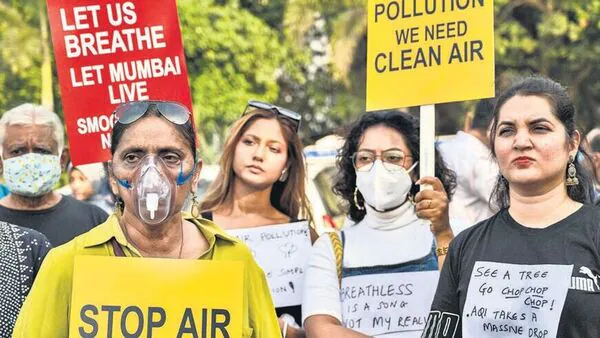
Mumbai Under GRAP‐4 Amid Poor Air Quality: Check What Is Not Allowed And Full List Of Guidelines
(MENAFN- Live Mint) The Brihanmumbai Municipal Corporation (BMC ) has implemented the Graded Response Action Plan-4 (GRAP-4) curbs in the Mumbai Metropolitan Region (MMR) to address the city's poor air quality.
Mumbai GRAP-4 rules
(Source: BMC) Also Read | Delhi AQI today: Several locations record 'very poor' air quality For construction material
In a detailed post on the social media platform X (formerly Twitter), BMC said that it has issued comprehensive guidelines covering 28 points, which include restrictions on construction activities that contribute to air pollution.
“Various measures are being taken by BMC to control air pollution in the MMR region (Mumbai city and suburbs). Guidelines have also been issued for air pollution control,” the city's municipal body stated in its photo posts.
Notably, the Mumbai suburbs of Borivali East, Chakala-Andheri East, Deonar, Malad, Mazgaon, Mulund, Navy Nagar, and Powai have been heavily impacted by poor AQI.
Also Read | Mumbai AQI: City chokes under smog; AQI at 111 with GRAP-4 restrictions active Mumbai imposes GRAP-4 rules: What does this mean?Notably, unlike Delhi's GRAP-4 rules, the requirements in Mumbai largely cover construction sites, small industrial units and related activities. According to the BMC guidelines, the following steps are to be followed strictly:
For construction sites- Construction projects over 70 meters tall require a minimum 35-foot-tall protective covering. Projects larger than one acre need a 35-foot covering, while smaller ones need a 25-foot covering. Buildings under construction must be completely enclosed with green cloth, jute, or tarpaulin. Demolition sites must also be entirely covered, and water must be continuously sprinkled during the process. Water must be continuously sprayed on construction materials while loading and unloading them at the construction project site. A sensor-based air pollution monitoring system should be deployed at all construction project sites, and immediate action should be taken if the pollution level is found to be above the limit. This monitoring system should be made available to BMC officials for supervision as needed.
Mumbai GRAP-4 rules
(Source: BMC) Also Read | Delhi AQI today: Several locations record 'very poor' air quality For construction material
- Water must also be consistently sprayed on debris/other materials at the construction site that generate dust particles. All work, such as grinding, cutting, drilling, sawing, and trimming, should be done in enclosed areas. Continuous water spraying should be used while working to minimise the generation of dusty air. Small industries such as bakeries have also been directed to track and limit their pollution levels. Construction and demolition debris generated at each construction site/premises should be taken only to the locations designated in the BMC's Construction and Demolition Debris Management Plan. After unloading the debris, the vehicle should be completely washed.
Also Read | Bomb scare at Kerala CM's residence; security forces, dog squad sweep premises For vehicles
- All vehicles transporting construction materials should be completely covered on all sides, ensuring that construction materials or debris particles do not mix with the air during transport. Do not carry material heavier than the limit in the vehicle, so that it does not fall during transport. CCTV cameras must be installed on all sides at all construction project sites. This will ensure that the wheels of vehicles carrying goods are clean and that the material is transported in compliance with the weight limit in the vehicles. All vehicles transporting materials must have a valid Pollution Under Control (PUC) certificate. PUC certificate should be presented to the competent authorities when and as requested. The Transport Commissioner has been directed to take action against vehicles exceeding the weight limit, uncovered vehicles, and those operating in a manner that causes construction materials to fall onto the roads. Heavy diesel vehicles that are more than eight years old will be strictly prohibited from plying within the Mumbai jurisdiction.
- All construction workers/managers will be required to wear personal protective equipment, such as masks, goggles, and helmets. All projects, such as bridges and flyovers, undertaken by the BMC should have 25-foot-high barricades at the site. All above-ground works of the metro rail project should be covered with a 25-foot-high barricade. The construction site should be covered with tarpaulin/green cloth/jute sheets. Smog guns/water sprinklers should be used during construction. The Maharashtra Pollution Control Board is directed to monitor air pollution emitted by BPCL, HPCL, RCF, Tata Power and industries in nearby industrial estates on a daily basis and take appropriate action. A daily report of this action should be submitted to the Additional Municipal Commissioner (Western Suburbs) and Additional Municipal Commissioner (City). All these preventive measures are mandatory for SRA, MHADA, MIDC, MSRDC, MMRDA, BPT, the Airports Authority of India, the Railways, government or semi-government authorities, as well as private construction projects.

Legal Disclaimer:
MENAFN provides the
information “as is” without warranty of any kind. We do not accept
any responsibility or liability for the accuracy, content, images,
videos, licenses, completeness, legality, or reliability of the information
contained in this article. If you have any complaints or copyright
issues related to this article, kindly contact the provider above.
Most popular stories
Market Research

More Story





Comments
No comment