








403
Sorry!!
Error! We're sorry, but the page you were looking for doesn't exist.
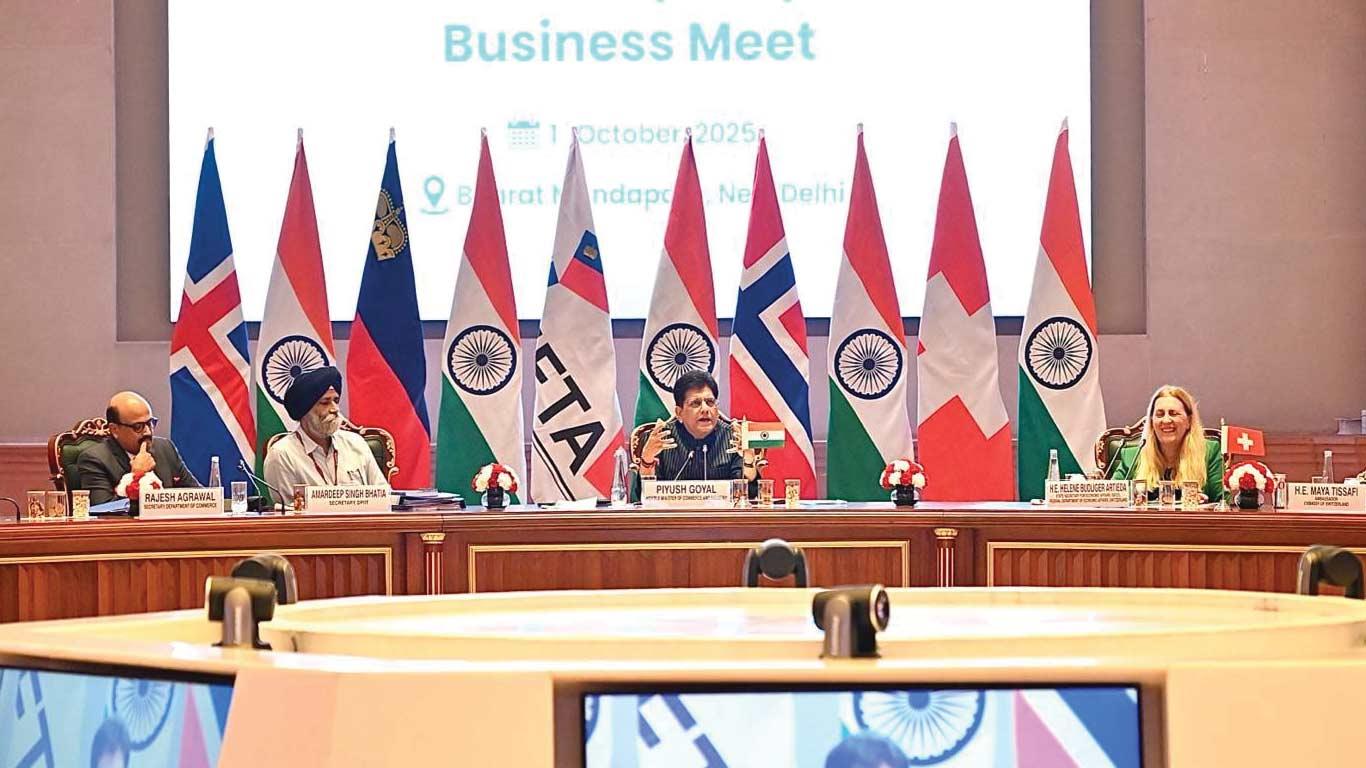
Indiaefta TEPA Comes Into Force, Expected To Attract USD 100 Bn Investment & Generate 1 Mn Jobs
(MENAFN- KNN India)
New Delhi, Oct 4 (KNN) The Prosperity Summit in New Delhi on Friday marked the entry into force of the India–EFTA Trade and Economic Partnership Agreement (TEPA), a comprehensive pact between India and the four member states of the European Free Trade Association - Switzerland, Norway, Iceland, and Liechtenstein.
The agreement is expected to attract USD 100 billion in investment over the next 15 years and generate 1 million direct jobs in India, while expanding mutual access to goods and services markets across the partner economies.
Commerce and Industry Minister Piyush Goyal, addressing the Summit, described TEPA as a“defining moment in India's economic partnership with Europe” and a“trusted partnership between friends built on mutual respect and sensitivities.”
He underlined that TEPA is the first trade agreement to include a firm investment commitment, balancing interests and ensuring fairness between partners.
Goyal outlined broad areas of cooperation including life sciences, clean energy, precision engineering, food processing, AI and digital services, accountancy, nursing, education, culture, tourism, and recreation.
He also cited geothermal energy partnerships with Iceland, maritime and shipbuilding collaboration with Norway, and advanced manufacturing and innovation projects with Switzerland and Liechtenstein.
Emphasising complementarities between Indian scale and EFTA innovation, Goyal noted that India's cost competitiveness, digital leadership, and skilled workforce strengthen its position as a global investment hub.
He pointed to India's 2,500 global capability centres and its appeal to multinational companies such as Nestlé and ABB, whose high market valuations in India reflect investor confidence.
Inviting investors from EFTA countries, the Minister assured them of India's open and transparent business environment, with 100 percent FDI permitted in most sectors, and pledged faster and more efficient approval pathways.
He said TEPA is“not merely about tariff reduction but about establishing a stable, trusted framework that reduces uncertainty and signals commitment to sustainable growth.”
Implementation of TEPA will focus on sectoral roadmaps in engineering, pharmaceuticals and med-tech, food processing, textiles, apparel, and marine products.
Outreach efforts will aim to onboard MSMEs, facilitate skills and quality enhancement, and improve logistics efficiency to reduce port dwell and transit times.
Both sides will jointly monitor FTA utilisation, investment growth, and services outcomes.
The partnership draws on the 'Power of Five (Panch)' - India's scale, demand, and talent; Switzerland's precision manufacturing and finance; Norway's maritime and clean energy expertise; Iceland's clean-tech and digital innovation; and Liechtenstein's high-value engineering.
TEPA's market access provisions are expected to benefit farmers, MSMEs, and service providers, particularly in agri-marine exports, specialty foods, digital services, and professional mobility. It will reduce compliance costs, foster standards cooperation, and open new avenues for mutual recognition of professional qualifications.
The Prosperity Summit concluded with several investment announcements from EFTA companies and a shared commitment to a results-driven partnership.
(KNN Bureau)

Legal Disclaimer:
MENAFN provides the
information “as is” without warranty of any kind. We do not accept
any responsibility or liability for the accuracy, content, images,
videos, licenses, completeness, legality, or reliability of the information
contained in this article. If you have any complaints or copyright
issues related to this article, kindly contact the provider above.
Most popular stories
Market Research

More Story







Comments
No comment