




403
Sorry!!
Error! We're sorry, but the page you were looking for doesn't exist.
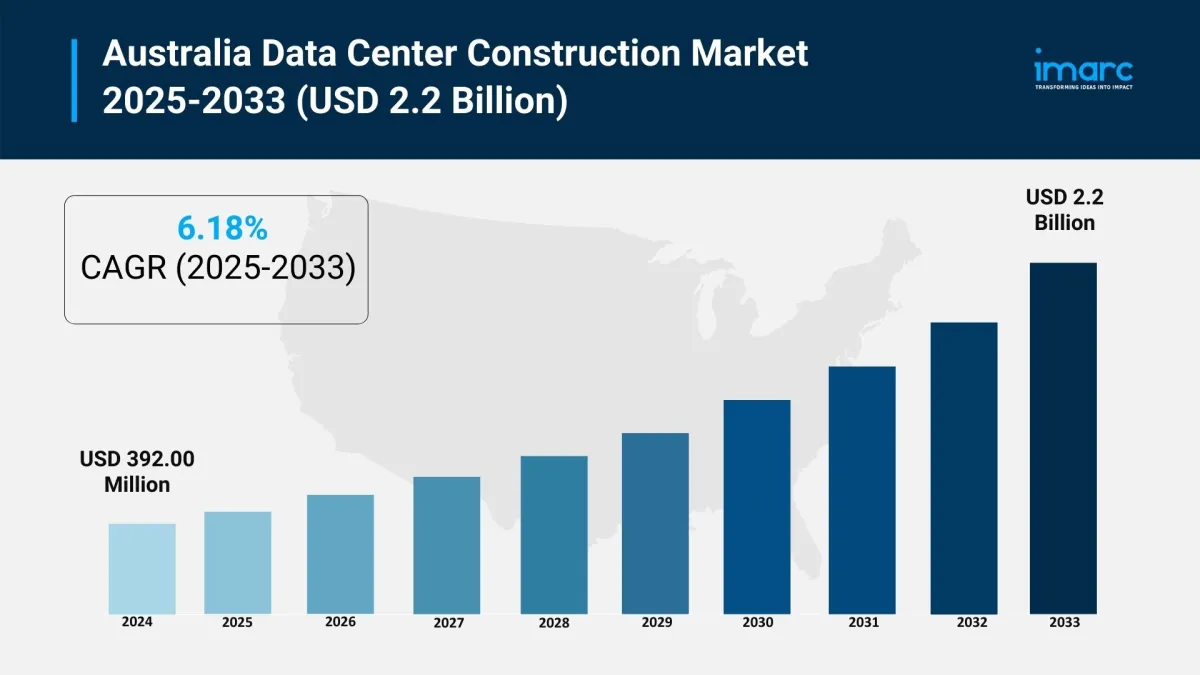
How Will Australia Data Center Construction Market Size, Share & Growth Evolve By 2033?
(MENAFN- IMARC Group)
The latest report by IMARC Group, titled“ Australia Data Center Construction Market: Industry Trends, Share, Size, Growth, Opportunity and Forecast 2025–2033 ,” provides a comprehensive analysis of the Australian data center construction market. The market size reached USD 1.2 Billion in 2024 . Looking forward, it is projected to reach USD 2.2 Billion by 2033 , exhibiting a compound annual growth rate (CAGR) of 6.18% during 2025–2033 .
Base Year: 2024
Forecast Years: 2025–2033
Historical Years: 2019–2024
Market Size in 2024: USD 1.2 Billion
Market Forecast in 2033: USD 2.2 Billion
Market Growth Rate (2025–2033): 6.18%
Australia Data Center Construction Market Overview
The Australian market is rapidly advancing due to digital transformation in sectors such as healthcare, retail, and finance, resulting in heightened demand for scalable, efficient data center infrastructure. Investments in new facilities-such as NEXTDC's D1 Darwin data center and HMC Capital's USD 2.12 billion acquisition of Global Switch Australia-highlight the strategic priority of digital infrastructure and position Australia as a leading hub in the Asia-Pacific region. Sustainability is a key focus, with green data center projects utilizing renewable energy and advanced cooling methods, exemplified by major developments in Sydney, Melbourne, and Perth.
Growing use of artificial intelligence, 5G, modular construction, and edge infrastructure fuels demand for high-density and highly reliable data center environments. Strategic location, regulatory support, and increased foreign investment reinforce ongoing growth and innovation, making Australia a target for both hyperscale and regional facilities.
Request For Sample Report:
https://www.imarcgroup.com/australia-data-center-construction-market/requestsample
How AI Is Transforming Australia's Data Center Construction Market
Artificial intelligence is driving a paradigm shift in Australia's data center construction sector through smarter design, greener efficiency, and accelerated deployment. AI-driven analysis fuels advanced cooling solutions-like liquid cooling and adaptive airflow systems-optimizing energy and water use in high-density facilities designed for AI workloads. Construction efficiency is also improving via modular and prefabricated components, enabled by AI-informed planning and global best practices, speeding up delivery timelines and reducing on-site risks. Moreover, AI is tightly integrating with renewable power management-helping real-time coordination between data centers, grids, and battery systems to enhance both sustainability and operational resilience. Behind the scenes, cutting-edge concepts like digital twins and“Physical AI” frameworks are emerging, enabling real-time simulation of thermal dynamics and infrastructure planning to dramatically improve precision and reduce costs during construction and operation phases.
Australia Data Center Construction Market Trends
-
Emphasis on sustainable design, renewable energy, and energy-efficient cooling.
Expansion of hyperscale and modular data centers supporting AI and cloud innovation.
Increased adoption of edge computing infrastructure for IoT and low-latency services.
Government policy support and investment initiatives strengthening digital infrastructure.
Regional diversification, including major developments in Sydney, Melbourne, Darwin, and Western Australia.
Shift toward LEED-certified and green data center construction.
Australia Data Center Construction Market Drivers
-
Acceleration of digital transformation across industries requiring secure, scalable data infrastructure.
Nationwide deployment of 5G and adoption of AI driving new data center demands.
Strategic geopolitical location attracting global operators and investors.
Rising enterprise and government focus on cybersecurity, data sovereignty, and compliance.
Ongoing infrastructure upgrades to ensure operational reliability and business continuity.
Challenges and Opportunities
Challenges:
-
High capital and operating costs for sustainability and advanced technologies.
Regulatory compliance and approval complexities in various regions.
Power supply and energy management constraints as capacity grows.
Opportunities:
-
Growth of green energy data centers with declining renewable power costs.
Edge computing and modular facilities delivering scalable, rapid deployment solutions.
Public-private partnerships expanding digital reach, particularly in remote or underserved areas.
Technology-driven upgrades supporting hybrid, hyperscale, and AI-centric workloads.
Australia Data Center Construction Market Segmentation
By Construction Type:
-
Electrical Construction
Mechanical Construction
By Data Center Type:
-
Mid-Size Data Centers
Enterprise Data Centers
Large Data Centers
By Tier Standards:
-
Tier I & II (Introductory, cost-effective)
Tier III (High reliability, redundancy)
Tier IV (Maximum fault tolerance, premium reliability)
By Vertical:
-
Public Sector
Oil and Energy
Media and Entertainment
IT and Telecommunication
Banking, Financial Services, and Insurance (BFSI)
Healthcare
Retail
Others
By Region:
-
Australia Capital Territory & New South Wales
Victoria & Tasmania
Queensland
Northern Territory & Southern Australia
Western Australia
Australia Data Center Construction Market News
-
NEXTDC opens D1 Darwin data center, boosting secure, low-latency cloud and AI access.
GreenSquareDC announces AUD 1 billion renewable energy-powered AI data center in Perth.
OVHcloud debuts third Sydney data center with state-of-the-art water-cooling for edge computing efficiency.
HMC Capital finalizes acquisition of Global Switch Australia sites for USD 2.12 billion, targeting significant capacity expansion.
Blackstone and Canada Pension Plan Investment Board acquire AirTrunk in a landmark Asia-Pacific digital infrastructure deal.
Key Highlights of the Australia Data Center Construction Market Report
-
1. Market Performance (2019-2024)
2. Market Outlook (2025-2033)
3. COVID-19 Impact on the Market
4. Porter's Five Forces Analysis
5. Strategic Recommendations
6. Historical, Current and Future Market Trends
7. Market Drivers and Success Factors
8. SWOT Analysis
9. Structure of the Market
10. Value Chain Analysis
11. Comprehensive Mapping of the Competitive Landscape
Q&A Section
Q1: What drives growth in Australia's data center construction market?
A1: Digital transformation, rising AI and 5G adoption, sustainability goals, and expanding cloud/data infrastructure demand.
Q2: Which regions lead development?
A2: New South Wales (Sydney), Victoria (Melbourne), Western Australia (Perth), and Northern Territory (Darwin) are major growth hubs.
Q3: What challenges exist?
A3: High costs, regulatory compliance, and energy management constraints.
Q4: What are the future opportunities?
A4: Green and edge data centers, modular and hyperscale facility expansion, and public-private partnerships.
About Us
IMARC Group is a global management consulting firm supporting changemakers worldwide with market research, entry, and expansion strategies.
Contact Us
IMARC Group
134 N 4th St. Brooklyn, NY 11249, USA
Email: sales[@]imarcgroup.com
Tel No: (D) +91 120 433 0800
United States: +1-201-971-6302

Legal Disclaimer:
MENAFN provides the
information “as is” without warranty of any kind. We do not accept
any responsibility or liability for the accuracy, content, images,
videos, licenses, completeness, legality, or reliability of the information
contained in this article. If you have any complaints or copyright
issues related to this article, kindly contact the provider above.
Most popular stories
Market Research

More Story






Comments
No comment