


Saving Lesotho's Textiles


Yet amidst these headwinds, there are also new opportunities for renewal.
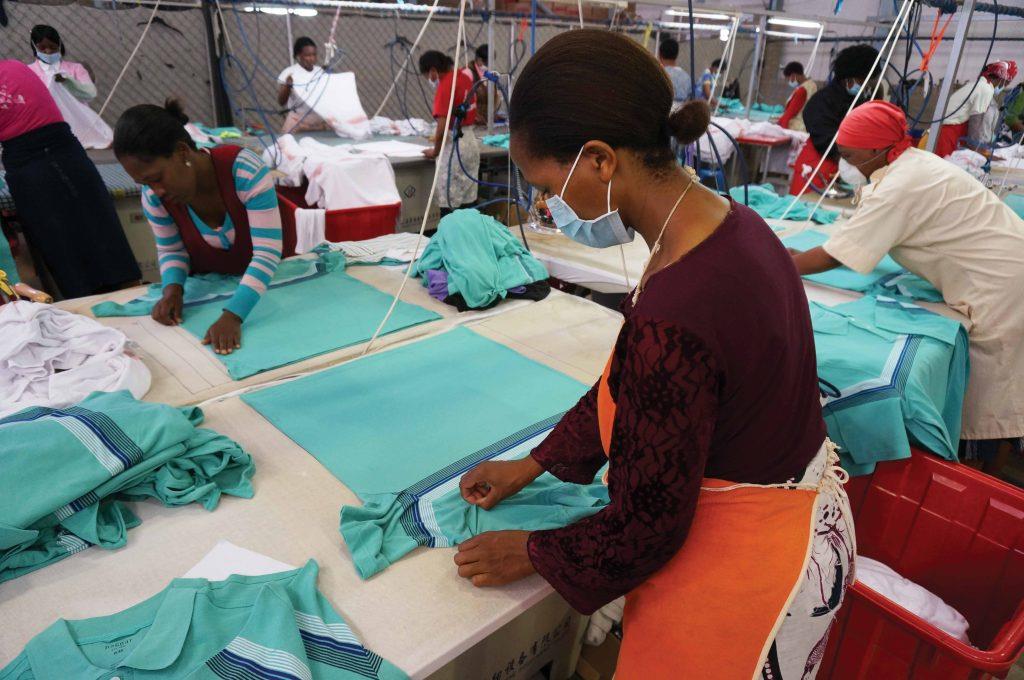
For decades, the textile and apparel industry has played a central role in Lesotho's economic development.
Thanks to preferential trade agreements such as the African Growth and Opportunity Act (AGOA), the country captured a valuable niche in the global value chain, primarily supplying garments to the United States.
The sector experienced substantial growth during the early 2000s, reaching the highest level of employment in the mid-2000s, with over 50000 workers. In more recent years, it contributed up to one-third of Lesotho's GDP and accounted for 43 percent of total exports in 2022 and employed over 45 000 workers, predominantly women.
Lesotho's success in textiles came through labour-intensive“Cut, Make, and Trim” (CMT) operations.
Under this model, international buyers supply the fabric, while local factories provide the labour to assemble the garments.
However, the Covid 19 pandemic triggered a sharp downturn due to disruption of supply chains. Factory closures saw employment drop below 35 000 by 2024.
The number of operating companies fell from 52 in 2021 to 36 by mid-2024, with only one vertically integrated textile mill remaining.
Currently, the sector employs barely 32 000 workers and the situation could deteriorate further if the proposed 50 percent US tariffs are enforced.
Most concerning was a 37.2 percent decline in garment exports to the United States, which was Lesotho's primary market between 2022 and 2023. Once the top African exporter to the US, Lesotho now ranks fourth behind Kenya, Madagascar and Ethiopia.
Adding to the pressure is the proposed imposition of 50 percent US tariffs on Lesotho's textiles, which would be a significant blow to the price-sensitive global apparel industry.
Simultaneously, the global sourcing landscape has shifted, shaped by inflation, geopolitical uncertainty, excess inventory, and a more risk-averse US retail sector.
The sector's importance extends beyond factory floors and gates.
It supports an ecosystem of secondary industries including street vendors, freight, packaging, accommodation, catering, telecommunications and utilities. This makes its revitalization critical to the broader Lesotho economy.
In recent years, aggressive competitors such as Bangladesh, Vietnam, Madagascar, and Kenya have moved beyond basic CMT operations.
By attracting substantial foreign direct investment (FDI), these countries have shifted toward higher-value Free on Board (FOB) production. Lesotho, by contrast, has been slower to transition, with only one firm producing its own denim and managing end-to-end operations.
Despite these challenges, there is reason for optimism. A national effort is underway to reposition Lesotho as a competitive sourcing destination.
The Lesotho National Development Corporation (LNDC) has launched an ambitious investment promotion drive, highlighting the country's skilled labour force, trade incentives, and upgraded industrial infrastructure.
This includes the construction of 16 new factory shells at Ha-Belo to attract both local and international investors.
To meet the growing global demand for ethical and sustainable production, the LNDC is partnering with Worldwide Responsible Accredited Production (WRAP) to promote Lesotho as an Ethical Sourcing and Investment Destination, with a strong focus on ESG and gender-based violence (GBV) compliance.
In parallel, the government is fast-tracking legislation for Special Economic Zones (SEZs) and finalising a new Investment Policy which will inform the Lesotho's Investment Law.
A Public-Private Dialogue (PPD) framework has also been established, with a dedicated Thematic Working Group on Textiles and Apparel tasked with drafting a comprehensive turnaround strategy for the sector backed by pragmatic policy reforms.
Crucially, the LNDC is also receiving technical assistance through the World Bank-financed Competitiveness and Financial Inclusion (CAFI) Project, coordinated by the Ministry of Trade, Industry and Business Development.
This support is helping to inform and implement key aspects of the sector's revitalization effort, including capacity building, social and environmental compliance, firm-level productivity assessments and enhancement.
Lesotho's long-term competitiveness will depend on two critical transitions:
1. Immediate shift to Sourcing FOB – empowering firms to manage fabric procurement and logistics, rather than relying solely on inputs from international buyers.
2. Medium-term move to Producing FOB – through strategic FDI and public-private partnerships that can establish local textile production capabilities, reduce reliance on imports, and shorten delivery lead times.
Recognising that some firms struggle to finance this transition due cash-flow constraints linked to long delivery lead times, the LNDC with technical assistance from the CAFI project is also finalising the design of a Supply Chain Finance (SCF) instrument aimed a easing access to finance for FOB firms.
While Lesotho does not currently produce most of its own fabric, examples from countries like Sri Lanka and Honduras show that FOB services can succeed by sourcing raw materials internationally without sacrificing market relevance.
Despite sharp declines in US-bound exports, Lesotho's secondary market, South Africa, has remained relatively stable, with exports falling only 3% in 2023. The country's proximity to South Africa offers a competitive advantage that could be further strengthened through better warehousing, integrated logistics, and cross-border collaboration.
Lesotho is also a signatory to several regional and international trade agreements, including SADC, AfCFTA, the EU-SADC Economic Partnership Agreement, and the SACU-European Free Trade Association (EFTA) Free Trade Agreement.
These provide long-term, negotiated market access opportunities that remain largely underutilised.
While AGOA continues to provide valuable access to the US market, its uncertain future underscores the urgency for Lesotho to diversify both its markets and products, while also modernising its industrial base.
Lesotho's textile and garment sector may be down, but it is far from out. With a skilled workforce, strategic location, preferential trade agreements, and a renewed commitment to industrial transformation, the country has a genuine opportunity for recovery.
However, success will require swift and coordinated action. A strategic pivot from labour-only CMT to higher-value FOB production supported by infrastructure, investment incentives, and ethical sourcing standards can restore Lesotho's standing in global apparel markets.
FOB firms could also adopt an aggregator approach by subcontracting small satellite CMTs in rural areas, helping curb unemployment among women and youth, reduce rural-urban migration, and alleviate poverty in impoverished villages.
To make this vision a reality, policymakers, industry leaders, and investors must work in concert through the PPD platform to safeguard jobs, rebuild confidence, and write the next chapter in Lesotho's industrial success story.
Chaba Mokuku is the managing director of CAFI.

Legal Disclaimer:
MENAFN provides the
information “as is” without warranty of any kind. We do not accept
any responsibility or liability for the accuracy, content, images,
videos, licenses, completeness, legality, or reliability of the information
contained in this article. If you have any complaints or copyright
issues related to this article, kindly contact the provider above.


Comments
No comment