





403
Sorry!!
Error! We're sorry, but the page you were looking for doesn't exist.
Centuries-Old Logbooks Reveal How Bowhead Whales Are Recovering From Near-Extinction
Author: Nicholas Freymueller
(MENAFN- The Conversation) Bowhead whales have the greatest life-span of any mammal on Earth. They can reach over 200 years in age thanks in part to their slow metabolism and cancer-suppressing genes.

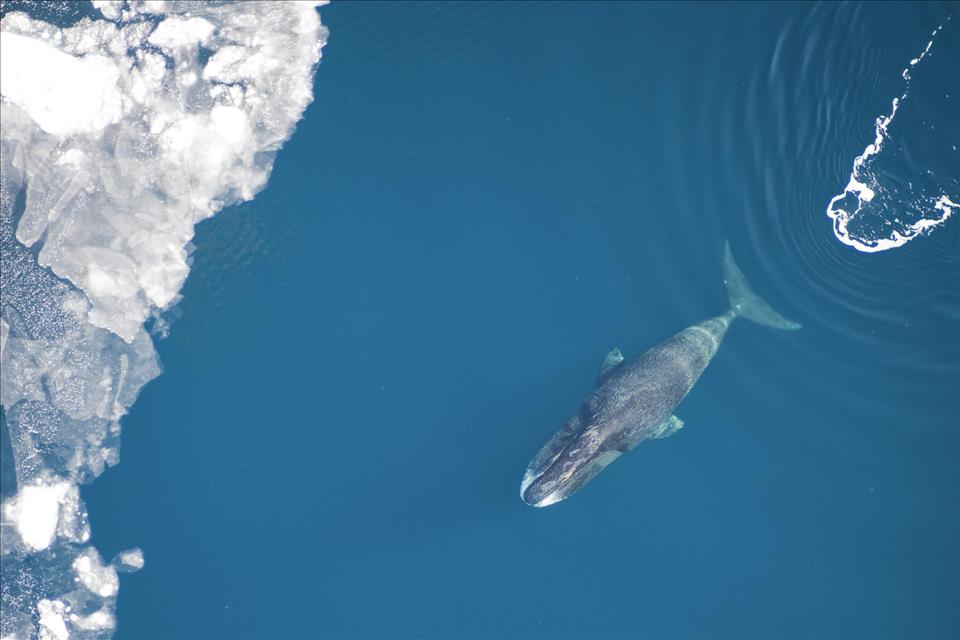
They are far stockier and shorter than other large baleen whales, making them perfectly adapted to life among Arctic sea ice. Their bodies are dark, verging on black. The only exception to this is the front part of their lower lips, which shines brilliant white.
For many thousands of years, bowhead whales have helped maintain stable Arctic marine food webs. For millennia, they have served as a vital food source for Inuit communities, who harvest them sustainably in spring and autumn during their seasonal migration.
Then commercial whaling arrived in the Arctic in the 1500s. For nearly 400 years, tens of thousands of whaling ships from Europe and North America travelled to the Arctic. Over this time, whalers killed over 250,000 bowhead whales.
These slow-moving giants were the most profitable whale to hunt, having the longest baleen of any whale, which was fashioned into women's corsets and other textiles. Their bodies yielded the most blubber, which when rendered into oil, illuminated winter nights in cities across Europe and North America.
By the time bowhead whaling was abandoned around 1914, there were likely fewer than 4,000 whales left. More than a century later, only two of their four populations have meaningfully began to bounce back. The reasons for these variable recovery patterns have remained a mystery. However, our new research helps explain why.
Tracing whaling routes through logbooksWe used old logbooks from whaling ships to understand how bowhead whales were exploited through time and space.
Many of these records were on Internet Archive, having been digitized by the New Bedford Whaling Museum.
As valuable as these logbooks were, they painted a frustratingly incomplete picture of where whalers travelled and killed whales.
This is because whalers typically failed to report their locations and, when they did, the information was often incomplete.
For nearly two years, we scoured through over 700 logbooks for additional clues as to where whalers voyaged. On some days, whalers noted the bay they were anchored in.
On other days, they reported locations like“72 degrees latitude, 40 miles off the coast.” That meant we had to figure out whether this coast meant Greenland or Baffin Island.
Even with this detective work, we were still left with many voyages with incomplete daily positional information.
To fill this gap, we turned to computer models designed to reconstruct animal movements. These models allowed us to fill the blanks and confidently trace complete whaling voyage routes across the Arctic.
Read more: Commercial whaling and climate change are inhibiting evolutionary change in Arctic whales
Sea ice protected bowhead whalesWe found that whalers spent summer months cautiously navigating through hazardous sea ice conditions. Sharp icebergs could tear through ship hulls while thick pack ice could trap and crush them.
They battled these treacherous icy conditions, suspecting that there were large numbers of whales beneath the impenetrable ice, out of reach of their ever-advancing weaponry.
Our research shows the whalers were right. We identified historic refugia - regions or environments that provide a safe haven for species - where bowhead whales were shielded from the devastating consequences of whaling for decades.
Whalers couldn't access these safe havens until improved technology enabled greater manoeuvrability through the ice. Such advancements included the invention of steamer ships powered by internal combustion engines.
By the time whalers began exploiting these remote icy locales in the 1880s, ships rarely pursued bowhead whales anymore. The Arctic whaling industry had become largely unprofitable, and many Arctic voyages returned home empty handed.
The refugia our research identified may be the key behind bowhead whale recovery patterns today.
The two bowhead whale stocks bouncing back today off Alaska and East Canada-West Greenland had the greatest amount of historical refugia. It is likely that this reduced the proportional impact of whaling on these populations, enabling them to recover sooner and faster.
A separate study of bowhead whale paleo-genetics backs up our finding. Geneticists used ancient DNA from bowhead whale fossils to quantify genetic diversity loss due to whaling in different populations. The bowhead whale populations that had more historic refugia experienced less negative population decline, thereby losing less genetic diversity.
Helping whales recover from whalingMany other whales were similarly exploited well into the late 20th century. Some species like humpbacks have rebounded strongly. Other species, including fellow members of the right whale family, remain highly threatened.
Why some whales have recovered and others remain threatened is not well understood. One hypothesis is that climate change has already resulted in habitat loss, slowing recovery.
Another hypotheses is that over-harvesting of whales changed food webs, reducing food availability and holding back recovery. This is because nutrient recycling by healthy whale populations promotes krill, their primary food.
Our research on bowhead whales offers a much simpler explanation. It suggests that the spatial pattern of hunting and the availability of refugia may be driving recovery patterns today despite whaling ceasing more than a century ago.
Institution:Adelaide University

Legal Disclaimer:
MENAFN provides the
information “as is” without warranty of any kind. We do not accept
any responsibility or liability for the accuracy, content, images,
videos, licenses, completeness, legality, or reliability of the information
contained in this article. If you have any complaints or copyright
issues related to this article, kindly contact the provider above.
Most popular stories
Market Research

More Story








Comments
No comment