




403
Sorry!!
Error! We're sorry, but the page you were looking for doesn't exist.
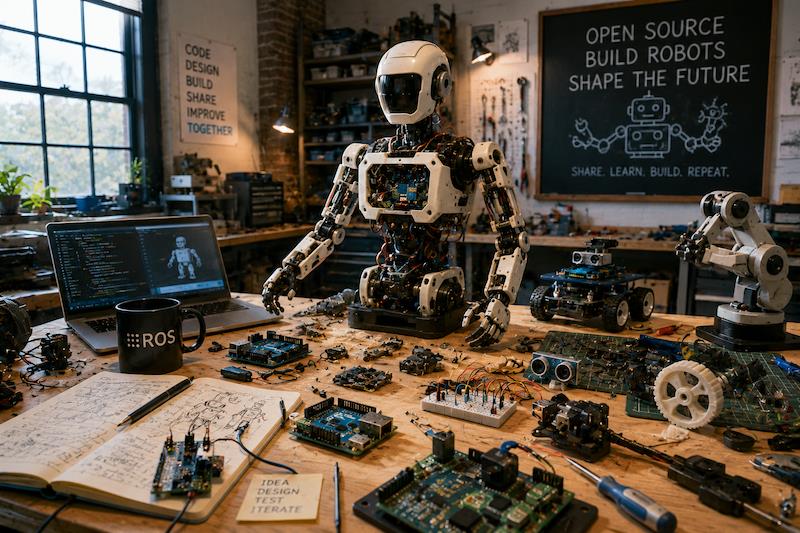
Open Source Hardware For Robotics: How Accessible Platforms Are Democratizing Robot Building
(MENAFN- Robotics & Automation News) Most discussions about open-source robotics focus on software. The Robot Operating System (ROS) has become the best-known example, providing developers with a common framework for building and operating robots.
Yet software is only part of the story.
Over the past two decades, a growing ecosystem of open-source hardware platforms has dramatically lowered the barriers to robotics development.
Components that once required specialist engineering teams and substantial budgets are now available off the shelf, often accompanied by openly shared designs, documentation, and community support.
The result is that students, researchers, startups, and hobbyists can build increasingly sophisticated robots at a fraction of the cost that would have been required only a few years ago.
In many ways, open-source hardware has done for robotics what the personal computer did for computing: it has moved innovation out of large institutions and placed powerful tools in the hands of far more people.
From industrial laboratories to garage workshopsFor much of robotics history, building a robot was an expensive undertaking.
Industrial robots were largely confined to automotive factories and major manufacturing facilities. Research robots often cost hundreds of thousands of dollars and were available only to well-funded universities, government laboratories, and large corporations.
Developing a new robotic system frequently required designing custom electronics, fabricating mechanical components, and writing software from scratch.
Today, that landscape looks very different.
Affordable microcontrollers, low-cost sensors, commodity computing hardware, 3D printing, and open-source software have combined to create a much more accessible environment for experimentation.
A robotics startup can now develop a proof-of-concept system for a few thousand dollars rather than a few hundred thousand. University students can build mobile robots in their dorm rooms. Hobbyists can experiment with autonomous navigation, computer vision, and robotic manipulation using components ordered online.
The democratization of robotics did not happen overnight. It emerged through a series of technologies that gradually reduced cost and complexity.
The pioneers of open-source robotics hardwareFew platforms have had a greater impact on grassroots robotics development than Arduino.
Introduced in Italy in 2005, Arduino transformed embedded electronics by making microcontroller programming accessible to non-specialists. Engineers, artists, students, and makers could suddenly control motors, sensors, and actuators without requiring deep expertise in electronics design.
The platform's open-source nature allowed manufacturers around the world to create compatible hardware, helping build one of the largest development communities in technology.
If Arduino provided the nervous system, the Raspberry Pi helped provide the brain.
Launched in 2012, the Raspberry Pi offered a low-cost Linux computer capable of running computer vision, networking, and increasingly sophisticated robotics applications. For many developers, it became the first affordable platform capable of supporting higher-level robotics functions.
Other platforms, including BeagleBone and numerous Arduino-compatible boards, further expanded the ecosystem.
Together, these technologies became the personal computers of robotics.
The rise of open robot platformsOpen-source hardware evolved beyond individual components.
Developers began creating complete robot platforms that could be assembled, modified, and improved by wider communities.
One of the most influential examples is TurtleBot.
Originally developed as an affordable ROS-compatible mobile robot, TurtleBot became a standard educational and research platform used by universities worldwide. It provided students with hands-on experience using ROS while giving researchers a common platform for experimentation.
The impact extended beyond education.
Because developers were working on similar hardware and software foundations, innovations could be shared and reproduced more easily.
Other examples include OpenManipulator robotic arms, ROS-based development platforms from Husarion, and numerous community-developed mobile robot systems.
These platforms accelerated learning by allowing developers to focus on solving problems rather than rebuilding basic infrastructure.
How 3D printing changed robot designOpen-source robotics hardware is not limited to electronics.
The rise of additive manufacturing has transformed mechanical design as well.
The RepRap project, launched in 2005, sought to create self-replicating 3D printers whose designs could be freely shared and improved. Although RepRap focused on manufacturing technology rather than robotics directly, its influence on robotics has been profound.
Engineers can now prototype custom brackets, enclosures, grippers, wheels, and structural components in hours rather than weeks.
Many open-source robot designs are distributed as downloadable CAD files, allowing users to print and assemble machines without extensive machining capabilities.
This has helped move robot development beyond traditional workshops and into classrooms, makerspaces, and home offices.
Building blocks for a new generation of robotsModern robotics development increasingly relies on open ecosystems of sensors, actuators, controllers, and development tools.
Low-cost cameras, inertial measurement units (IMUs), LiDAR sensors, motor controllers, and driver boards are now widely available.
Open-source hardware communities frequently provide not only designs but also documentation, tutorials, and troubleshooting assistance.
The value of these ecosystems extends beyond individual products.
What makes modern robotics development possible is the ability to combine interoperable components quickly and efficiently. Developers no longer need to invent every subsystem from scratch.
Instead, they can assemble solutions using proven building blocks.
The startup ecosystem built on open foundationsFor investors, one of the most significant consequences of open-source robotics is the reduction in barriers to entry.
Many robotics startups have been built on a foundation of open technologies.
Rather than developing operating systems, simulation environments, computer vision libraries, and basic hardware platforms internally, companies can leverage existing tools and focus resources on differentiation.
This has helped accelerate startup formation across sectors such as warehouse automation, agricultural robotics, drones, autonomous vehicles, and service robotics.
The effect is similar to what occurred in the software industry when open-source operating systems and cloud infrastructure became widely available.
Lower barriers encourage experimentation.
Experimentation increases innovation.
Innovation attracts investment.
The result has been a rapidly expanding robotics ecosystem.
Open source versus proprietary roboticsDespite the benefits of open-source hardware, proprietary systems remain important.
Commercial robotics deployments often require:
-
reliability;
certification;
technical support;
cybersecurity;
lifecycle management; and
accountability.
As a result, most successful robotics companies combine open and proprietary approaches.
Open technologies provide a foundation for innovation, while commercial products add the robustness required for industrial deployment.
Rather than competing directly, open-source and proprietary systems increasingly coexist.
Open source drives experimentation and innovation.
Commercial systems drive scale and adoption.
Together, they help advance the industry.
10 influential open-source hardware platforms in roboticsThese platforms and projects have helped lower the barriers to robotics development by making hardware, designs, and documentation openly accessible to a wider audience.
From microcontrollers and single-board computers to complete robot platforms, robotic arms, drones, and agricultural systems, they have enabled students, researchers, startups, and hobbyists to build increasingly sophisticated machines without the budgets traditionally associated with robotics.
Together, they form an important part of the open-source ecosystem that has accelerated innovation and expanded participation across the global robotics industry.
-
Arduino
Raspberry Pi
TurtleBot
OpenManipulator
BeagleBone
RepRap
Husarion ROSbot
OpenCR
Crazyflie
FarmBot
The robotics industry is now entering another period of transformation.
Artificial intelligence is increasingly being integrated into robotics development through robot learning, foundation models, synthetic data generation, and simulation-driven training.
Projects such as LeRobot, Open X-Embodiment, and robotics initiatives associated with Hugging Face are creating new open ecosystems around embodied AI.
The next generation of developers may spend less time writing explicit robot behaviors and more time training systems through data and machine learning.
In this environment, open-source hardware remains critical.
Affordable robotic platforms provide the physical systems needed to test and deploy these emerging AI capabilities.
Just as ROS helped democratize robotics software, open hardware may help democratize embodied AI.
Building the industry from the bottom upThe success of ROS demonstrated that collaborative software development could accelerate robotics innovation.
Open-source hardware is performing a similar role on the physical side of the industry.
By lowering barriers to experimentation, these platforms are expanding participation in robotics far beyond large corporations and research institutions.
Students, startups, makers, and independent developers can now contribute meaningfully to technological progress.
Many of tomorrow's most successful robotics companies may trace their origins not to corporate R&D labs, but to open-source platforms, shared communities, and collaborative projects that made robot building accessible to anyone with curiosity, determination, and an internet connection.
As robotics continues to evolve, that democratization may prove to be one of the industry's most important achievements.

Legal Disclaimer:
MENAFN provides the
information “as is” without warranty of any kind. We do not accept
any responsibility or liability for the accuracy, content, images,
videos, licenses, completeness, legality, or reliability of the information
contained in this article. If you have any complaints or copyright
issues related to this article, kindly contact the provider above.
Most popular stories
Market Research

More Story








Comments
No comment