






403
Sorry!!
Error! We're sorry, but the page you were looking for doesn't exist.
Hypnotic Documentary Lays Bare Persian Gulf's Climate Inequality
(MENAFN- Swissinfo)
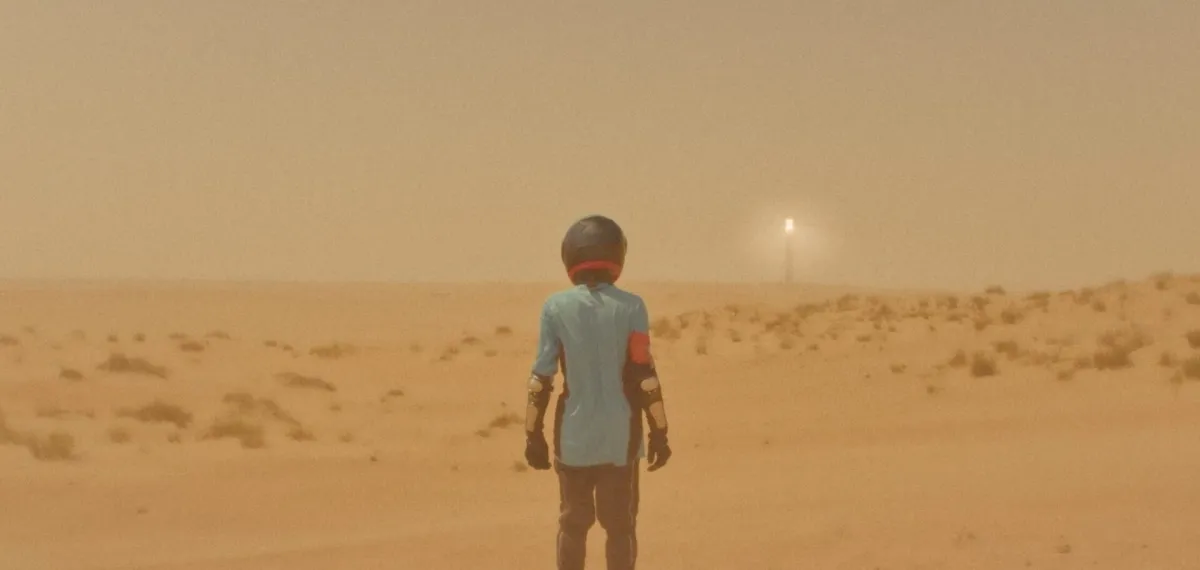
With Heat, Swiss documentary filmmaker Jacqueline Zünd has crafted her first explicitly political film. Following lonely souls condemned to endure the Gulf's deadly temperatures, her Visions du Réel world premiere depicts a dystopia the rest of the world still mistakes for the future.
This content was published on
May 28, 2026 - 09:00
9 minutes
Hugo Emmerzael
With summer around the corner, it's tempting to turn to films that naturally incorporate rising temperatures in their narrative.
From the sweltering heat wave that allows the American actor James Stewart to spy on all his neighbours in Alfred Hitchcock's Rear Window (1954) to the stiflingly hot New York City day that ignites a fuse in the racially tense neighbourhood of Spike Lee's Do The Right Thing (1989), heat itself becomes the central character of a film – if done well.
Few films, however, have framed the excruciating climb of temperatures as evocatively as Jacqueline Zünd's aptly titled Heat, which enjoyed a successful world premiere at the documentary festival Visions du Réel, held in the Swiss town of Nyon.
Hot on the heels of her first foray into fiction cinema with last year's Locarno Film Festival entry Don't Let the Sun (2025), the Swiss documentarian now employs crushing temperatures as both a central character and a thematic framing device. Through these, she critically dissects rising economic inequality in a world where the cold is gradually turning into the ultimate luxury.
External Content Brutal disparities“Heat works like a magnifying glass,” Zünd says over Zoom of her hypnotic new documentary, set in what soon could become uninhabitable regions of the Arab Gulf. Filming the hyper-capitalist petrol economies, with a primary focus on the inner workings of Dubai, she witnessed over the course of multiple years how the barometer ticking above 50°C“made visible a brutal economic disparity.”
With Heat, she homes in on a quartet of characters: a struggling ice bar hostess, a precarious delivery driver, a concerned meteorologist, and a real estate agent who brings blocks of ice to suffering stray cats. Her film captures how the accelerating climate catastrophe is completely rewriting the social contract.
“I was looking for an exterior condition that significantly alters our inner world,” she says. She found the starting point for her fifth full-length film in the rising temperatures:“A straightforward fact that we have to deal with, even if we'd like to forget it also impacts us.” The extreme setting of Heat teases what inevitably is coming for all of us.
“Migrant labourers are forced to endure deadly temperatures on the streets,” she says, recalling what she witnessed in Dubai,“all while the economic elite retreat to air-conditioned homes and have everything delivered to their doorstep by those very same migrants.”
“Many of these labourers die working outside under the boiling sun,” she adds, pointing to the 10,000 migrant deathsExternal link reported annually in the Gulf states, many of which are attributed to life-threatening heat, labour conditions, and air pollution.
>> Jacqueline Zünd talks about Don't Let the Sun in last year's Locarno Film Festival:
External Content Climate speaks for itselfInevitably, these jarring disparities turn Heat into a highly political film about ecology, economy and a new form of human vulnerability, something Zünd initially didn't set out to make.
“I was always focused on social issues,” says the director of tender films such as Visions du Réel-winner Goodnight Nobody (2010) and Where We Belong (2019), which premiered at the Locarno Film Festival. However, spending so much time in the Gulf“pushed me to make a truly political film.”
Quite consciously, though, Zünd never translates her critical observations into a scorching pamphlet. Rather, she lets the Gulf's climate speak for itself. Only on select occasions does a voice-over narration of the four human protagonists pierce through the immersive scenery, capturing how these lonely souls drift all by themselves through the desert heat.
“I didn't want to be polemical, as it has the risk of turning Heat into merely a climate film,” she says.“And let's be honest: climate protests have lately somewhat slipped of fashion.”
Instead, together with cinematographer Nicolai von Graevenitz and sound designer Oscar van Hoogevest, she crafted a deeply immersive audio-visual experience that stylistically conveys the sweltering heat, as if it's also radiating from the screen.
Heat does contain awe-inspiring vistas of a neon-lit petrol city that spectacularly illuminates the sandy regions at night, but Zünd often prefers to film the nearly abandoned streets and soulless, yet conveniently air-conditioned shopping malls that truly dictate the climate of this region.
“On the surface you have all this glamour, but if you take one look underneath that surface, you're immediately struck by a sharp contrast,” she says.“I was really shocked by how dystopian all of it actually is behind that veneer of luxury.”
Dystopia nowYou might call Heat an accidental dystopian film or, as the director puts it, a meditation on“the dystopian world we already live in.” Ironically, her recent feature film Don't Let the Sun explicitly flirts with dystopian cinema, depicting a world so hot that people can no longer step out of their homes during the day.
Zünd was surprised that people labelled that film as science fiction,“because I never thought of it that way.”
“I think we are already close to these realities,” she says.“What is more interesting to me is that I made a dystopian story in fiction, and then I found a dystopian world already existing in the Arabian Gulf. It's a very thin line.”
Faithfully capturing the dystopian heat turned out to be the biggest challenge. It turns out one can't just place a camera outside on a scorching hot day and obtain convincing imagery that conveys the oppressive climate.
She paints a vivid picture of the shoot:“Standing outside on a 48°C-day with a humidity of 60%, after about 20 minutes you start to feel so dizzy, you're forced to go back inside. Even the cameras would shut down after half an hour.” And yet, rewatching that footage in the editing room could lead to disappointing results.
“Often it didn't look hot at all, as if we were filming a mild March afternoon.”
Picturing the heatTo make a genuinely searing film, Zünd's team travelled to the Aswan desert in Egypt, where the unique climate conditions produce brilliant yet terrifying optical effects of refracted light. Sound designer Van Hoogevest also had the task of making the invisible heat palpable on the soundtrack.
“We layered hundreds of sounds on top of each other,” says Zünd, recalling the post-production of the film.“We needed sounds that draw you in, but that would also be so piercing that it almost starts to hurt a little bit. Because physically, being outside in such heat hurts a lot.”
By inhabiting these conditions herself, Zünd cannot help but bring enormous care to the people who actually have to weather the heat of Dubai. You can't help but feel anguish for the delivery worker, always shown with his motorcycle helmet on, which makes the heat even more crushing for him.
More visually arresting are the absurd working conditions in which Sophie, a young migrant worker from Africa, finds herself. As the hostess of an ice bar, she traverses a 40–50°C city on a daily basis to step into an enclosed space cooled down to -6°C, so rich patrons can enjoy a chilled beverage in front of towering ice sculptures.
“We just wanted to visit this strange place,” says Zünd.“When we encountered Sophie there, I could immediately imagine how horrible it must be to work every day under such conditions.”
Hot solitudeWhat this cast of characters ultimately reveals is how stifling heat creates a wedge between human beings. The loneliness on display is a theme that, according to Zünd, runs through all her work,“even if I never start with that intention.”
For this exact reason, the director maintains warm connections with all the people she films, as she believes documentary filmmaking is not only about extracting images,“but also about giving everything back, even when the film is already finished.”
With Dubai currently caught up in a conflict between Iran and the United States and Israel, Zünd is following the situation even more closely. She is happy to report that Sophie has since made it back to Africa, while the delivery man is still surviving the scorching streets of Dubai.
For a filmmaker who insists she never set out to make a climate film, Heat ultimately functions as a more humanist effort. Zünd shows us that the climate dystopia we imagine might happen in the future is already a reality for marginalised people right now.
Seen in that light, she wants to cinematically“rebuild our consciousness through the subconscious.” And with global temperatures rising, Heat is the rare film that radiates such urgency without overtly insisting on it.
Edited by Virginie Mangin & Eduardo Simantob/gw
Popular Stories Most DiscussedIn compliance with the JTI standards
More: SWI swissinfo certified by the Journalism Trust Initiati
You can find an overview of ongoing debates with our journalists here. Please join us!
If you want to start a conversation about a topic raised in this article or want to report factual errors, email us at ....
Read more
Legal Disclaimer:
MENAFN provides the
information “as is” without warranty of any kind. We do not accept
any responsibility or liability for the accuracy, content, images,
videos, licenses, completeness, legality, or reliability of the information
contained in this article. If you have any complaints or copyright
issues related to this article, kindly contact the provider above.
Most popular stories
Market Research

More Story


Comments
No comment