

How AI Data Centres Risk Straining Switzerland's Water Resources


I analyse the risks, opportunities and concrete impacts of artificial intelligence on society and everyday life. Since joining SWI swissinfo in 2020, I translate the complexity of science and technology into stories that speak to a global audience. Born in Milan to an Italian-Egyptian family, I have been passionate about knowledge and writing since childhood. I worked between Milan and Paris as a multilingual editor for technology magazines before transitioning to international journalism with SWI swissinfo.
-
More from this aut
Italian Departm
-
Deutsch
de
KI-Rechenzentren setzen Schweizer Wasserressourcen unter Druck
Read more: KI-Rechenzentren setzen Schweizer Wasserressourcen unter
Français
fr
Les centres de données liés à l'IA pourraient affecter les ressources en eau de la Suisse
Read more: Les centres de données liés à l'IA pourraient affecter les ressources en eau de la S
Italiano
it
Come i data center di IA rischiano di mettere sotto pressione le risorse idriche della Svizzera
Original
Read more: Come i data center di IA rischiano di mettere sotto pressione le risorse idriche della Svi
Español
es
Cómo los centros de datos de IA ponen bajo presión los recursos hídricos de Suiza
Read more: Cómo los centros de datos de IA ponen bajo presión los recursos hídricos de
Switzerland is often described as the“water tower of Europe”: a country with abundant lakes and glaciers, where some of the continent's major rivers originate. But this abundance may be put to the test by the rapid expansion of data centres – the IT infrastructure that keeps the digital world running.
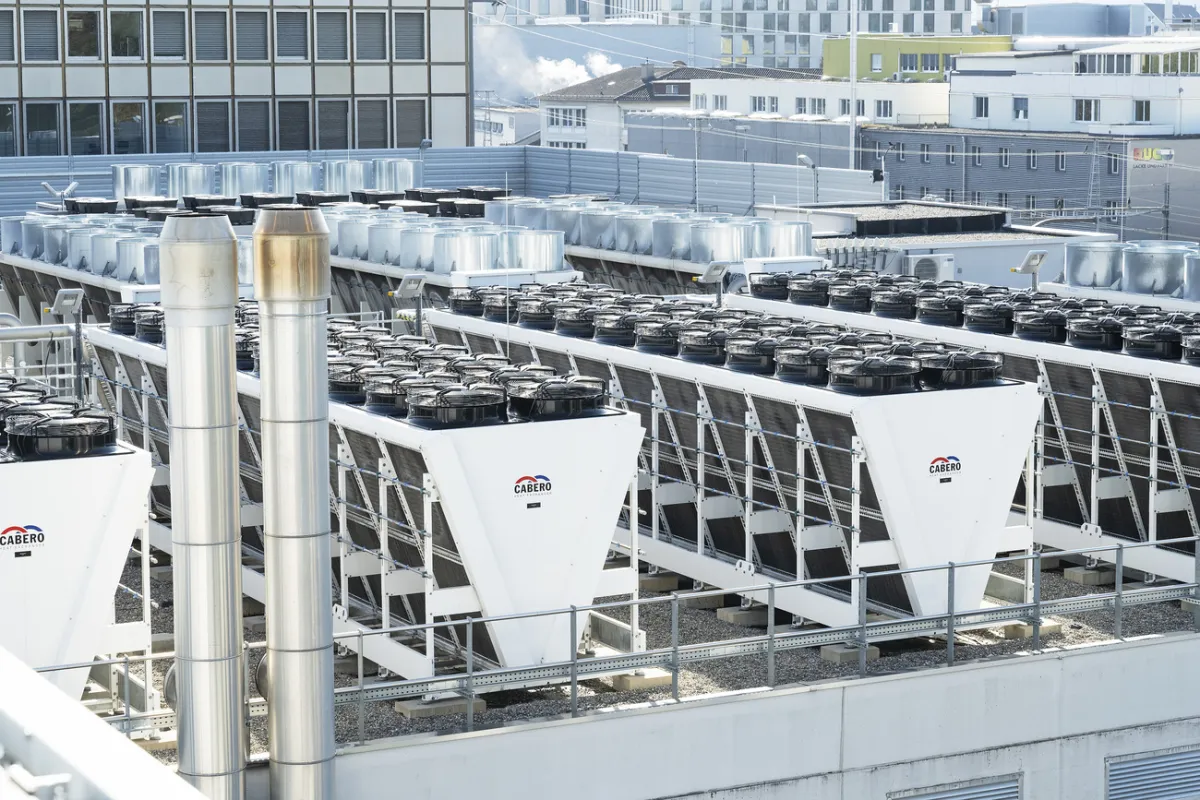
Today, Switzerland hosts around 120 data centres, with about 20 more under construction, giving it one of the world's highest concentrations of data centres per capita. The growing adoption of artificial intelligence is accelerating this expansion. High-performance servers used for AI consume more energy and generate more heat, increasing the need for intensive cooling systems – many of which rely on water.
“More and more companies – and people in general – are using AI. So cooling demand will just go up as AI computing systems become increasingly complex,” says David Atienza Alonso, a professor at the Swiss Federal Institute of Technology Lausanne (EPFL) and an expert in AI computing architectures.
Geopolitics may further amplify this trend. The emergence of data centres as targets in armed conflicts and the growing global competition for AI dominance are pushing many countries to build digital infrastructure within their own borders. Switzerland is no exception, having placed sovereignty at the centre of its digital strategyExternal link.
“Everyone wants greater control over data and where it is stored, which requires local infrastructure,” Atienza Alonso says.“But this implies building more and more data centres, with a growing impact on both water and energy consumption.” If this trend continues, he warns,“we may reach a point where electricity and water supply can be challenging to provide in some regions, if the needs of AI infrastructure are not anticipated early on”.
The 'invisible' water consumption of data centresDespite water being essential to data centres' operations, there are few official figures on how much water the sector uses. At the global level, the International Energy Agency (IEA) estimatesExternal link current consumption at around 560 billion litres per year and predicts it will rise to 1.2 trillion litres by 2030 – a volume comparable to the annual water consumption of around ten million households. Most of this water is used for cooling data centres and for producing the electricity to power them.
Beyond cooling, data centres also have a significant indirect water footprint through the electricity they consume.
“When you use electricity, you also use water,” says Javier Farfan Orozco, a researcher in technologies for a sustainable future at Åbo Akademi University in Finland.
In Switzerland, where a significant share of electricity comes from hydropowerExternal link, this connection is particularly relevant. Reservoirs used for power generation can lose substantial amounts of water through evaporation, depending on local climate conditions – a factor that is often overlooked in public debate, Farfan Orozco says.
Thermal power plants, including nuclear – one of the main sources of electricity in Switzerland – also require water, mainly for cooling.
Given that data centres already account for an estimated 6–8% of Switzerland's electricity consumption, this indirect water use further amplifies their overall impact.
In Switzerland, there is no law requiring operators to disclose their water use. But according to estimates by Atienza Alonso, Swiss data centres already account for about 1% of national freshwater consumption – roughly equivalent to the needs of 400,000-800,000 people.
One issue with water use is the size of data centres. Small and medium-sized facilities are generally efficient, thanks to new technologies, and can be relatively easily connected to local water systems with limited impact.
But even with ongoing improvements in cooling technology, large-scale facilities will continue to require very high volumes of water and will need to be built near rivers or lakes, Atienza Alonso says. So-called“hyperscale” data centres – exceeding 20 megawatts and powering cloud and AI services – can consume more than one billion litres of water per yearExternal link, equivalent to a town of 10,000 to 50,000 people.
More More Emissions reduction Swiss organisation wins award for tracking data centre pollutionThis content was published on Apr 16, 2026 The Swiss Datacenter Efficiency Association has received international recognition for a computer that measures, for the first time, the environmental and climate impact of a data centre.
Read more: Swiss organisation wins award for tracking data centre poll
Legal Disclaimer:
MENAFN provides the
information “as is” without warranty of any kind. We do not accept any
responsibility or liability for the accuracy, content, images, videos,
licenses, completeness, legality, or reliability of the information
contained in this article. If you have any complaints or copyright issues
related to this article, kindly contact the provider above.
Comments
No comment