







403
Sorry!!
Error! We're sorry, but the page you were looking for doesn't exist.
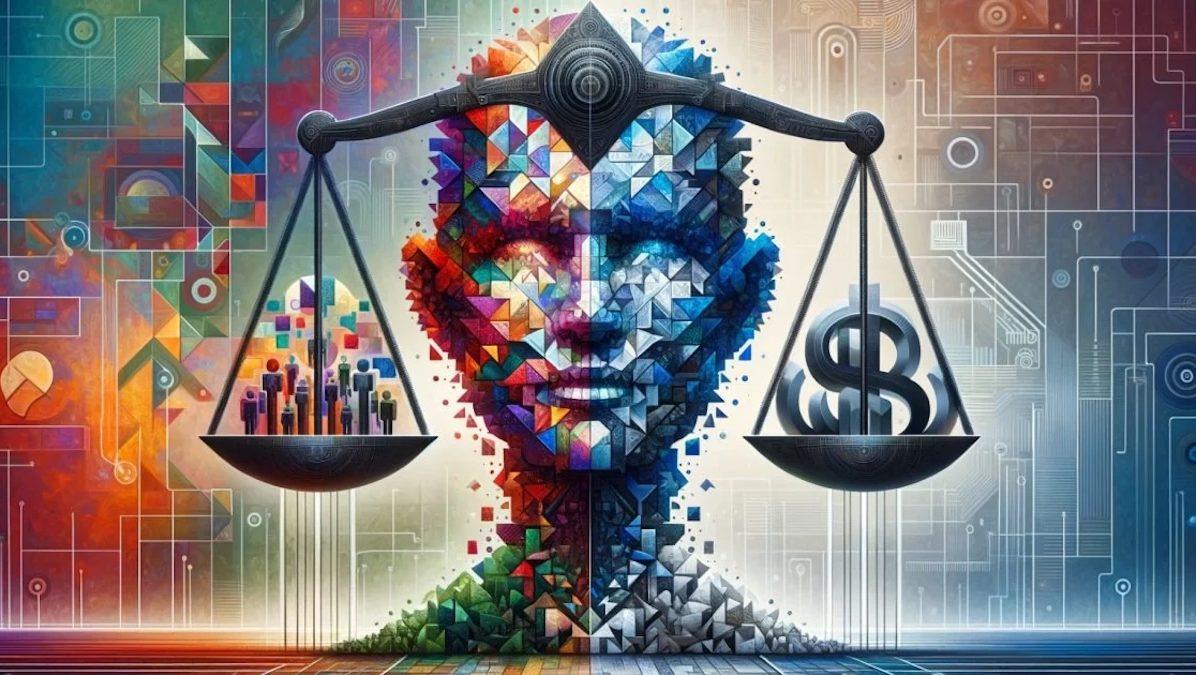
AI And Robots Can't Fill Bellies So, Capitalism's End?
(MENAFN- Asia Times)
Upon close examination, the global economic psyche reveals humanity as recently caught between two opposing poles.
On the one hand, unprecedented technological advancement promises to colonize the Moon and Mars, eradicate diseases at their roots, and deliver an unimaginable rise in the standard of living.
On the other hand, the two pillars of technology – industrial robotics and artificial intelligence (AI) – threaten to reduce the value of human sweat to nadir, which should evoke concern among policymakers about societal insecurity.
The first fear is that factory robots and automation will replace the workforce. The second fear cuts deeper: that AI will usurp not only the jobs of blue-collar workers in overalls but also those of white-collar professionals whose fingers work on computers' keyboards.
For instance, for a best-case scenario Kai-Fu Lee estimated that 50% of all human jobs could be replaced by AI and robots, affecting both blue-collar and white-collar roles. This is a 15% higher unemployment rate than during the Great Depression of the 1930s.
In the worst-case scenario, as Roman Yampolskiy warned, AI and humanoid robots could replace 99% of work within the next five years, leading to unprecedented unemployment with“no contingency plan” by the governments and companies for retraining. He predicts humans could gain 60-80 free hours per week, but sees this as a collapse of the labor market.
This anxiety is not unfounded. However, this is not merely a problem of individual unemployment; it could trigger widespread social unrest, increased inequality and political instability, which should compel academics and policymakers to consider urgent reforms and long-term solutions.
Through an economist's lens, this question must be viewed not merely as a tale of labor substitution, but as the death knell of capitalist and mixed economies. It represents a profound philosophical and structural crisis – one that demands urgent policy reforms, such as implementing universal basic income, expanding education and retraining programs while also considering the economic and political challenges involved in these reforms.
Labor's contributin to the current economy's structural foundationThe structural anomalies of the global economy can be dissected not through complex econometrics but through a straightforward statistical analysis of economic realities. A review of global gross domestic product (GDP) reveals that industrial production and manufacturing account for approximately 15-16% of the total, while mining and quarrying contribute to resource-intensive economies. Mining for those can account around 8-15% of GDP, while in others it ranges from 2-3%, depending on whether a nation is a developed or a resource-rich developing economy.
The true backbone of the modern economy is the services sector, which now contributes nearly two-thirds –roughly 60-70% – of global value. Besides, agriculture, a sector that once provided livelihoods for 90% of the human labour force, has been consolidated to a 4-5% contribution.
Collectively, these sectors represent a blue-collar economy valued at approximately 70% of global GDP – a massive market sustained almost entirely by the daily consumption of billions of workers.
These industries constitute the vital lifeline of the modern capitalist mixed economy alike. However, if robotics and artificial intelligence were to eliminate human jobs in these basic areas, a fundamental question arises: How would the world's economies continue to function in the future?
This question should coerce policymakers to develop strategies to prevent economic collapse.
These sectors constitute the lifeline of modern economies. If robotics and AI were to obliterate employment across all these sectors completely, a fundamental question arises: How would the world's economy function? This query forces us to confront the most basic, yet immortal, formula of economics.
Latest stories Next, an Iran nuclear deal with Chinese characteristics Iran top diplomat says country may rejoin Islamabad peace talks Wartime-level Northern Marianas typhoon hit tests US commitment The vicious cycle of supply and demandIf robots produce goods and AI delivers services, who will consume them? Consumption requires income. Income requires employment or enterprise. If robots and AI seize all employment, money ceases to flow into human hands. Without money, humans cease to be consumers.
The success of capitalism hinges on the symbiosis of labor and capital: Labor earns income, income creates demand, demand drives production and production, in turn, creates employment.
But when technology fully substitutes for labor, this cycle fractures. The purchasing power of a limited capitalist class alone cannot sustain aggregate demand in the economy, for economic demand is defined by broad consumption, not the luxury purchases of a tiny plutocracy.
An “effective demand” crisis does more than devastate the economy; it strips the entire production structure of its purpose, leaving it hollow and adrift. If an investment does not create jobs, such as when only robots are purchased, it does not create new consumers. Without consumers, production has no real purpose. This is a classic example of the chicken-and-egg problem in economics.
Future economic anomaliesAs an economist, I see the following scenarios not as characters from science fiction; they are plausible economic anomalies likely to manifest within the next two decades. Recognizing these potential crises can motivate policymakers, academics and citizens to act before these challenges become unavoidable, fostering a sense of urgency and collective responsibility.
I) The paradox of food and agriculture: Suppose agriculture becomes fully automated. GPS- or Baidu-guided tractors till the soil, drones spray fertilizer and pesticides and robotic arms pick fruit. Output soars. But what happens if the consumers who meant to buy this food and produce are unemployed and impoverished? Will the robots cook and eat the food they harvest? Do robots and AI feel hunger?
When the worker's wallet is empty, only his hunger remains. Consequently, the market price of agricultural produce plummets toward zero. Herein lies the cruel irony: Abundance would become the very cause of famine.
II) The crisis in industrial goods and consumer durables: Imagine a fully automated factory continuously churning out state-of-the-art motorcars, televisions, refrigerators, washing machines, computers, and smartphones. Production costs are low, quality is high. But what if the consumer class meant to buy these goods has become a relic of history? As public purchasing power evaporates, inventory stockpiles swell in warehouses. The company slashes production, cancels orders for new robots, and eventually, the capitalist owner goes bankrupt due to a lack of market demand.
III) The Demise of housing, air travel, and hospitality: Real estate tycoons have built sprawling cities. Hoteliers have opened world-class restaurants and resorts. Airlines have purchased billions of dollars' worth of aircraft. But what justifies this infrastructure if the majority of the world's population transforms from“consumers” into“dependents”? Ultimately, airports will fall silent, hotels will shutter and gleaming skyscrapers will stand as hollow“Ghost Towers.”
If there is no income and no consumption, who will pay income tax and consumption tax? And how would the government raise revenue to fund the state's operations?
The global economic crisis is comingAll these questions lead to a single conclusion: If there is no demand in the market, the economy stops working.
We have witnessed the Great Depression of 1929-1930 in history books. Back then, despite the production capacity, goods piled up. Milk was dumped into rivers because the public lacked purchasing power. Yet, even then, human labor was still necessary. Today's technology, however, carries the threat of eliminating the need for humans.
This will usher in a global, perpetual depression – one that is not cyclical but structural. Production will have no consumers. Investment will cease. An investment that creates no jobs cannot generate consumers. This would constitute a“cardiac arrest” of the global economy.
The global economic crisis alters the social fabricIf technology keeps growing without limits and without a new social agreement, human civilization will definitely face the following:
a) Conflict and social unrest: When billions lose their means of survival, they will not sit in silence and waste away. History is a relentless witness: Whenever masses are pushed out of the economic engine, revolutions ignite, rebellions flare and civil wars erupt. Unemployment sows despair, and despair becomes the spark for revolt. The stage is set for a showdown between the privileged few and the countless empty-handed. In a world overflowing with jobless youth, social unrest is not just likely – it is inevitable.
b) The impossible cost of crime control: As the source of employment and income dries up, a vast swath of humanity will turn to the alternative“economy” of crime. Rates of theft, robbery, fraud, and cybercrime will skyrocket. Prisons will overflow. But the crucial question remains: Courts, public prosecutors and Prisons require vast budgets to operate.
When the economy seizes up, government tax revenue vanishes. How can a state afford the cost of police, administration, and incarceration without income? As the cost of conflict management and crime control becomes unbearable, governments will be forced to raise taxes on a shrinking base, further depressing demand and deepening the crisis. Eventually, the state apparatus itself will weaken and crumble.
Way forward for a new dealThis situation is not mere theoretical conjecture; it is a logical conclusion. However, this does not mean we should halt technological progress. It means we must fundamentally re-evaluate the economic distribution system. Should we wail,“The robot took my job,” or should we engage in a political debate asking,“What is our stake in the profits earned by the robots?”
Some concrete solutions are as follows:
1) A collaborative model for technology and human labour: Robots and AI must be framed as collaborative tools, not as weapons of total substitution. Humans must be integrated with technology across sectors that require creativity, emotion, and decision-making – such as green energy, space tech, healthcare, education and creative fields. Governments and the private sector must jointly develop“Tech-Employment” models.
Sign up for one of our free newsletters-
The Daily Report
Start your day right with Asia Times' top stories
AT Weekly Report
A weekly roundup of Asia Times' most-read stories
2) Overhaul of the education system: Curricula must be restructured to impart skills adaptable to new technology. This does not mean just technical skills; it means nurturing critical thinking, creativity and emotional intelligence – inherently human traits that AI cannot fully replicate.
3) National and international policy for demand creation: Robust public investment in infrastructure, social security, health and education is essential. This decisively creates jobs and boosts spending power. Countries must collaborate; rich nations have a responsibility to share technology with poorer countries. Failure to do so will inevitably fuel global inequality and related challenges.
4) Universal basic income, and its possibilities and limits: Some economists propose solutions like universal basic income (UBI). While the idea holds merit, its limitations are equally clear. UBI redistributes income, but it does not fully restore the cycle of productivity and demand. A serious debate on equitable wealth distribution and basic income options is inevitable within the coming generation. This debate must transcend political ideology and be guided by the inexorable mathematics of economics.
The bell tolls for free-market and state-run capitalism alikeThe technology we worship today may reduce production costs, but it will also demolish the very foundation of consumption. The lifeblood of capitalism is the consumer. If the capitalist class hoards the ownership of robots and AI while the consumer base vanishes, that capitalist's wealth holds no real value. Money only holds value if it can purchase resources from a functioning market economy. Without a market, money is merely paper or a digit on a screen.
We can view the changes brought by AI and robotics as either an opportunity or a calamity. If we weaponize the technology solely for labor displacement, capitalism will be digging its own grave. But if we make technology a tool for human-centric development, it could be the gateway to a new era.
History teaches us: When a system creates conditions in which the majority of its citizens cannot survive economically, that system itself changes. Thus, the rise of AI and robotics should not be seen as an ordinary industrial revolution. It is the final bell for capitalism.
The world must decide soon. Is technology for humanity? Or is humanity for technology?
Maintaining a balanced cycle of employment, demand and productivity is the greatest challenge of our time. Ignoring it invites the largest economic and social collapse in history. This is not a warning. It is the inevitable math of economics.
There is still time – but there is no room for delay.
This article was first published on Bhim Bhurtel's Substack and is republished with permission. Become a subscriber to Bhim's Substack here.
Sign up here to comment on Asia Times stories OrThank you for registering!
-
Share on X (Opens in new window)
Share on LinkedIn (Opens in new window)
LinkedI
Share on Facebook (Opens in new window)
Faceboo
Share on WhatsApp (Opens in new window)
WhatsAp
Share on Reddit (Opens in new window)
Reddi
Email a link to a friend (Opens in new window)
Emai
Print (Opens in new window)
Prin

Legal Disclaimer:
MENAFN provides the
information “as is” without warranty of any kind. We do not accept
any responsibility or liability for the accuracy, content, images,
videos, licenses, completeness, legality, or reliability of the information
contained in this article. If you have any complaints or copyright
issues related to this article, kindly contact the provider above.
Most popular stories
Market Research

More Story







Comments
No comment