




403
Sorry!!
Error! We're sorry, but the page you were looking for doesn't exist.
From The Bosporus To Hormuz: A History Of Straits And The Illusion Of Permanent Control
(MENAFN- Tribal News Network) There is an old principle in geopolitics, as durable as it is dangerous: he who controls the narrow passage controls the world. Maritime chokepoints have shaped empires, started wars, and redrawn maps of power more decisively than almost any other geographical feature.
The Strait of Hormuz in 2026 is the latest proof. But the full weight of that claim only becomes visible when set against the longer sweep of history, in which straits from the Bosporus to Gibraltar have each in turn appeared irreplaceable-and each has eventually revealed the limits of the power that sought to hold it.
The Bosporus offers the oldest case. Barely seven hundred metres wide at its narrowest, it connects the Black Sea to the Mediterranean and has been contested for as long as states have existed. Constantinople was built to command it, and for over a millennium Byzantine power rested on that command.
Also Read: From Rust Belt Roots to the White House: The Rise of J. D. Vance
When the Ottomans seized the city in 1453, they inherited leverage over the grain trade of the entire Black Sea littoral and the commercial ambitions of Venice and Genoa alike. Yet permanence proved conditional. The opening of Atlantic trade routes after 1492 slowly drained the strait of its centrality, rerouting global commerce around Ottoman control. The passage endured; the dominance it conferred did not.
At the western end of the Mediterranean, the Strait of Gibraltar told a parallel story across a longer timeframe. Britain seized it from Spain in 1704 and held it against every subsequent challenge, anchoring the Royal Navy's command of both the Atlantic approaches and the inland sea. Napoleon understood what he could never solve: without Gibraltar, a continental power could not achieve true maritime supremacy.
Yet even here the logic eventually ran against the holder. The jet age and the Cold War reduced the Rock from a decisive chokepoint to a symbol-strategically persistent, no longer strategically sufficient.
Less familiar but equally consequential is the Danish Sound, the Øresund, barely four kilometres wide between Denmark and Sweden.
From 1429 to 1857, Denmark collected the Sound Toll-a levy on every vessel transiting the strait-that at its height generated more than two-thirds of the Danish crown's total revenue. It made Denmark one of the wealthiest states in northern Europe and made it the permanent target of every Baltic trading power.
When the toll was finally abolished under international pressure in 1857, Denmark had not been defeated militarily. It had been outmanoeuvred diplomatically, as the community of maritime powers-led, notably, by the United States in one of its earliest exercises in open-sea diplomacy-collectively refused to accept permanent ransom of a natural passage.
The principle that no single state may indefinitely hold a shared waterway to ransom was not invented in 2026. It was established four centuries earlier in the North Sea.
The Strait of Malacca brings the argument into Asia. Connecting the Indian Ocean to the South China Sea, it has been the principal artery of Asian maritime trade since the Srivijaya Empire built its power on controlling it in the seventh century.
The Portuguese seized Malacca in 1511; the Dutch displaced them; the British displaced the Dutch. Each believed it had secured a permanent advantage. Each was eventually forced to manage vulnerabilities-piracy, shallow draught, the sheer volume of traffic-that made singular control increasingly nominal.
Today roughly ninety thousand vessels transit it annually, its governance shared uneasily among Singapore, Malaysia, Indonesia, and the external powers whose trade it carries. Geography persists; monopoly does not.
Suez is the modern chokepoint par excellence-engineered rather than natural, and therefore revealing in ways that purely geographical straits are not. Opened in 1869, it cut the journey from Britain to India by nearly forty percent and restructured global shipping almost overnight.
Britain occupied Egypt in 1882 partly to secure it. When Nasser nationalised it in 1956, the British and French military response was swift and strategically catastrophic, demonstrating that the age of holding foreign chokepoints by force of arms had passed. When the canal closed again from 1967 to 1975, the world adapted by rerouting around the Cape-painfully and expensively, but successfully. The lesson was not that Suez was unimportant. It was that no passage, however critical, lies beyond the trading system's capacity to circumvent.
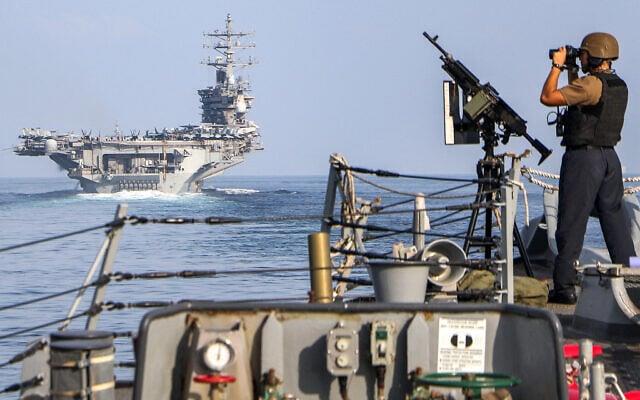
Against this history, the Strait of Hormuz is both familiar and exceptional. At thirty-three kilometres wide between Iran and Oman, it is the sole maritime exit from the Persian Gulf. In 2024, roughly twenty percent of global petroleum consumption and one-fifth of global LNG trade transited it daily.
Unlike Malacca, it cannot be widened. Unlike Suez, it cannot be rebuilt. No alternative route comes close to its capacity-the bypass pipelines carry at most a quarter of normal daily flow. Its geography is, for practical purposes, fixed.
In this sense Hormuz is the purest chokepoint in the modern world.
Iran's 2026 blockade is the latest expression of a pattern visible across every strait examined here: a passage weaponised by a power that controls access but cannot sustain the costs of prolonged closure. Iran's own oil exports and nearly all its non-oil imports transit the same waters it has declared closed.
It is strangling its own economy to apply leverage on others-a position with a precise historical analogue in Denmark's Sound Toll, and a precise historical outcome: eventual capitulation, not consolidation.
The Byzantine Empire lost the Bosporus because it lacked the political capacity to defend it. Denmark lost the Sound Toll because the international community refused permanent ransom.
Britain lost Suez because political legitimacy, not military force, was the binding constraint. Iran's grip on Hormuz will loosen for the same structural reasons.
The costs to the blocker eventually exceed the costs to the blocked, and the international system mobilises, however slowly, to restore access.
What the full history of straits teaches is not that geography is powerless but that it is never permanently decisive.
From the Pillars of Hercules to the Persian Gulf, the narrow passage has always been where the fate of nations is quietly decided. History's deeper lesson is that the nations which survive that verdict are those that refuse to be held by geography even as they seek to exploit it. The passage endures. The illusion of permanent control does not.

Legal Disclaimer:
MENAFN provides the
information “as is” without warranty of any kind. We do not accept
any responsibility or liability for the accuracy, content, images,
videos, licenses, completeness, legality, or reliability of the information
contained in this article. If you have any complaints or copyright
issues related to this article, kindly contact the provider above.
Most popular stories
Market Research

More Story








Comments
No comment