




403
Sorry!!
Error! We're sorry, but the page you were looking for doesn't exist.
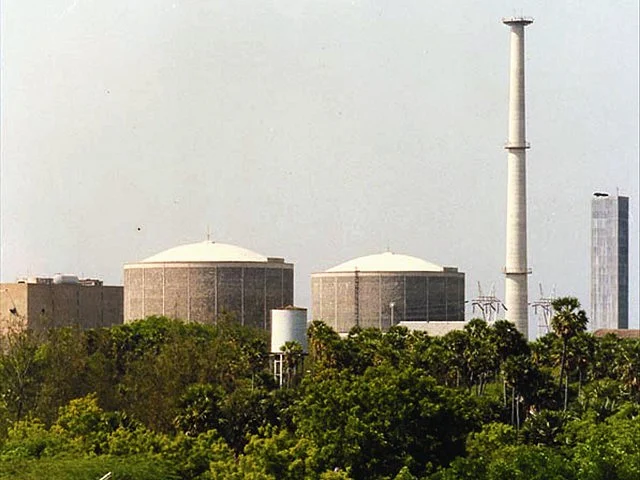
Explained: How India Fast-Tracks Nuclear Energy Capacity To 100GW By 2047
(MENAFN- Khaleej Times) India has set up an ambitious target to expand its nuclear capacity to at least 100 GW by 2047, the 100th anniversary of its independence.
The country has a three-stage nuclear power programme: pressurised heavy water reactors, fast breeder reactors and thorium-based reactors. It has developed a two-pronged strategy to achieve its 100 GW target, setting up large reactors including 700 MWe indigenous pressurised heavy water reactors (PHWRs) and large capacity imported reactors at greenfield sites; and small reactors such as the 200 MWe Bharat Small Modular Reactors (BSMRs) and 55 MWe Small Modular Reactors (SMR-55s).
Recommended For YouOn April 6, 2026, the 500 MWe (Megawatts electric) Prototype Fast Breeder Reactor (PFBR) at Kalpakkam, Tamil Nadu, successfully attained its first criticality (start of controlled fission chain reaction),“marking a historic step in providing long-term energy security and advancing indigenous nuclear technology capabilities.”
We take a look at the evolution of India's ambitious nuclear power generation programme over the decades and how it will achieve its 100 GW target:
What is the three-stage programme for nuclear power generation?The country has a three-stage programme for generating nuclear power. The first one relates to PHWRs, which use natural uranium to produce plutonium and depleted uranium and electricity. The second stage relates to fast-breeder reactors (FBRs), which are more efficient. The fuel is plutonium and it also uses fast neutrons to undergo fission. In the last stage, nuclear reactors will use plutonium and thorium to produce power.
Stay up to date with the latest news. Follow KT on WhatsApp Channels
India today has 24 operable reactors (with 8,780 MWe capacity) and eight (with a capacity of 6,028 MWe) are under construction. In 2023, as against the total generation of 1,987 TWh (Terawatt-hour), coal accounted for almost 75 per cent, followed by hydro (seven per cent), solar (six per cent), wind (five per cent), natural gas (three per cent), nuclear (two per cent) and the rest biofuels and waste.
Government projections are that the installed nuclear power capacity will go up to 22 GW by the early 2030s and the long-term target of 100 GW by 2047.
When did the country set up nuclear power plants?The first nuclear power plants began operations in 1969 at Tarapur in Maharashtra, with two 160 MW capacity boiling water reactors (BWRs). In 1981, a 200 MW PHWR plant came up in Rawatbhata in Rajasthan, followed by 220 MW plants over the following two decades in Rajasthan, Kalpakkam in Tamil Nadu, Narora in Uttar Pradesh, Kakrapar in Gujarat, and Kaiga in Karnataka. Kudankulam in Tamil Nadu saw two 1,000 MW units being set up in 2014 and 2017. In 2005 and 2006, two 540 MW units were set up in Tarapur, followed by three 700 MW units in 2023, 2024 and 2025 in Rajasthan and Gujarat.
According to the Nuclear Power Corporation of India Ltd, these plants have generated 973,577 MUs (million units) of power between October 1969 and February 2026, contributing to the avoidance of 837 million tonnes of CO2eq emission.
What is the significance of the criticality of the PFBR, achieved earlier this month?Fast Breeder Reactors are a cornerstone of India's long-term nuclear strategy. Unlike conventional thermal reactors, the PFBR uses Uranium-Plutonium Mixed Oxide (MOX) fuel. The core of PFBR is surrounded by a blanket of Uranium-238. Fast neutrons convert fertile Uranium-238 into fissile Plutonium-239, enabling the reactor to produce more fuel than it consumes. The reactor is designed to eventually use Thorium-232 in the blanket. Through transmutation, Thorium-232 will be converted into Uranium-233, which will fuel the third stage of India's nuclear power programme.
The PFBR with a capacity of 500 MWe is adequate to power about half a million average homes simultaneously. The reactor, unlike conventional ones that use water as a coolant, circulates liquid sodium, which transfers heat much more efficiently than water. It also makes more fuel than it burns.
How safe are India's nuclear power plants?The Nuclear Power Corporation of India Ltd (NPCIL), a public sector enterprise under the administrative control of the Department of Atomic Energy (DAE), is responsible for the design, construction, commissioning and operation of nuclear power reactors. Safety is an overriding priority in all its activities.
It has over 56 years of experience in safe operation of nuclear power plants. The occupational exposure of its employees are maintained well below the values specified by the Atomic Energy Regulatory Board (AERB), says the company.
What was the impact of the Three Mile Island and Chernobyl accidents on India's nuclear plans?The Bhabha Atomic Research Centre (BARC) points out that following the accidents at Three Mile Island in the US in 1979 and in Chernobyl in Ukraine in 1986, passive safety systems became integral to gen-III and gen-IV reactors. It also saw the BARC design advanced heavy water reactors (AHWRs). These reactors also aim to produce over 60 per cent of power from thorium.
While India has limited uranium reserves, it has an abundance of thorium. It is home to one of the largest thorium deposits in the world, estimated at between 450,000 tonnes and 500,000 tonnes.
Is thorium the key to India's future nuclear programmes?The country has limited uranium, but an abundance of thorium. The beach sands of Kerala and Orissa, for instance, have rich reserves of monazite, which contains about 10 per cent of thorium. India holds the largest thorium and monazite reserves worldwide. Globally, thorium reserves add up to over six million tonnes; India holds about 850,000 tonnes of thorium deposits. It also has about 12 million tonnes of monazite deposits.
According to the Atomic Minerals Directorate for Exploration and Research (AMD), part of the DAE, India has 7.23 million tonnes of in-situ (on site) rare earth elements oxide and 1.18 million tonnes of of thorium oxide, contained in 13.15 million tonnes of monazite.
ALSO READ- India hits nuclear breakthrough with successful test of prototype fast breeder reactor Which Asian countries can withstand fuel crisis as US-Israel-Iran war drags on? India LPG crisis: Ethanol cooktops pushed as cheaper fuel alternative

Legal Disclaimer:
MENAFN provides the
information “as is” without warranty of any kind. We do not accept
any responsibility or liability for the accuracy, content, images,
videos, licenses, completeness, legality, or reliability of the information
contained in this article. If you have any complaints or copyright
issues related to this article, kindly contact the provider above.
Most popular stories
Market Research

More Story





Comments
No comment