




403
Sorry!!
Error! We're sorry, but the page you were looking for doesn't exist.
Benz Confirms Major High Grade Gold Extensions To Zone 126 And Discovery Of New Lens 5
(MENAFN- Newsfile Corp)
HIGHLIGHTS:
- Lens 4 grows deeper and stronger with thickest high grade hit to date at Glenburgh with 200m+ step out
- 15m at 12.7g/t gold from 850m 25GLR117 (Major 200m+ down dip extension); and 20m at 5g/t gold from 676m 25GLR094 (building out Lens 4 to the 90m to the west).
- 17m at 6g/t gold from 662m 25GLR082.
- 2m at 16.8g/t gold from 528m 25GLR090. This discovery hit sits on the margin of the interpreted lens, with thicker and higher-grade mineralisation anticipated down-dip/down-plunge.
Vancouver, British Columbia--(Newsfile Corp. - December 7, 2025) - Benz Mining Corp (TSXV: BZ) (ASX: BNZ) (" Benz " or the " Company ") is pleased to report an additional discovery from ongoing drilling at the Zone 126 prospect within the Glenburgh Gold Project in Western Australia.
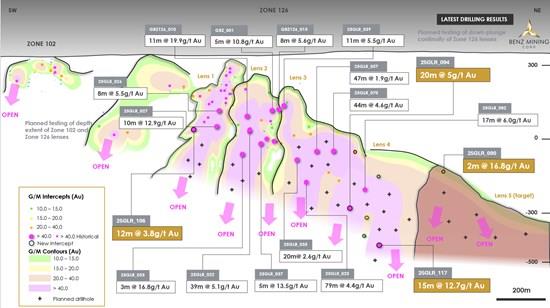
Figure 1. Long section view looking north of Zone 126 trend. Proposed drilling demarcated by crosses. Current release new intercepts in bold outline. Previous results released on 6 November 2024, 3 April 2025, 28 April 2025, 30 June 2025, 31 July 2025, 20 August 2025 and 11 September 2025.
To view an enhanced version of this graphic, please visit:
Benz CEO, Mark Lynch-Staunton, commented:
"Glenburgh continues to deliver exceptional results, and the system is clearly growing in both scale and strength. Lens 4 has now pushed significantly deeper with our thickest high-grade intercept to date, extending the system by more than 200 metres down-dip and overall to 800 metres vertical. The expansion further reinforces the robustness of this deposit, and together with our earlier Lens 4 discovery hole, it shows Lens 4 is evolving into a major high grade system with significant depth potential.
"We're also highly encouraged by the initial intercept into the interpreted Lens 5 position, which once again validates the predictive power of our exploration model. Although this intercept sits on the very edge of the system, we expect thicker and higher-grade mineralisation as we drill down-dip and down-plunge. Importantly, all lenses from 1 through 5 remain completely open at depth, underlining the significant opportunity to add high-grade ounces.
"Beyond the immediate growth around Zone 126, we are now starting to unlock the broader district-scale opportunity. Ongoing structural mapping continues to define the regional folding architecture, and identifies NE3 and Hurricane as the two next major high-grade discovery corridors. NE3 is to be tested as an opposing fold limb to Zone 126, while Hurricane presents a 1 km long +100 ppb gold-in-soil anomaly occupying the interpreted synformal hinge position along strike to the SW.
"Both targets carry genuine potential to deliver discoveries of similar size and scale to the Zone 126 trend. Historical drilling intersected high-grade mineralisation near to surface; Benz plans to drill down-dip and down the NE-plunge of both these targets, testing positions that remain completely open at depth. This untested upside presents a very exciting opportunity for the Project heading into 2026.
"Momentum is building across multiple fronts and, with each new discovery, Glenburgh is shaping up as one of Australia's most compelling emerging gold districts."
Zone 126 Drilling: Two Rigs Driving Continuous High-Grade Growth
Drilling at the Glenburgh Gold Project continues to demonstrate the scale potential of the Zone 126 trend, with Lens 4 now growing deeper, thicker and higher-grade as drilling steps into previously untested portions of the system. A major down-dip extension has been confirmed by hole 25GLR117, which returned 15m at 12.7g/t gold from 875m, representing a 200m+ step-out from previous drilling. This result marks the highest grade intercept recorded in Lens 4 to date and provides substantial validation of the Company's structural model at depth.
Further support for the expansion of Lens 4 comes from 25GLR094, which intersected 20m at 5g/t gold from 675m, successfully building out the lens a further 90m to the west from the original discovery hole of 17m at 6.0g/t gold. Together, these new results continue to reinforce the strong continuity of high-grade mineralisation along plunge and highlight the significant opportunity to keep growing this lens into a material high-grade ore shoot.

Figure 2: Collar map for released hole with drilling highlights labelled.
To view an enhanced version of this graphic, please visit:
New Lens 5 Discovery
In addition to the continued growth of Lens 4, drilling has now delivered the first discovery hole in the emerging Lens 5 position. Hole 25GLR090 intersected 2m at 16g/t gold from 475m, marking initial confirmation. Importantly, this intercept sits on the margin of the interpreted lens geometry. Based on the Company's structural model, thicker and higher-grade mineralisation is anticipated down-dip and down-plunge, where the full thickness of the lens is interpreted to develop.
Multiple Lenses Remain Open at Depth
Lenses 1 through 5 all remain open at depth, with recent drilling continuing to demonstrate strong potential for further high-grade extensions. Notably, 12m at 3.8g/t gold was intersected in the down-dip continuation of Lens 1, highlighting that the entire Zone 126 corridor remains vastly under-tested below 400-500m depth. Each lens exhibits the same plunging structural controls and favourable host lithologies, reinforcing the opportunity to continue adding high-grade ounces through ongoing drilling.
Next High grade discovery centres: Hurricane & NE3 Targets.
Ongoing detailed structural mapping and interpretation of drilling results continues to refine interpretations of the folded architecture of mineralisation at Glenburgh, opening up numerous opportunities for the next Zone 126 scale discovery; Hurricane and NE3 are emerging as the two highest-priority targets (Figure 3).
The NE3 target is being tested as an interpreted opposing (NE) fold limb to Zone 126, while Hurricane represents a 1 km long +100 ppb gold-in-soil anomaly located at the interpreted synformal hinge position along strike to the SW. Critically, the NE3 and Hurricane targets have coherent >100 ppb gold-in-soil anomalies; the same surface signature that has accompanied every high-grade lens discovered at Zone 126 to date.
With Hurricane (1 km gold-in-soil anomaly) and NE3 (600 m gold-in-soil anomaly) targets supported by confirmed mineralisation in shallow drilling (see Figure 3 Below), we now have two standout targets- each with genuine potential to deliver a discovery of similar size and scale to the Zone 126 trend.
The emerging geological framework highlights multiple parallel and along-strike possible repetitions of the Zone 126 mineralised position, while also focussing initial drilling efforts beneath these clear surface geochemical expressions.
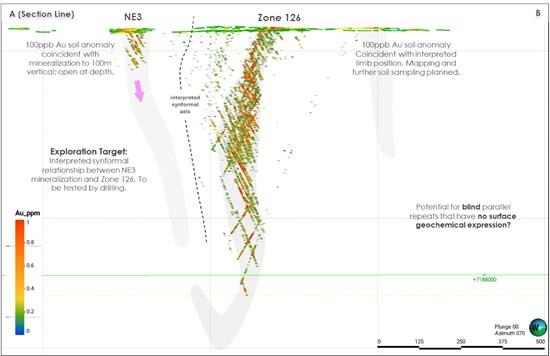
Figure 3. Plan view of refined interpretation of regionally folded architecture with new target zones for immediate drill testing. Previous results released on 6 November 2024.
To view an enhanced version of this graphic, please visit:
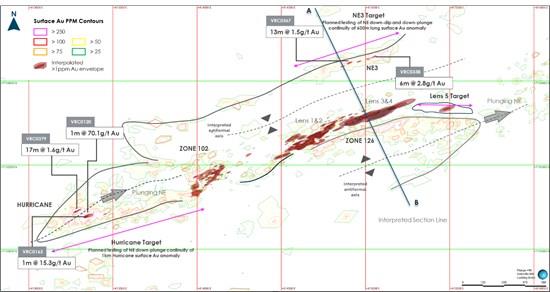
Figure 4: Refer to section line A-B in figure 3. Section view looking east with 400m clipping window.
To view an enhanced version of this graphic, please visit:
NE3
NE3 is a compelling discovery opportunity, interpreted to be the opposing limb to mineralisation defined at Zone 126, separated by a synformal fold hinge. A 600 m long >100 ppb gold-in-soil anomaly and confirmed mineralisation from historical drilling reinforce this interpretation. Like Zone 126, previous drilling did not target the NE plunge direction, or drill below ~100m depth; Benz considers these highly favourable mineralised positions that remain completely open.
Historical results include 13m at 1.5 g/t gold and 6m at 2.8g/t gold. Together, these elements position NE3 as a genuine Z126-scale repeat target with significant high-grade discovery potential.
Hurricane
Hurricane is interpreted to lie along strike to the SW of Zone 126, in a synformal position within the fold architecture; amphibolite and biotite-rich gneissic rocks mapped at surface are analogous to Zone 126 geology. A 1km m long >100 ppb gold-in-soil anomaly and confirmed mineralisation from historical drilling reinforce this interpretation. Early work suggests Hurricane may offer scale potential comparable to Zone 126 itself, marking it as a compelling new growth front at Glenburgh in 2026. Planned drilling at Hurricane will follow the same strategy as Zone 126, following known high grade intercepts down-dip, and down-plunge to the northeast.
Comparing Zone 126 and Hurricane
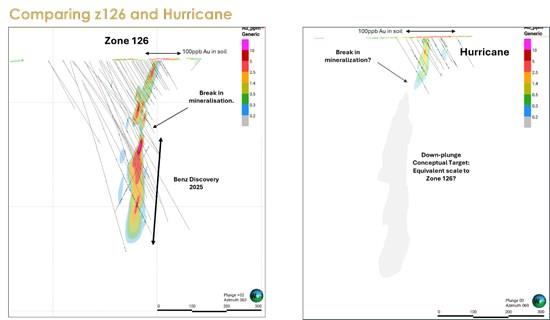
Figure 5: Section view looking east. Comparing Zone 126 with Hurricane side by side. Interpolated grade shells shown.
To view an enhanced version of this graphic, please visit:
Figure 5 compares the recent discoveries at Zone 126 with the current situation at Hurricane. At Zone 126, a small high-grade shoot reported to surface, tested by relatively shallow historical drilling. As renewed drilling progressed down-plunge in 2025, that modest surface expression unravelled into a major discovery, ultimately defining multiple thick high-grade lenses extending over more than a kilometre of strike and persisting to more than 800 metres vertical depth.
Hurricane is showing the same exciting pattern, with a discrete high-grade shoot at surface sitting above a 1km-long >100ppb gold-in-soil anomaly and similar structural controls to those observed at Zone 126. Based on the success of drilling at Zone 126 in 2025, Hurricane has the potential to grow significantly with depth as drilling unfolds.
Geometric Learnings Driving Target Refinement
Drilling in 2025 has shown that the geometry of Zone 126 mineralisation can swing from steeply NW-dipping to SE-dipping over relatively short distances, an unsurprising outcome of the folded gneissic geology.
When drillhole directions are not locally optimal, and an intersection is thought to not be representative, Benz's workflow is specifically designed to respond to this by review of downhole structural measurements and geology, and follow-up targeting of drillholes from more optimum positions.
When this happens, a drillhole may skim the edge of the ore lens rather than cut through its thicker, higher-grade core. These "near misses" can appear at first glance as lower-grade intercepts, but increasingly we recognise them as valuable geometric indicators rather than true limits to mineralisation. This is a highly encouraging observation, as it means many of the gaps or lower-grade intersections within the broader trend likely reflect orientation swings, not geological breaks, supporting the interpretation of a more continuous and substantial high-grade system. We then modify drill orientation to re-target the heart of the system.
This approach ensures that both sides of any apparent gap are tested and gives us strong confidence that we are efficiently defining the true size, grade continuity and geometry of the high-grade lenses. Many of these apparent breaks are now seen as missed opportunities rather than true boundaries, highlighting the potential for further growth as drilling continues.
Geological work update
Detailed structural mapping and multielement analysis of gneissic rocks is progressively revealing the controls on mineralisation at Glenburgh. The presence of several different phases of metamorphosed mafic rocks including porphyritic/porphyroblastic and possible differentiated mafic sills, along with metasedimentary sequences points towards a greenstone-like succession from the Paleoproterozoic or late Archean, now overprinted by high-grade metamorphism.
Work is underway to determine the origin and extent of these greenstones and identify any further previously-unrecognised opportunities in the wider Gascoyne region. A program of detailed laboratory work to further understand this enigmatic orebody is in the pipeline for 2026.
Glenburgh - A New Frontier Gold District
The 100%-owned Glenburgh Gold Project is rapidly emerging as a new frontier gold district with multi-million-ounce potential. Located in Western Australia's Gascoyne region, Glenburgh hosts an 18-20 kilometre mineralised corridor anchored by the large-scale Icon-Apollo trend and the high-grade Zone 126 system.
Glenburgh's unique combination of thick, bulk-style gold mineralisation (Icon-Apollo) and multiple high-grade underground lenses (Zone 126) positions it as a rare opportunity in the Australian gold sector. With gold prices at record levels, the ability to develop both large-scale open pit and underground operations offers exceptional leverage and growth potential.
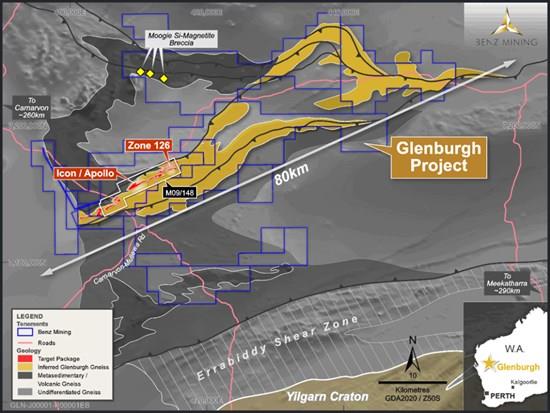
Figure 6. Geological overview of the Glenburgh Gold Project.
To view an enhanced version of this graphic, please visit:
- END -
This announcement has been approved for release by the Board of Benz Mining Corp.

Legal Disclaimer:
MENAFN provides the
information “as is” without warranty of any kind. We do not accept
any responsibility or liability for the accuracy, content, images,
videos, licenses, completeness, legality, or reliability of the information
contained in this article. If you have any complaints or copyright
issues related to this article, kindly contact the provider above.
Most popular stories
Market Research

More Story








Comments
No comment