


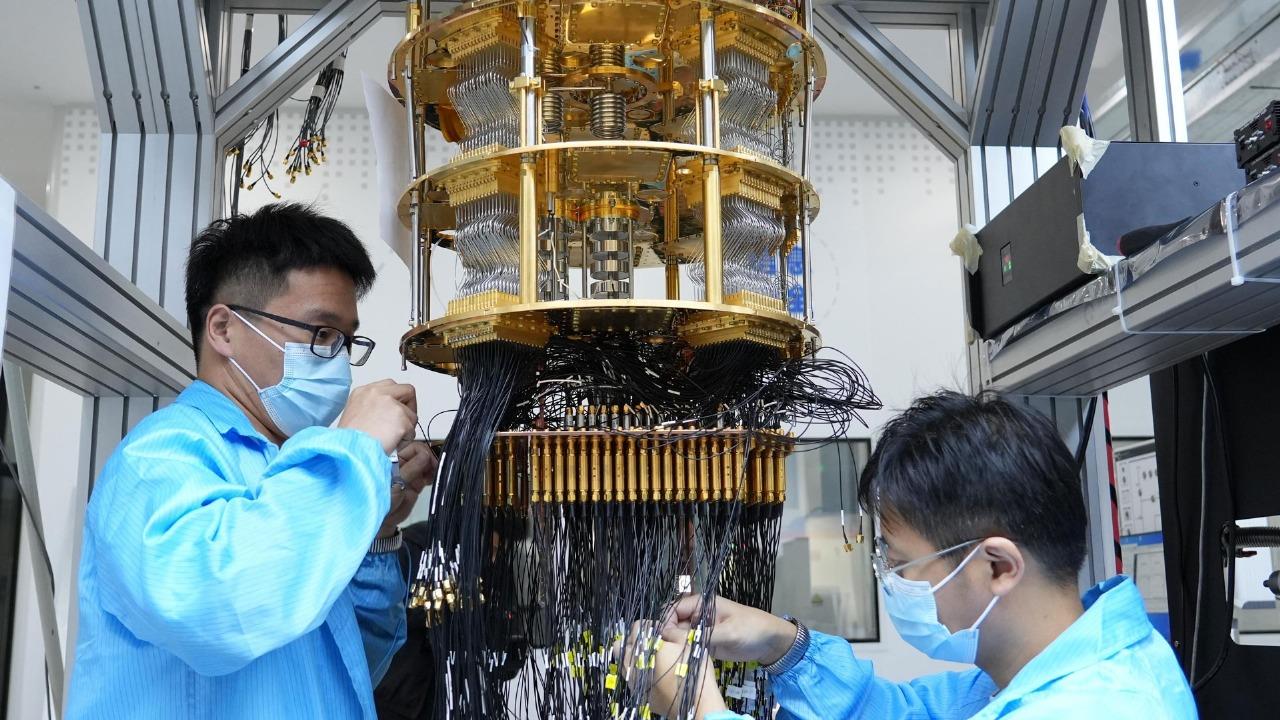
China's Quantum Leap Could Crack US Nuclear Deterrence


This month, Nikkei Asia reported that China's rapid push into quantum computing is emerging as a potentially decisive military equalizer, with experts warning that the technology could eclipse traditional symbols of US power such as aircraft carriers.
Experts note China's investment surge - including a planned 1 trillion renminbi (US$140 billion) state-backed fund to accelerate“hard technologies” like quantum systems - is aimed at securing an advantage ahead of the expected 2030s arrival of“Q-Day,” when quantum computers may be able to break all classical encryption.
Jesse Van Griensven of EigenQ said quantum machines could eventually disable airports, power grids and military networks, reducing the US“to the Stone Age” without firing a shot.
Ryan Fedasiuk of the American Enterprise Institute (AEI) warned that if China achieves an error-corrected quantum computer before the US, Japan or Taiwan transition to quantum-resistant algorithms, China could read decades of stolen data under its“harvest now, decrypt later” strategy.
Analysts also noted China's large-scale rollout of quantum communications and Quantum Key Distribution (QKD) networks, giving it a head start in securing its own systems. Although quantum capabilities remain immature, experts said the first nation to achieve fault-tolerant machines could gain instantaneous access to adversaries' secrets, fundamentally reshaping future warfare.
These quantum breakthroughs matter far beyond hacking and encryption - they cut directly into the platforms that anchor the US's strategic power.
Quantum computers use qubits that occupy multiple states at once, letting them explore countless possibilities in parallel rather than step by step. QKD, meanwhile, uses quantum particles to transmit encryption keys that expose any attempt to intercept them.
Underscoring the military advantages afforded by quantum computing, a May 2025 US Defense Intelligence Agency (DIA) report mentions that quantum communications, computing and sensing will probably provide militaries with more advanced capabilities in decryption, positioning, navigation and timing, as well as intelligence, surveillance and reconnaissance (ISR).



Legal Disclaimer:
MENAFN provides the
information “as is” without warranty of any kind. We do not accept
any responsibility or liability for the accuracy, content, images,
videos, licenses, completeness, legality, or reliability of the information
contained in this article. If you have any complaints or copyright
issues related to this article, kindly contact the provider above.


Comments
No comment