




403
Sorry!!
Error! We're sorry, but the page you were looking for doesn't exist.
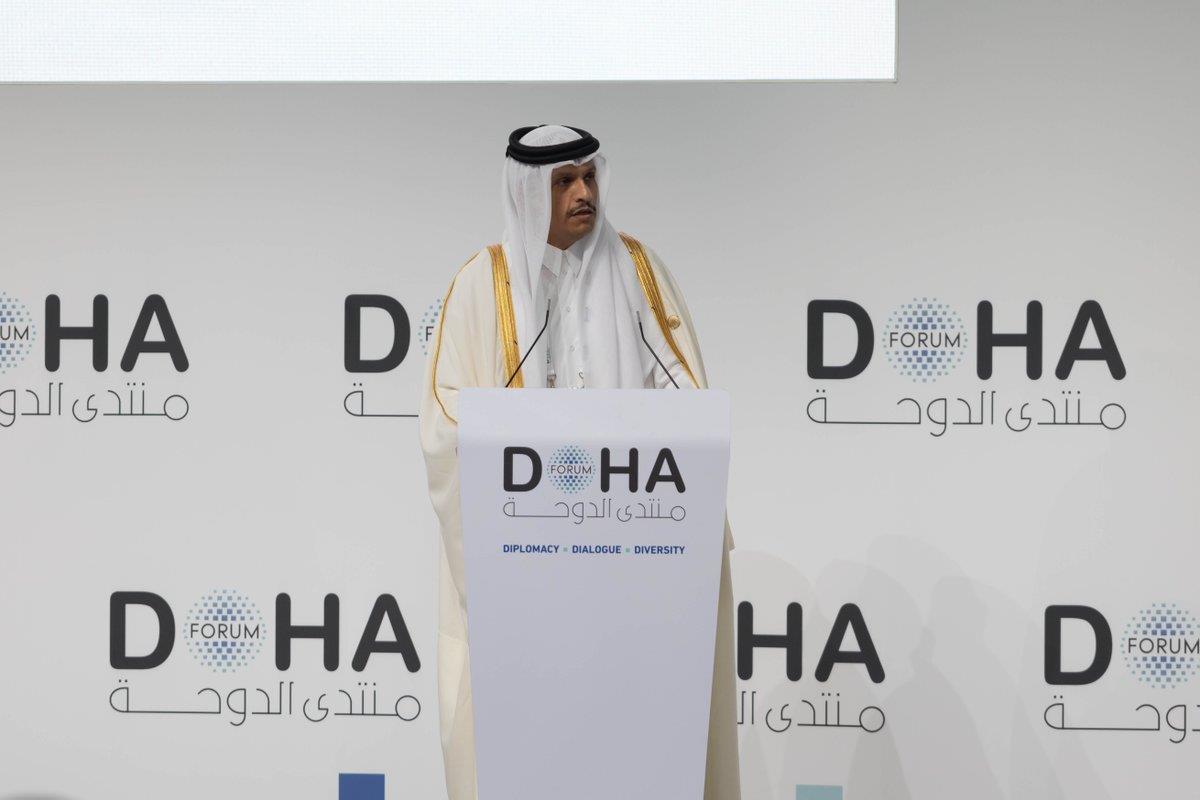
Doha Forum 2025: Prime Minister Says Qatar Believes Justice Is Fundamental Pillar For World Peace
(MENAFN- The Peninsula)
QNA
Doha, Qatar: Prime Minister and Minister of Foreign Affairs, HE Sheikh Mohammed bin Abdulrahman bin Jassim Al-Thani affirmed that the State of Qatar believes that justice is not merely a political aspiration, but a fundamental pillar for safeguarding international peace and entrenching stability.
In his address at the opening session of the 23rd edition of the Doha Forum 2025, held this morning, His Excellency stated that Qatar's policies are driven by a conviction that words must be matched by actions, that principles must guide practice, and that the country's international responsibilities must be upheld impartially and in service of humanity and human dignity.
He added that, in line with this approach, the State of Qatar continues to play an active mediating role-one of the cornerstones of its foreign policy-by initiating channels of dialogue, providing credible negotiation platforms, and facilitating understandings between disputing parties.
His Excellency highlighted that Qatar's track record of successful mediation efforts, and the confidence the international community places in its role in achieving peace, demonstrate that mediation is neither a political luxury nor a utilitarian choice for Qatar, but a deeply rooted doctrine pursued with sincerity-grounded in the belief that genuine peacebuilding begins with inclusion rather than exclusion, and through expanding common ground rather than deepening division.
He emphasized that this approach was clearly reflected in the achievement reached yesterday, as the State of Qatar, in cooperation with its partners Norway, Spain, and Switzerland, succeeded in securing a significant breakthrough between the Government of Colombia and the self-designated "EGC" group. The agreement, he noted, offers a genuine opportunity to enhance the safety and dignity of Colombians and to provide conflict-affected communities with a tangible glimmer of hope after years of violence.
His Excellency explained that the agreement also opens the door to an organized political process aimed at disarmament, combating the production and trafficking of narcotics, and building sustainable peace within an agreed framework capable of restoring stability to conflict-stricken areas.
He stressed that this progress reaffirms that sincere and responsible mediation can protect civilians and pave the way for a peace grounded in responsibility, trust, and the commitment of all parties to what best serves their peoples.
His Excellency underscored that the world does not need more promises; but rather justice practiced by all without double standards, responsibility borne collectively without favoritism, and courage that transforms words into action.
Highlighting the role of the forum, he noted that the Doha Forum stands as a leading global platform bringing together policymakers, thought leaders, and experts from across the world, serving as an influential space for dialogue on major global challenges and the formulation of practical solutions.
He stated that this year's theme -Justice in Action: Beyond Promises to Progress- captures a reality evident to all: that the divide between stated commitments and actual implementation is growing, and that justice is increasingly absent from the workings of international law in a world where interests overshadow principles and force supplants legal norms.
Read Also-
Qatar's partnership with Gates Foundation boosted global economic, health empowerment, poverty reduction: Bill Gates
Doha Forum is held amid regional, international circumstances requiring concerted efforts: Amir
Amir inaugurates Doha Forum 2025
Gaza truce incomplete without 'full withdrawal' by Israel, says PM at Doha Forum
His Excellency warned that the world is witnessing an unprecedented escalation of crises-not due to a lack of resources or knowledge, but due to the absence of accountability and the continuation of conflicts without just solutions, posing a direct threat to international peace and security.
He pointed out that when crises are managed through the logic of force rather than law, and when aggressors evade accountability, the international order begins to resemble a system built on promises that remain unfulfilled.
He further noted that successive tensions have revealed that crisis management at its bare minimum, or the preservation of temporary international consensus without addressing root causes, is no longer a viable option. Crises that are not resolved through fair and lasting solutions inevitably return more complex, extending beyond their borders; temporary agreements do not halt the movement of history but merely postpone its obligations.
In this regard, he stressed that only just solutions can build sustainable peace and prevent the perpetuation of conflict and division.
His Excellency warned that the absence of accountability remains one of the gravest flaws in the international system-manifest in the region through the plight of the Palestinian people under flagrant violations of international law, and the tragedies unfolding in Sudan, including massacres and grave abuses. These all underscore that achieving justice and protecting rights are indispensable conditions for preserving regional stability and preventing fragmentation.
Speaking on Syria, His Excellency stated that after harsh years marked by the absence of justice, the Syrian people are moving on a path they hope will lead to recovery-within a framework of transitional justice that reinforces cohesion and rejects sectarianism, paving the way for a peace that turns the page on the past and is rooted in participation and justice.
He noted that the challenges facing the region are intertwined with global trends characterized by a serious erosion of respect for international law, the excessive use of force without accountability, and the weakening of international institutions. These factors, he said, are creating a global environment marked by rising risks and diminishing public trust in the world order.
In this context, he affirmed that the world today must rebuild confidence in legal norms, establish a fairer international order, and strengthen the role of communities and humanitarian organizations as genuine partners in shaping a more stable and inclusive future. Durable peace, he stressed, cannot be achieved through symbolic resolutions but through collective action that places human dignity at the centre of all policymaking.
Concluding his address, the Prime Minister and Minister of Foreign Affairs expressed his hope that the Doha Forum will serve as a platform for deepening cooperation among governments, communities, and humanitarian organizations in pursuit of a more just and secure future for all humanity.

Legal Disclaimer:
MENAFN provides the
information “as is” without warranty of any kind. We do not accept
any responsibility or liability for the accuracy, content, images,
videos, licenses, completeness, legality, or reliability of the information
contained in this article. If you have any complaints or copyright
issues related to this article, kindly contact the provider above.
Most popular stories
Market Research

More Story




Comments
No comment