




403
Sorry!!
Error! We're sorry, but the page you were looking for doesn't exist.
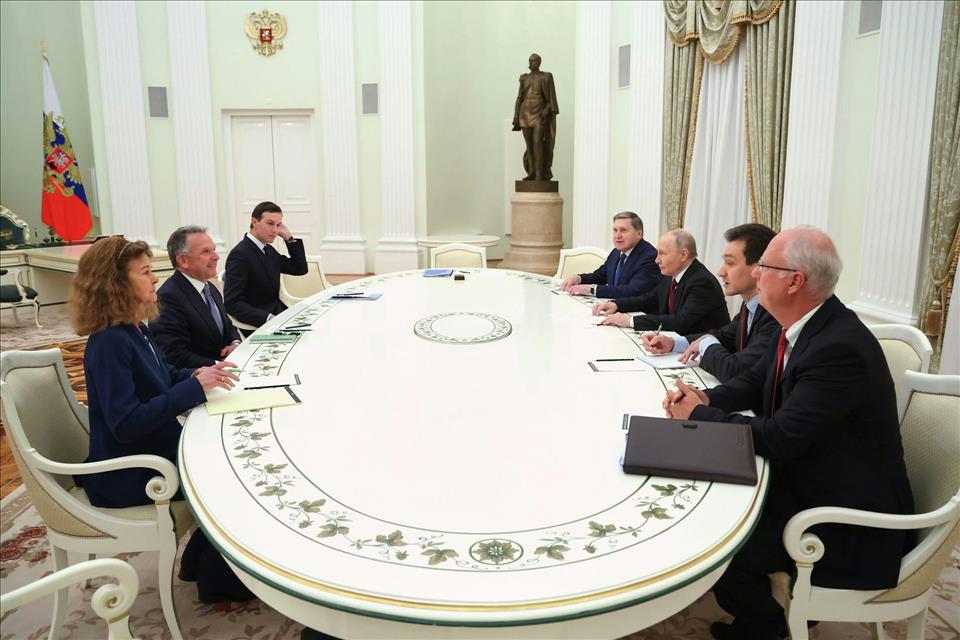
Impasse At The Kremlin: Here's What We Know After The Latest US-Russia Talks
Author: US-Russia
(MENAFN- The Conversation) Once again there is an impasse in the attempts to bring an end to the war in Ukraine. A five-hour meeting in the Kremlin between the Russian president, Vladimir Putin, and the US team led by Donald Trump's envoys, businessmen Steve Witkoff and Jared Kushner, has failed to make any significant progress.![ISW map showing the state of the conflict in Ukraine, December 3 2025.]()
The state of the conflict in Ukraine, December 3 2025. Institute for the Study of War

Putin's aide Yuri Ushakov described the talks, held on December 2, as“constructive”. But, tellingly, he added that“some American proposals appear more or less acceptable”. This was clearly a reference to the 28-point plan drawn up in late November by Witkoff and Kirill Dmitriev, the head of Russia's direct investment fund.
This plan drew strong criticism from both Ukrainian and European leaders as it appeared to favour Russia, calling for Ukraine to give up territory, banning it from ever joining Nato and restricting the size of its armed forces.
The UK, France and Germany met in Geneva on November 22 and developed a counterproposal providing for a larger Ukrainian military and deferring the questions of Ukrainian territory and Nato membership for further negotiation. The plan was revised the following day by US and Ukrainian officials in Geneva and then again at Witkoff's private members' club in south Florida on November 30.
Washington and Kyiv announced a new“refined peace framework”, which they said represented“meaningful progress toward aligning positions and identifying clear next steps”. Any future agreement, a White House statement said,“must fully uphold Ukraine's sovereignty and deliver a sustainable and just peace”.
But, predictably, progress towards any kind of peace, just or not, has run into a brick wall at the Kremlin. At the core of the stalemate is the question of territory. Putin insists on securing the whole of the Donetsk and Luhansk oblasts, including territory Russia has been unable, to date, to secure by force of arms. Kyiv and its European allies have made it clear that this outcome is unacceptable.
This highlights an important point of difference from some US statements, particularly Donald Trump, who has warned that:“The way it's going, if you look, it's just moving in one direction. So eventually that's land that over the next couple of months might be gotten by Russia anyway.”
Putin has worked hard to reinforce this perception. In the days leading up to the most recent talks, he claimed that his troops had finally captured the strategically important town of Pokrovsk. He also warned that Russia would be ready to fight a war against Europe,“if Europe wants... They are on the side of war.”
The state of the conflict in Ukraine, December 3 2025. Institute for the Study of War
In fact the reality is far more complex and lies somewhere in between. Russia's advance in eastern Ukraine is real, but it is painfully slow and extraordinarily costly in terms of casualties.
Some estimates suggest it could take Russia months and possibly years to occupy all of Donetsk and Luhansk. Meanwhile, Russia has already lost more men in this campaign than in Chechnya and Afghanistan combined.
Does Russia want peace right now?But the lack of progress in the talks – and the refusal of Putin to accept compromise – raises a deeper question: does Russia actually want to end the war at the moment?
The Kremlin's current“red lines” for a peace deal: major territorial concessions by Ukraine, limits on its army and a ban on it ever joining Nato (surely the most certain security guarantee) looks more like a demand for capitulation from Kyiv than a compromise. Putin knows Kyiv cannot accept these terms.
But he appears to believe that time and resources are on his side. Russia's economy is coping despite western sanctions. The high wages it is offering to people who sign up for the military are providing sufficient new troops to avoid taking the unpopular decision of a nationwide draft.
And, unlike his opponent, Ukrainian president Volodymyr Zelensky, he faces little domestic pressure. Zelensky, by contrast, has recently been hit by a corruption scandal that has cost him his closest advisor, Andrii Yermak. And, as winter hardens across Ukraine, Russian attacks on the country's energy infrastructure regularly leave the country without power.
The US president is certainly keen for a deal. He has dubbed himself the“peace president”, so being seen to be a prime mover in bringing the Ukraine conflict to an end would burnish his image both internationally and for domestic audiences.
The Trump administration is clearly also interested in any commercial opportunities that might emerge in a settlement, some of which were included in the 28-point peace deal.
Putin's wishlistFor Putin, an eventual military victory in Ukraine – while an end in itself – is not the only motivation for continuing the war. The conflict is also helping the Russian president realise other, longer-term foreign policy objectives, including, first and foremost, driving a wedge between the US and Europe and weakening Nato.
The absence of US secretary of state Marco Rubio from a meeting of Nato foreign ministers on December 3 and an apparent gap in US and European initial visions for peace suggest that the strength of western coordination is being tested.
Meanwhile dissent within the EU over continuing mechanisms to fund Ukraine's defence, particularly from Hungary and Slovakia, betrays a growing divide in European unity. Hence the threatening rhetoric to take the fight to Europe itself, if necessary.
The impasse in Moscow shows how far away the sides remain and puts the pressure firmly back on Ukraine and its allies. It's clear that Russia is not interested in moving away from its maximalist war aims.
Witkoff and Kushner are now set to meet with Ukrainian officials next week. Much may hang on how the US president reacts to the impasse between Putin and his envoys.
Commenting on the talks, Trump said:“What comes out of that meeting I can't tell you because it does take two to tango. We have something pretty well worked out (with Ukraine)”. This could mean his sympathies are, at present, with Kyiv.
But as we know, this can change in the space of a phone call with Moscow.
Institution:Leiden University

Legal Disclaimer:
MENAFN provides the
information “as is” without warranty of any kind. We do not accept
any responsibility or liability for the accuracy, content, images,
videos, licenses, completeness, legality, or reliability of the information
contained in this article. If you have any complaints or copyright
issues related to this article, kindly contact the provider above.
Most popular stories
Market Research

More Story



Comments
No comment